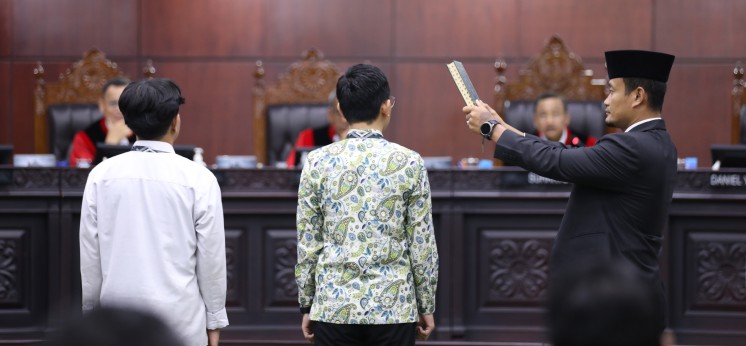
Witnesses testifying for the Petitioners taking oath at the start of a hearing on the 2026 State Budget Law, Monday (6/15/2026). Photo by MKRI/Ifa.
JAKARTA (MKRI) — The Constitutional Court was in session for the material review of Law No. 17 of 2025 on the 2026 State Budget to hear testimonies by expert and witnesses for the Petitioners of Cases No. 52/PUU-XXIV/2026 and No. 55/PUU-XXIV/2026 on Monday, June 15, 2026. Both petitions concern the use of mandatory spending for education for the free nutritious meal (MBG) program within the 2026 State Budget (APBN 2026).
The Petitioners of Case No. 55/PUU-XXIV/2026 presented Iman Zanatul Haeri, a history teacher at Madrasah Aliyah Al-Tsaqafah under the Said Aqil Siroj Foundation Islamic boarding school and head of teacher advocacy at the Association for Education and Teachers (P2G), as a witness. He described various impacts of the free nutritious meals program based on complaints and reports collected from teachers.
“Following the implementation of MBG in 2026, there were mass layoffs of PPPK (contract government employees) teachers who were regarded as already well-to-do, and non-tenured (honorer) teachers were also dismissed. Non-tenured teachers who had been appointed as part-time PPPK teachers now receive salaries lower than those of non-tenured teachers,” Iman said in the Court’s plenary courtroom in Jakarta.
He explained that these mass dismissals involved PPPK teachers who had been laid off or whose contracts were not renewed. Part-time PPPK teachers, even after receiving appointment decrees (SK), earn lower salaries than non-tenured teachers. Some non-tenured teachers have either been dismissed or retained only with the choice between salaries funded through the School Operational Assistance Fund (BOS) or the Teacher Professional Allowance (TPG) or certification. Meanwhile, private madrasah teachers who had been promised appointment as PPPK teachers have seen their TPG benefits suspended. By way of example, Iman noted that some part-time PPPK teachers in Cianjur Regency of West Java Province receive salaries of around 300,000 rupiah, while teachers in Sumedang Regency receive only Rp50,000 before deductions for BPJS (social security) contributions.
Iman further stated that his association had conducted a survey involving 239 teachers, including 62 non-tenured teachers and 62 part-time PPPK teachers. He stressed that persuading teachers to testify before the Constitutional Court had been difficult because of safety concerns and fear of structural intimidation from school principals, supervisors, education offices, and other parties who perceived such testimony as potentially detrimental to the free meal program.
The survey identified several impacts of educational budget policies that allocate funds to the free meal program on teachers, including increased workloads, reduced teaching time due to non-instructional activities, insufficient income, delayed payment of salaries or honoraria, reduced educational facilities, delayed or unpaid professional allowances, diminished opportunities for appointment as PPPK teachers, and other adverse effects. Iman further noted that several part-time PPPK teachers had not received salaries since their appointment in December 2025.
Teachers are also required to undertake additional duties, such as supervising meal distribution and recording the allocation of meals, resulting in reduced and less effective instructional time because distribution, collection, and return of meal containers often occur during class hours. According to Iman, the impacts of the free meal program extend to teachers’ careers, welfare, inequality, and psychological well-being.
“This constitutional effort of ours is the most fundamental measure available—perhaps even the last resort. There is simply no avenue to advocate for ensuring that funds allocated for teachers’ welfare within the education budget are not diverted to MBG. Frankly speaking, if we wish to report this to the police, the police operate SPPG kitchens; if we wish to report it to the Indonesian National Armed Forces (TNI), the military also operates SPPG kitchens; and if we wish to report it to the House of Representatives, many legislators also operate SPPG kitchens,” Iman stated.
A similar perspective was presented by Muhammad Zidan Ramdani, a student of the Faculty of Da’wah and Communication Sciences at Syarif Hidayatullah State Islamic University Jakarta and chairperson of the faculty’s Student Executive Board, who testified on behalf of the Petitioners in Case No. 52/PUU-XXIV/2026. He explained that his university is a state Islamic higher education institution with public service agency (BLU) status under the Ministry of Religious Affairs.
Accordingly, the continuity of educational services at his university remains highly dependent on the State Budget (APBN). Therefore, any policy affecting educational budget allocations will directly or indirectly influence the quality of educational services received by students.
“Honorable Panel of Constitutional Justices, even before the implementation of the free nutritious meals (MBG) program, the problems faced by universities and students were already quite complex,” Zidan stated.
He identified numerous fundamental issues requiring adequate educational funding. Based on student aspirations, these challenges include limited access to scholarships, the need to improve educational facilities, strengthening faculty quality, and enhancing support for student research and development.
“All of these require substantial and sustainable budgetary commitments. Under such circumstances, any reduction or reallocation of educational funding risks exacerbating problems that have not yet been fully resolved. Ultimately, the impact will be felt directly by students as beneficiaries of educational services,” Zidan concluded.
Also read:
Questioning Constitutionality of MBG Cutting Education Budget in 2026 State Budget
Petition on MBG’s Constitutionality Revised
Once Again, Constitutionality of Free Nutritious Meal Program Challenged
Petitioner Revises Legal Standing in Case Against Free Meal Program
Education Budget Reduced by Meal Program, Contract Teacher Files Petition
Petitioners Challenging Free Meal Program Add Provisions as Grounds for Review
Govt-House Unprepared, Hearing on Free Meal Program Delayed
Govt's, House's Responses on Free Meal’s Inclusion in 2026 State Budget
CALS: MBG Program Burdens Education Budget
Petitioners’ Expert Denies Free Meal Program’s Intrinsic Value in Education System
The Petitioners of Cases No. 52/PUU-XXIV/2026, No. 55/PUU-XXIV/2026, and No. 40/PUU-XXIV/2026 concern the constitutionality of the mandatory education spending in Law No. 17 of 2025 on the 2026 State Budget. The Court had heard the experts and witnesses for Case No. 40/PUU-XXIV/2026 on May 20, 2026.
Article 22 paragraph (3) of the 2026 State Budget provides that the education budget covers operational funding for educational affairs. At a glance, the formulation seems neutral. However, when read along with its elucidation, which explicitly mentions “the nutritious meals program in institutions related to general and religious education,” the norm suffers from serious clarity issues.
Without limitation, the phrase “operational funding of educational affairs” may be interpreted loosely to include funding that is not directly related to schools or students. The norm no longer serves as a limiting norm, but instead becomes a tool for facilitating the extension of fiscal authority by the legislature or budget officer.
Explore Cases No. 40/PUU-XXIV/2026, 52/PUU-XXIV/2026, and 55/PUU-XXIV/2026 (in Indonesian).
Author : Mimi Kartika
Editor : N. Rosi
PR : Andhini S. F./Raisa A. M.
Translator : Yuniar Widiastuti (NL)
Disclaimer: The original version of the news is in Indonesian. In case of any differences between the English and the Indonesian versions, the Indonesian version will prevail.
Monday, June 15, 2026 | 17:11 WIB 10