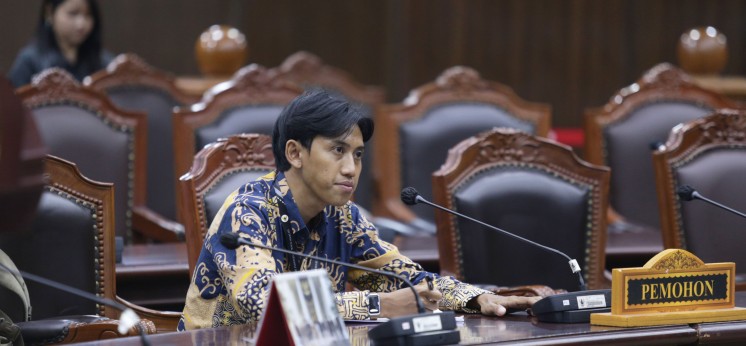
The Petitioner of Case No. 55/PUU-XXIV/2026 on the 2026 State Budget Law, Thursday (2/12/2026). Photo by MKRI/Bayu.
JAKARTA (MKRI) — Reza Sudrajat, a non-civil service contract teacher, has filed a petition for the judicial review of Article 22 paragraphs (2) and (3) of Law No. 17 of 2025 on the State Budget for Fiscal Year 2026 (2026 State Budget Law) along with its elucidation. The Petitioner in Case No. 55/PUU-XXIV/2026, who appeared without legal counsel, presented his alleged constitutional losses before Chief Justice Suhartoyo and members of the panel at a preliminary hearing on Thursday, February 12, 2026 in one of the Court’s panel courtrooms.
He asserted that the constitutional loss he has suffered is not merely subjective, but real and actual. Article 31 paragraph (4) of the 1945 Constitution obliges the State to prioritize an education budget allocation of at least 20 percent. “However, in the 2026 State Budget Law, my right to obtain decent welfare and students’ rights to receive educational facilities have been obscured by the emergence of a budget item that should not have been included,” he stated.
The Petitioner emphasized that he is not opposed to the provision of nutritional meals for the public; he fully supports the program. However, his objection concerns its inclusion within a budget that, in his view, is inappropriate—namely, the education budget.
He questions the allocation of funds for the free nutritious meal (MBG) program amounting to Rp268 trillion out of a total education budget of Rp769 trillion. According to him, this results in non-compliance with the constitutional mandate requiring 20 percent of the state budget (APBN) to be allocated to education. “Including the meal program expenditure, the real education budget would amount to only 11.9 percent of the total, far below the constitutional mandate of 20 percent,” he stated.
Furthermore, referring to Law No. 12 of 2011, the elucidation of a statute serves to clarify the norm of the law, not to create new norms or arbitrarily expand its meaning. Sociologically and juridically, operational education funding should prioritize the fulfillment of educators’ basic rights, including salaries and allowances, as well as the provision of educational facilities and infrastructure. However, in Article 22 of Law No. 17 of 2025 and its elucidation, the MBG program is suddenly included within that funding category. This, according to the Petitioner, is inconsistent with the proper function of an elucidation and could potentially shift education financing priorities.
The Petitioner also argued that as the MBG program is included in the education budget, the “real” education allocation would no longer reach 20 percent as mandated by Article 31 paragraph (4) of the 1945 Constitution. Additionally, he contended that the elucidation to Article 22 paragraph (3) of the 2026 State Budget Law expands the meaning of the norm by including the MBG program within operational education funding, whereas in his view the program is more appropriately categorized under social protection. “The impact of this expansion of meaning is clearly visible in practice. The original function of the education budget for maintenance of facilities has not yet been fulfilled,” he stressed.
In his petition, he emphasized that as a non-civil service contract teacher who has completed the teaching professional education program, the enforcement of these provisions limits fiscal ability to provide personnel expenditures in the education sector, including the appointment of contract teachers into the civil service. He believes this situation gives rise to constitutional losses in the form of reduced legal certainty and diminished opportunity to obtain fair treatment in employment relations, which is guaranteed under Article 28D paragraph (2) of the 1945 Constitution.
Moreover, the Petitioner argued that including the MBG program in the education budget potentially obscures the constitutional meaning of the minimum 20 percent education allocation as stipulated in Article 31 paragraph (4) of the 1945 Constitution and risks reducing funding priorities for improving educational quality and educators’ welfare. Accordingly, he requested the Court to review the constitutionality of Article 22 paragraphs (2) and (3) of the 2026 State Budget Law, along with its elucidation.
Responding to the petition, Constitutional Justice M. Guntur Hamzah advised the Petitioner to explain in greater detail the connection between his status as a teacher and the alleged constitutional loss. He stated that teachers are themselves beneficiaries of the education budget; therefore, the Petitioner must clearly elaborate the basis of his claim.
“This must be examined carefully: on what basis can you claim to be harmed as a teacher, when as a teacher you also benefit [from the program]? Where is the link showing that because funds are allocated to MBG program, you suffer a loss? This must be explained more clearly so that the petition is not ultimately deemed to lack legal standing,” he stated.
The panel of justices gave the Petitioner 14 days to revise the petition. The revised the petition must have been received by the Court no later than 12:00 WIB on Wednesday, February 25, 2026.
Explore case No. 55/PUU-XXIV/2026 (in Indonesian).
Author : Utami Argawati
Editor : Lulu Anjarsari P.
PR : Raisa Ayuditha M.
Translator : Yuniar Widiastuti (NL)
Disclaimer: The original version of the news is in Indonesian. In case of any differences between the English and the Indonesian versions, the Indonesian version will prevail.
Thursday, February 12, 2026 | 15:37 WIB 390