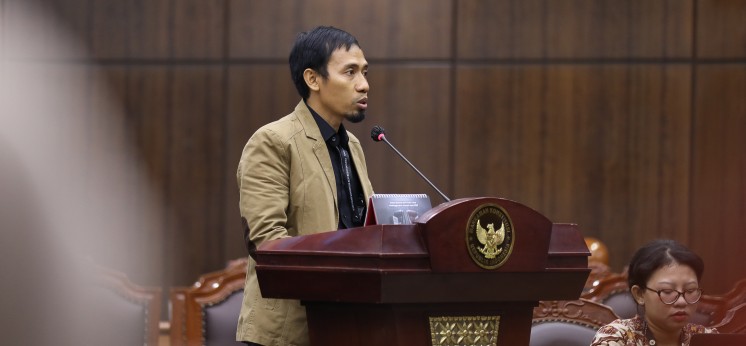
Abdullah Ubaid Matraji testifying for the Petitioners at a judicial review hearing on the National Education System Law and the 2026 State Budget Law, Wednesday (5/20/2026). Photo by MKRI/Ifa.
JAKARTA (MKRI) — The Constitutional Court held the fifth hearing for the material review of Law No. 17 of 2025 on the 2026 State Budget in relation to the 2026 State Budget (APBN 2026) on Wednesday, May 20, 2026 to hear the experts and witnesses for the Petitioners of Case No. 40/PUU-XXIV/2026. The Petitioners presented coordinator of CSO Jaringan Pemantau Pendidikan Indonesia (JPPI) or Network Education Watch Indonesia (New Indonesia) Abdullah Ubaid Matraji and state administration law lecturer of Universitas Nahdlatul Ulama Indonesia Muhtar Said as experts as well as teachers Siti Mardiah and Agung Sholihin.
New Indonesia coordinator Abdullah Ubaid Matraji stated that in assessing whether a program—in this case, the free nutritious meals (MBG) program—may be financed through education funds, reference must be made to the definitions established under implementing positive law, namely Law No. 20 of 2003 on the National Education System (Sisdiknas Law) and its implementing government regulations (PP). Based on these fundamental references, the administration of education is subject to strict limitations, namely activities directly connected to instructional, pedagogical, academic, and managerial processes within educational institutions so that teaching and learning activities may take place.
“The MBG program, although it may have an indirect impact on children’s physical readiness to learn, substantively falls within the domain of social security and public health, rather than constituting an intrinsic component of the national education system,” he stated at a hearing in the plenary courtroom.
National Education Standards
Ubaid further explained that the MBG program is not relevant to the eight National Education Standards as stipulated under Government Regulation No. 57 of 2021 on National Education Standards (SNP) as mandatory standards. These eight standards include standards on graduate competency, content, process, educational assessment, educational personnel, facilities and infrastructure, management, and financing.
For instance, he noted that the MBG program is unrelated to graduate competency standards, which concern minimum criteria regarding graduates’ competencies encompassing students’ attitudes, knowledge, and skills. It focuses on nutritional intake and physical nutritional adequacy, rather than serving as a direct instrument for measuring or shaping graduates’ academic or cognitive achievements.
Accordingly, he argued that if a program does not fall within one of these eight standards, it cannot legally be claimed as an implementation of the national education system. The purpose behind setting the threshold of “at least 20 percent” mandatory education budget under Article 31 paragraph (4) of the 1945 Constitution is an affirmative action by the State to address educational disparities, eliminate fees for basic education, repair damaged schools, improve teachers’ welfare, and guarantee children’s right to education.
Article 31 paragraphs (1), (2), and (3) of the 1945 Constitution explicitly position education as a core obligation or primary function of the State, focused exclusively on the implementation of the national education system, financing basic education, and learning processes. By contrast, the fulfillment of nutritional needs such as the MBG program derives from Article 28H paragraph (1) of the 1945 Constitution, which guarantees every person the right to physical and mental well-being, health, and an adequate standard of living.
Although the State is obligated to fulfill both rights, education and food constitute two substantively distinct rights with different modes of implementation. Under both national and international law, the right to education and the right to food are separate rights with distinct State obligations.
Ubaid emphasized that including the MBG program within the education budget or the implementation of education not only obscures the essence of the guarantees of those rights, but also potentially distorts the focus and allocation of resources that should be exclusively directed toward improving the quality of national education. He further pointed out that even the Constitutional Court’s decision issued last year concerning tuition-free basic education in both public and private schools has not yet been fully implemented nationwide.
“The greatest danger in including the MBG program within the education budget is not merely a matter of budget administration, but rather the erosion of the right to education itself. The current education budget remains insufficient to address fundamental educational needs, ranging from inadequate and deteriorating school infrastructure, millions of children who remain out of school and have yet to enjoy their right to education, deplorable teacher welfare conditions, and the generally low quality of education,” he explained.
From the perspective of state administrative law, lecturer Muhtar Said stated that state budgeting cannot be understood merely as an act of fiscal policymaking, but rather constitutes an act of government administration (bestuursdaad) subject to the principles of a rule-of-law state (rechtstaat). Accordingly, every use of public funds must have a clear legal basis, constitutional objective, and conformity with governmental functions.
In the context of state financial management, this principle is particularly important because the State Budget (APBN) is not merely a fiscal document or an instrument of budgetary politics. Under administrative law doctrine, the APBN constitutes an administrative legal instrument binding all actions involving the use of state finances. Therefore, every state expenditure must comply with the principles of legality, specialty, legal certainty, due care, and the prohibition against abuse of authority.
Article 31 paragraph (4) of the 1945 Constitution clearly stipulates that the State must prioritize an education budget of at least 20 percent of both the State Budget (APBN) and Regional Budgets (APBD) to fulfill the needs of implementing the national education system. This provision creates a direct and binding administrative obligation upon all governmental institutions in formulating state fiscal policy.
The Government may argue that the MBG program managed by the National Nutrition Agency (BGN) serves a positive purpose for human development and the quality of future generations. However, under a rule-of-law administrative system, good intentions cannot justify the use of authority classifications and budget allocations that deviate from their constitutional design.
“In a rule-of-law state, what is tested is not only what the Government does, but also how the Government exercises its authority. Moreover, the National Nutrition Agency is not a ministry vested with authority over the administration of education. The MBG program does not logically emerge as an inherent consequence of the phrase ‘operational funding for the implementation of education,’” Muhtar stated.
“There is also the context of the National Nutrition Agency and its nutrition nomenclature, which does not belong to the field of education. One may say that the National Education System Law defines concepts related to health, but if one reads Chapter I on General Provisions, Article 1 states that the process is intended so that students understand health matters, not that students themselves become healthy,” Muhtar explained.
Meanwhile, Siti Mardiah, who works as an early childhood education (PAUD) teacher and manages a private educational institution, stated that to finance her institution, each student receives operational assistance amounting to Rp600,000 annually, or Rp50,000 per month. According to her, for schools with a small student population, the amount received is insufficient to meet the institution’s operational needs, let alone other necessities.
Another witness, Agung Sholihin, who had previously worked as a teacher and principal at a private school, explained that he relinquished his status as a permanent teacher for the foundation last year due to the heavy workload and extremely low compensation, amounting to only around Rp300,000–400,000 per month. Such compensation was also often paid in accumulated installments every few months, as disbursement depended on the cycle of School Operational Assistance (BOS) funding.
Also read:
Questioning Constitutionality of MBG Cutting Education Budget in 2026 State Budget
Petition on MBG’s Constitutionality Revised
Once Again, Constitutionality of Free Nutritious Meal Program Challenged
Petitioner Revises Legal Standing in Case Against Free Meal Program
Education Budget Reduced by Meal Program, Contract Teacher Files Petition
Petitioners Challenging Free Meal Program Add Provisions as Grounds for Review
Govt-House Unprepared, Hearing on Free Meal Program Delayed
Govt's, House's Responses on Free Meal’s Inclusion in 2026 State Budget
CALS: MBG Program Burdens Education Budget
In addition to Case No. 40/PUU-XXIV/2026, the constitutional justices also heard Cases No. 52/PUU-XXIV/2026 and No. 55/PUU-XXIV/2026. The three cases concern the constitutionality of the mandatory education spending in Law No. 17 of 2025 on the 2026 State Budget.
Article 22 paragraph (3) of the 2026 State Budget provides that the education budget covers operational funding for educational affairs. At a glance, the formulation seems neutral. However, when read along with its elucidation, which explicitly mentions “the nutritious meals program in institutions related to general and religious education”, the norm suffers from serious clarity issues.
Without limitation, the phrase “operational funding of educational affairs” may be interpreted loosely to include funding that is not directly related to schools or students. The norm no longer serves as a limiting norm, but instead becomes a tool for facilitating the extension of fiscal authority by the legislature or budget officer.
At the following session, scheduled for Monday, June 15, 2026, the constitutional justices will hear the experts/witnesses for the Petitioners in Cases No. 52/PUU-XXIV/2026 and No. 55/PUU-XXIV/2026.
Explore Cases No. 40/PUU-XXIV/2026, 52/PUU-XXIV/2026, and 55/PUU-XXIV/2026 (in Indonesian).
Author : Mimi Kartika
Editor : Lulu Anjarsari P.
PR : Andhini S. F./Raisa A. M.
Translator : Yuniar Widiastuti, Rizky K. Chaesario (NL)
Disclaimer: The original version of the news is in Indonesian. In case of any differences between the English and the Indonesian versions, the Indonesian version will prevail.
Wednesday, May 20, 2026 | 14:41 WIB 168