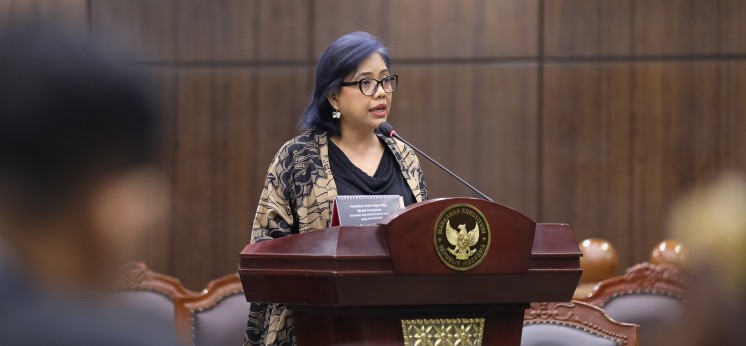
Bivitri Susanti, representing Related Party from CALS, delivering her statement during the resumed hearing on the material judicial review of Law No. 17 of 2025 on the State Budget on Tuesday (28/04) at the Courtroom. Photo by MKRI/Ifa.
Jakarta (MKRI) – The Constitutional Court (MK) held a material judicial review of Law No. 17 of 2025 on the 2026 State Budget to hear testimony from Related Parties, comprising Yayasan Edukasi Riset Cendikia (ERC) for Case No. 40/PUU-XXIV/2026; Sujimin and others for Case Nos. 40/PUU-XXIV/2026 and 55/PUU-XXIV/2026; and lecturers, professors, and academics organizing under the Constitutional and Administrative Law Society (CALS) for Case Nos. 40/PUU-XXIV/2026, 52/PUU-XXIV/2026, and 55/PUU-XXIV/2026. The three cases question the allocation of the Free Nutritious Meals (MBG) Program within the education budget under the 2026 State Budget Law.
Hesti Armiwulan, along with 19 other individuals working as lecturers, professors, and teachers of constitutional and state administration law under the CALS, brought themselves as a related party in the cases. Among them is Bivitri Susanti, a lecturer from Jenteral Law School, who delivered the testimony before the Court. She stated that CALS has a direct interest in ensuring that the Constitution is not carelessly interpreted, which could reduce the term education to a fiscal aspect and require it to carry out programs outside its intended purpose, such as the MBG Program.
“Because the norm being challenged directly stipulates the Free Nutritious Meals program which requires mandatory spending of 20 percent of the education budget,” Bivitri said in the Plenary Courtroom, Jakarta, on Tuesday, April 28, 2026.
Article 22, paragraph (3), of the 2026 State Budget provides that the education budget covers operational funding for educational affairs. At a glance, the formulation seems neutral. However, when read together with the Elucidation of Article 22, paragraph (3), which explicitly mentions “nutritious meals program in institutions related to general and religious education”, the norm suffers from serious clarity issues.
Without limitation, the phrase “operational funding of educational affairs” may be interpreted loosely to include funding that is not directly related to schools or students. The norms no longer serve as limiting norms, but instead become a tool for facilitating the extension of fiscal authority by the legislature or budget officer.
Bivitri stated that the issue is more real because the Elucidation of Article 22, paragraph (3), of the 2026 State Budget not only explains the terms in the body but also adds new substance by including the MBG Program under the operational funding for educational affairs category. The addition is normative because it changes the scope of the object, which is calculated from the education budget.
Therefore, the elucidation no longer serves merely as an official interpretation but also establishes a new norm that carries legal consequences for the state budget structure and the fulfillment of Article 31, paragraph (4), of the 1945 Constitution of the Republic of Indonesia. However, Indonesian law-making procedure prohibits such an operation because elucidation serves as an official interpretation of normative legislation in the body of the law and must not be used to extend, reduce, or add to normative interpretation, nor does it allow the inclusion of new normative formulation.
Constitutional Error in MBG Funding
They also consider the phrase “at least 20 percent” of the state budget and regional budget to fulfill the national education implementation as the minimum percentage, which is protective in nature. In Constitutional Court Decision No. 026/PUU-III/2005, the Court held that a state budget that does not allocate at least 20 percent to education is unconstitutional.
Bivitri mentioned that Constitutional Court Decision Nos. 011/PUU-III/2005, 026/PUU-III/2005, and 24/PUU-V/2007 together establish a mutually reinforcing sequence of protections. The government must not postpone fulfilling the 20 percent obligation; the education budget from the state budget must not fall below 20 percent, and essential educational components must not be reduced for any reason. Therefore, if the MBG program is allocated from the education budget, it would in fact constitute a new form of budgetary reallocation previously rejected by the Court.
Bivitri stated that CALS does not question the purpose of the MBG Program in terms of humanity, health, and social protection. The program may be valuable and worth funding by the state budget. However, they don’t question the program's intention but the constitutional error in the source of funding. Here is the main issue. It may be a good policy, but it does not necessarily imply that it will be funded by the education budget if the program is not part of the essential needs of national education, as intended in Article 31 paragraph (4) of the 1945 Constitution.
In essence, they argued, the MBG Program falls within the nutrition, health, and social protection regime rather than education. In general, the MBG program's success indicators differ substantially from those of education. The MBG program is measured through nutrition adequacy, food quality and security, benefit outreach, distribution frequency, supply chain efficiency, and health impacts. Meanwhile, education’s success is measured by access to education, participation, school dropout rates, the quality of learning, the availability of teachers, the adequacy of classrooms and learning facilities, and the advancement of scientific knowledge.
“If the main indicators are different, the legal regime should not be confused. The Indonesian Constitution applies differentiation of state obligations. The right to education, right to health, and the obligation to ensure social welfare are indeed related, but they have distinct bases, regimes, and funding instruments,” Bivitri argued.
She added that if the MBG Program is allocated under the education budget, the issue is not only an error in classification or regime, but it gives rise to two types of distortion at the same time, constitutional and fiscal distortions. Constitutional distortion occurs because the mandate of Article 31, paragraph (4), of the 1945 Constitution, which should protect education funding, is used as a formal justification for funding programs other than education. Meanwhile, fiscal distortion happens because the education funding component becomes tighter.
If the BGN allocation of Rp223.56 trillion is deducted from the total education budget of Rp769.09 trillion, in nominal terms, around Rp545.53 trillion, or 70.9 percent, does indeed remain. However, this remainder cannot automatically be understood as funding fully available for basic, secondary, higher, and religious education. This is because the 2026 education budget is still structured into several major channels: central government expenditure, transfers to regions, and financing.
Insofar as MBG is understood as a means of fulfilling the right to food, it is not merely about rolling out a meal‑distribution program, but about how the state allocates resources in a fair, effective, and non‑regressive manner, as required under Article 2 paragraph (1) of the ICESCR and the Maastricht Guidelines. In this light, key principles of economic, social, and cultural rights, such as maximum available resources, progressive realization, and non‑retrogression, oblige the state to manage resources, particularly the budget, in an optimal and comprehensive way for the full spectrum of ESC rights, rather than for a single sector alone.
Bivitri went on to say that one of the strongest reasons the education budget must not be saddled with non‑core programs is that Indonesia’s core education needs remain enormous. Indonesia runs an education system on a vast scale, and official education statistics lay bare the weight of that constitutional mandate. Hundreds of thousands of education units, millions of teachers, and tens of millions of students must be funded, managed, assured of quality, and guaranteed access every single year. A system of this magnitude, she stressed, is by itself enough to show that any narrowing of fiscal space for education has to be treated with utmost seriousness.
On the other side, another Related Party, represented by an entrepreneur named Sujimin, argued that the MBG program is highly consistent with supporting measures in the reform of the national education system, aimed at achieving the goals of education by helping to facilitate the full development of every child’s potential from early childhood through to lifelong learning. In his view, the designation of MBG as a sustainable national priority program has passed through lawful and constitutional procedures, in line with the principles of the rule of law.
MBG Impact
Meanwhile, another Related Party, the ERC Foundation, represented by AI Nurhidayat, told the Court that in 2026, regional government support was scrapped, namely a grant of Rp50,000 per student per month, or Rp600,000 per year, for schools run by the Foundation. He argued that this represented a significant reduction in support, further constraining the operational room for these institutions in providing quality education services.
“Now, we only manage operational assistance amounting to Rp133.000 per student per month. This fact raises fundamental questions about the capacity of the current education funding system to prepare Indonesia’s young generation with adequate competitiveness and skills,” he said.
Also read:
Questioning Constitutionality of MBG Cutting Education Budget in 2026 State Budget
Petition on MBG’s Constitutionality Revised
Once Again, Constitutionality of Free Nutritious Meal Program Challenged
Petitioner Revises Legal Standing in Case Against Free Meal Program
Education Budget Reduced by Meal Program, Contract Teacher Files Petition
Petitioners Challenging Free Meal Program Add Provisions as Grounds for Review
Govt-House Unprepared, Hearing on Free Meal Program Delayed
Govt's, House's Responses on Free Meal’s Inclusion in 2026 State Budget
The three cases concern the constitutionality of the mandatory education spending in Law No. 17 of 2025 on the 2026 State Budget.
Non-civil service contract teacher Reza Sudrajat and the Association of Indonesian Progressive Educators filed Petition No. 55/PUU-XXIV/2026 for the judicial review of Article 22 paragraphs (2) and (3) of Law No. 17 of 2025 on the State Budget for Fiscal Year 2026 (2026 State Budget Law) along with its elucidation, arguing that including the free nutritious meal (MBG) program managed by the National Nutrition Agency (BGN) in the 20-percent mandatory spending for education has reduced the “real” education allocation to only 11.9 percent of the state budget, which constitutes failure to fulfill the mandate of Article 31 paragraph (4) of the 1945 Constitution.
Case No. 52/PUU-XXIV/2026 was filed by Rega Felix, a lecturer. He questions the constitutionality of Article 49 paragraph (1) of Law No. 20 of 2003 on the National Education System (Sisdiknas) and its elucidation, arguing that the provisions do not include guarantee of lecturers’ welfare as a primary component of the education expenditure. He believes that the inclusion of the MBG program as part of the operational components of education risks reducing allocations for essential educational needs, such as educators’ welfare, educational infrastructure, and funding for research and innovation.
Meanwhile, Case No. 40/PUU-XXIV/2026 was filed by Taman Belajar Nusantara Foundation and four citizens. They challenge the constitutionality of Article 22 paragraph (3) of Law No. 17 of 2025 on the 2026 State Budget and its elucidation, believing it to be in conflict with Article 31 paragraph (4) of the 1945 Constitution for classifying MBG funding as part of education spending. They argued that the policy threatens to shrink the fiscal space for core education functions, including improving teacher quality, providing educational infrastructure, and funding education assistance for the underprivileged.
Explore Cases No. 40/PUU-XXIV/2026, 52/PUU-XXIV/2026, and 55/PUU-XXIV/2026 (in Indonesian).
Author : Mimi Kartika
Editor : Lulu Anjarsari P.
PR : Andhini S. F./Raisa A. M.
Translator : Rizky Kurnia Chaesario/Yuniar Widiastuti (NL)
Disclaimer: The original version of the news is in Indonesian. In case of any differences between the English and the Indonesian versions, the Indonesian version will prevail.
Tuesday, April 28, 2026 | 14:26 WIB 287