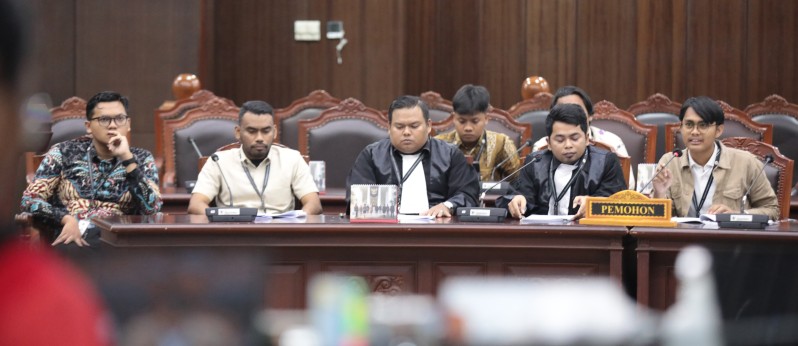
Preliminary hearing of the State Budget Law review, Thursday (05/02). Photo by MKRI/IlhamWM.
Jakarta (MKRI) - Under the elucidation of Article 22 paragraph (3) of the 2026 State Budget Law, the Free Nutritious Meal (MBG) Program is categorized as operational funding for the delivery of education, effectively carving out up to 20% of the education budget. This is what the Taman Belajar Nusantara Foundation (TB Nusantara) and four citizens challenge in Petition No. 40/PUU-XXIV/2026. The preliminary hearing for this petition was held on Thursday, February 4, 2026, in the Plenary Courtroom. The Petitioners argue that Article 22 paragraph (3) and its Elucidation in Law No. 17 of 2025 on the 2026 State Budget conflict with the 1945 Constitution.
Article 22 paragraph (3) of the 2026 State Budget Law states, “The education budget as referred to in paragraph (1) includes funding for the operational delivery of education.” Meanwhile, the elucidation of Article 22 paragraph (3) stipulates, “Funding for the operational delivery of education includes nutritious meal programs in institutions related to the delivery of both general and religious education.”
The Petitioners contend that Article 22 paragraph (3) and its elucidation contradict Article 31paragraph (4) of the 1945 Constitution, which requires the state to allocate at least 20 percent of the state budget to education. In their view, this constitutional provision is a direct mandate for the state to place education as a fundamental sector of national development.
“The losses suffered by the Petitioners are both actual and potential. The norms of Article 22 paragraph 3 and its elucidation in the 2026 State Budget Law, which incorporate MBG program financing into the education budget, have reduced the pure education budget, narrowed the fiscal space for education financing, and diverted education funds to non-education programs,” said Sipghotulloh Mujaddidi.
The Petitioners argue that the term “prioritize” in the 1945 Constitution means the education budget must be treated as a primary post in state fiscal policy and cannot be treated as an ordinary budget that may be reallocated. They also maintain that the education allocation must be used directly for core education delivery needs, including facilities and infrastructure, improved learning quality, educator welfare, and equal access to education.
“For the Petitioners who are students, educators, and community education providers, the impact is felt directly through limited educational facilities, stagnant educator welfare, and declining quality of education services,” Sipghotulloh explained.
In their petition, the Petitioners cite several Constitutional Court decisions that they interpret as confirming that the 20 percent education budget must be used directly to implement national education. These include Decisions No. 012/PUU-III/2005, 026/PUU-III/2005, 026/PUU-IV/2006, 24/PUU-V/2007, and 13/PUU-VI/2008.
Another legal counsel for the Petitioners, Fahrul Rozi, argued that the Elucidation of Article 22 paragraph (3) of Law No. 17 of 2025 places funding for the Free Nutritious Meal Program within the 20 percent education budget component. According to the Petitioners, this means the 2026 education budget is not fully dedicated to delivering national education.
The Petitioners maintain that, in substance, the MBG program is a policy aimed at meeting students’ nutrition and health needs, thus it does not fall within the core functions of education delivery. Therefore, they argue that including its funding within the education budget constitutes a misclassification of policy. Before MBG was implemented nationwide, the 2025 education budget allocation was around Rp724.2 trillion, with around Rp71 trillion earmarked for MBG. In the 2026 State Budget, however, MBG funding is said to rise to around Rp223 trillion out of a total education budget of about Rp769.1 trillion.
In the Petitioners’ view, this increase in MBG allocation threatens to shrink the fiscal space for core education functions, including improving teacher quality, providing educational infrastructure, and funding education assistance for the underprivileged.
They further argue that nutrition programs and nutritional interventions are essentially part of public health and social protection policy that only support, rather than constitute, the learning process itself. For that reason, they deem it inappropriate to count such programs within the education budget component. The Petitioners also criticize the elucidation of Article 22 paragraph (3) of Law No. 17 of 2025 for expanding the meaning of the norm in the main body of the article. In their view, under legislative drafting principles, an elucidation should clarify norms only and must not add to or broaden the substance of the regulation.
The Petitioners state that this expanded meaning in the elucidation risks creating legal uncertainty and opens the door to interpretations that deviate from the constitutional mandate on education budget allocation.
“[To] declare Article 22 paragraph (3) of Law No. 17 of 2025 on the 2026 State Budget (State Gazette of the Republic of Indonesia Year 2025 No. 179, Supplement to the State Gazette No. 7144) contrary to the 1945 Constitution of the Republic of Indonesia and to have no binding legal force insofar as it is not interpreted as ‘The education budget as referred to in paragraph (1) includes funding for the operational delivery of education and does not include nutritious meal programs’,” said Fachrur Rozi.
Responding to the petition, Justice Daniel Yusmic P. Foekh said the Petitioners need to further substantiate each Petitioner's legal standing. “For example, Petitioner I, who acts as a legal entity, has correctly attached the founding and approval documents. Then, for a private legal entity, do not forget to show the alignment between its vision and mission and the norm being challenged, and who represents it; clarify its legal standing. Regarding legal standing in State Budget cases, it is usually tied to taxpayer status. If you are students or lecturers, you should strengthen that. The Court usually grants legal standing in State Budget cases on the basis of taxpayer status. Please reinforce this,” he stressed.
At the close of the hearing, the Panel of Justices granted the Petitioners 14 days to revise their petition. The revised petition must be submitted by Wednesday, February 18, 2026, at 12.00 Western Indonesia Time.
Author: Utami Argawati
Editor: Lulu Anjarsari P.
PR: Andhini S.F.
Translator: Rizky Kurnia Chaesario
Disclaimer: The original version of the news is in Indonesian. In case of any differences between the English and the Indonesian versions, the Indonesian version will prevail.
Thursday, February 05, 2026 | 16:09 WIB 406