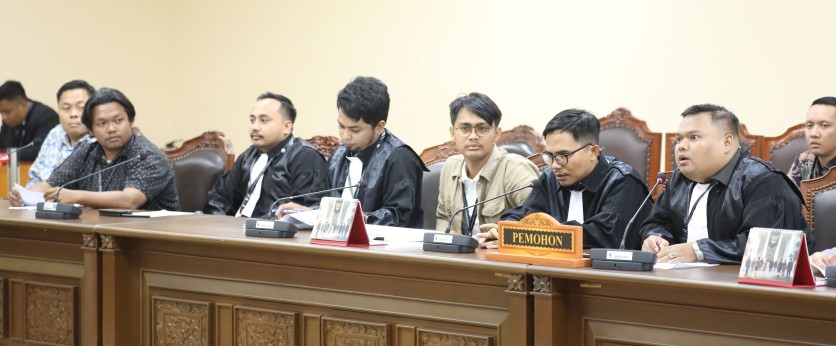
Petitioners and their legal counsel on the judicial review of Law No. 17 of 2025 on 2026 State Budget delivering the revised petition on Wednesday, February 18, 2026. Photo by MKRI/Panji.
Jakarta (MKRI) - The Constitutional Court held another hearing on the judicial review of Article 22 paragraph (3) and its Elucidation in Law No. 17 of 2025 on the 2026 State Budget (Law 17/2025) against the 1945 Constitution on Wednesday, February 18, 2026, in a panel courtroom.
Petitioners’ legal counsel, Sipghotulloh Mujaddidi, told the Court that the revised petition clarifies the Petitioners' status, noting that the case is brought by six Petitioners, with the main Petitioner being the Taman Belajar Nusantara Foundation. He explained that the foundation appeared before the Court with students from several areas at the outskirts of Jakarta, giving it a direct interest in the fulfillment of education providers’ rights as guaranteed by Article 31 paragraph (3) of the Constitution.
He added that the Petitioners had set out detailed components of the education budget in the 2026 State Budget, including the items affected by the establishment of the National Nutrition Agency (BGN), whose funding is booked within the 20-percent education allocation. “The breakdown of the affected education budget components can be seen on page 26 of the petition,” he said.
Sipghotulloh further explained that student Petitioners II to IV are also harmed by the inclusion of BGN funding in the education budget. The impacts they feel include delayed payment of allowances to teachers and lecturers who teach them, cuts to the Smart Indonesia scholarship program, and reduced budget allocations for the National Library.
Previously, the Taman Belajar Nusantara Foundation and four citizens filed a material review of Article 22 paragraph (3) and its Elucidation in Law No. 17 of 2025 on the 2026 State Budget against the 1945 Constitution, registered as Case No. 40/PUU-XXIV/2026. They argue that classifying MBG funding as part of education spending distorts the constitutional mandate that at least 20 percent of the state budget be devoted to education.
In the revised petitum, the Petitioners ask the Court to declare Article 22 paragraph (3) of the 2026 State Budget Law unconstitutional and non-binding unless interpreted to mean that “the education budget as referred to in paragraph (1) includes funding for the operational delivery of education and does not include nutritious meal programs.”
“(We request the Court to) declare the elucidation of Article 22 paragraph (3) of Law No. 17 of 2025 on the 2026 State Budget (State Gazette of the Republic of Indonesia Year 2025 No. 179, Supplement to the State Gazette No. 7144) contrary to the 1945 Constitution of the Republic of Indonesia and without binding legal force,” said Ali Murtadho, another member of the Petitioners’ legal counsel.
Also read:
Questioning Constitutionality of MBG Cutting Education Budget in 2026 State Budget
During the preliminary hearing on Thursday, February 5, 2026, the Taman Belajar Nusantara Foundation, represented by Chair Miftahol Arifin and Head of the Legal and Advocacy Division Umran Usman, was listed as Petitioner I. Petitioners II to V comprised Dzakwan Fadhil Putra Kusuma, Muhammad Jundi Fathi Rizky, Rikza Anung Andita, and Sa’ed.
The Petitioners contend that Article 22 paragraph (3) and its elucidation contradict Article 31 paragraph (4) of the 1945 Constitution, which requires the state to allocate at least 20 percent of the state budget to education. In their view, this constitutional provision is a direct mandate for the state to place education as a fundamental sector of national development.
The Petitioners argue that the term “prioritize” in the 1945 Constitution means the education budget must be treated as a primary post in state fiscal policy and cannot be treated as an ordinary budget that may be reallocated. They also maintain that the education allocation must be used directly for core education delivery needs, including facilities and infrastructure, improved learning quality, educator welfare, and equal access to education.
The Petitioners maintain that, in substance, the MBG program is a policy aimed at meeting students’ nutrition and health needs, thus it does not fall within the core functions of education delivery. Therefore, they argue that including its funding within the education budget constitutes a misclassification of policy.
Before MBG was implemented nationwide, the 2025 education budget allocation was around Rp724.2 trillion, with around Rp71 trillion earmarked for MBG. In the 2026 State Budget, however, MBG funding is said to rise to around Rp223 trillion out of a total education budget of about Rp769.1 trillion. In the Petitioners’ view, this increase in MBG allocation threatens to shrink the fiscal space for core education functions, including improving teacher quality, providing educational infrastructure, and funding education assistance for the underprivileged.
The hearing was chaired by Chief Justice Suhartoyo, accompanied by Justices Daniel Yusmic P. Foekh and M. Guntur Hamzah. Chief Justice Suhartoyo, as panel chair, said he would refer the petition to the Justices’ Deliberation Meeting (RPH) for further examination.
Author: Utami Argawati
Editor: Lulu Anjarsari P.
PR: Andhini S.F.
Translator: Rizky Kurnia Chaesario
Disclaimer: The original version of the news is in Indonesian. In case of any differences between the English and the Indonesian versions, the Indonesian version will prevail.
Wednesday, February 18, 2026 | 19:16 WIB 261