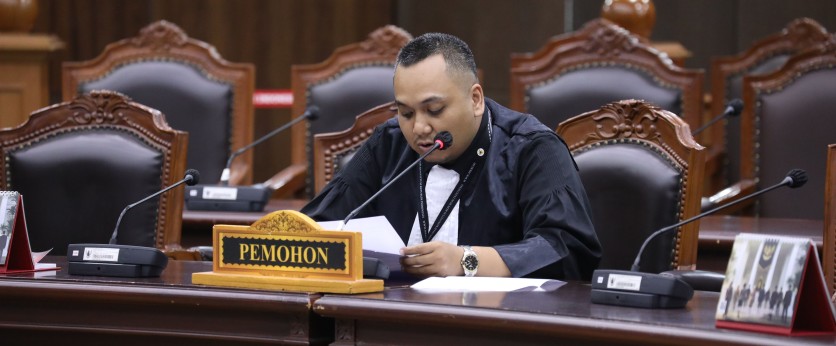
Rega Felix presenting his petition at the preliminary hearing for Case No. 52/PUU-XXIV/2026 on the National Education System Law and the 2026 State Budget Law, Wednesday (2/11/2026). Photo by MKRI/Panji.
JAKARTA (MKRI) — The Constitutional Court held the preliminary hearing for Case No. 52/PUU-XXIV/2026 on Wednesday, February 11, 2026. The petition on the constitutionality of Law No. 20 of 2003 on the National Education System (Sisdiknas) and Law No. 17 of 2025 on the 2026 State Budget was filed by Rega Felix, a lecturer.
He questions the constitutionality of Article 49 paragraph (1) of the Law and its elucidation, arguing that the provisions do not include guarantee of lecturers’ welfare as a primary component of the education expenditure. He believes, these provisions have led to unclear limits of the use of the education budget, thus potentially harm lecturers’ constitutional right to self-development through the fulfillment of their basic needs, as guaranteed by Article 28C paragraph (1) of the 1945 Constitution.
“In the provisional request, the Petitioner asks that Justice Adies Kadir recuse himself solely to safeguard the honor of the constitutional justices and the Constitutional Court, due to direct causal link between the provision being reviewed and his background. In the code of ethics, this is to prevent any perception of bias, including a cooling-off period before reviewing a law that is directly associated with any constitutional justice in their previous office,” he stated while reading the provisional request before Chief Justice Suhartoyo and members of the panel.
In the petition, the Petitioner stated that he does not oppose the free nutritious meal program (MBG). However, he believes it to be a supporting educational program, while the fulfillment of students’ nutritional needs may be pursued through alternative policy measures that need not be positioned as a primary component of education expenditure.
He argued that the core needs of education continue to increase over time; therefore, the Government remains obligated to comply with the provision of mandatory allocation of at least 20 percent of the state budget (APBN) to education to meet those primary needs. Accordingly, the Petitioner rejects the classification of the free nutritious meal program as a principal component of education expenditure that must be funded from the 20-percent education budget allocation.
According to the Petitioner, the minimum 20 percent education budget allocation in the state budget should be focused on the primary needs of education, including improving lecturers’ welfare and strengthening research funding. “The Government is obligated to allocate at least 20 percent of the state budget to fulfill the primary needs of education. [I] reject the [free nutritious meal program as a principal component of education expenditure that must be financed from the 20 percent education budget allocation,” he stated.
“All arguments ultimately return to this structure of reasoning, namely that Article 49 paragraph (1) of the National Education System Law is unconstitutional because it fails to provide a clear normative limitation on the meaning of the primary components of education,” he emphasized.
In addition, in his petition, the Petitioner also challenges Article 22 paragraph (3) of the 2026 State Budget Law, which includes the free nutritious meal program as part of the operational components of education. He argued that although the education budget in 2026 has been allocated at approximately 20 percent of the 2026 total state budget, classifying the program as part of educational operational costs risks reducing allocations for essential educational needs, such as educators’ welfare, educational infrastructure, and funding for research and innovation.
The Petitioner believes this situation directly leads to the potential constitutional loss he will experience as a lecturer, as limited welfare and research support may hinder the advancement of knowledge and the performance of higher education duties. He also highlighted a reduction in research funding within the relevant ministry compared to the previous year, which, in his view, further constrains opportunities for research development.
The Petitioner therefore requested that the Court declare Article 49 paragraph (1) of the National Education System Law conditionally unconstitutional and not legally binding insofar as it is not interpreted to mean: “Education funds, excluding service education expenditure and expenditure other than the primary components of education, shall be allocated at a minimum of 20 percent of the State Budget (APBN) in the education sector and at a minimum of 20 percent of the Regional Budget (APBD).”
Furthermore, he requested that the Elucidation to Article 49 paragraph (1) of the National Education System Law be declared conditionally unconstitutional and not legally binding insofar as it is not interpreted to mean: “Primary components of education expenditure shall include, inter alia, educators’ salaries, basic educational infrastructure, operational costs of educational provision, and the advancement of science and technology, whereas costs other than the primary components of education include, inter alia, nutritious meal programs, student transportation, and other supporting facilities.”
He also asked the Court, “To declare Article 22 paragraph (3) of Law No. 17 of 2025 on the State Budget for the Fiscal Year of 2026 (State Gazette of the Republic of Indonesia of 2025 No. 179, Supplement to the State Gazette No. 7144) conditionally unconstitutional and not legally binding insofar as it is not interpreted to mean: ‘The Education Budget as referred to in paragraph (1) includes funding for the operational provision of education and does not include the nutritious meal program,’” the Petitioner concluded.
Responding to the petition, Constitutional Justice M. Guntur Hamzah advised the Petitioner to refine his legal standing. “You must construct your position as a lecturer. There may indeed be a connection with the 20 percent education budget, but this relates to the State Budget Law that you are challenging. If your petition is declared to lack legal standing, what is your actual or potential constitutional loss arising from the enactment of the relevant provision of the State Budget Law? That is what must be elaborated; otherwise, there will be no causal relationship with you, Rega Felix, as a lecturer,” he explained.
The panel of justices gave the Petitioner 14 days to revise the petition. The revised the petition must have been received by the Court no later than 12:00 WIB on Tuesday, February 24, 2026.
Explore case No. 52/PUU-XXIV/2026 (in Indonesian).
Author : Utami Argawati
Editor : Lulu Anjarsari P.
PR : Raisa Ayuditha M.
Translator : Yuniar Widiastuti (NL)
Disclaimer: The original version of the news is in Indonesian. In case of any differences between the English and the Indonesian versions, the Indonesian version will prevail.
Wednesday, February 11, 2026 | 17:02 WIB 296