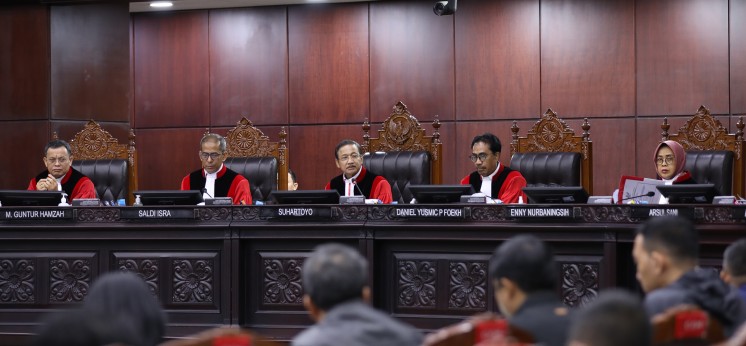
A judicial review hearing on the National Education System Law and the 2026 State Budget Law, Wednesday (3/11/2026). Photo by MKRI/Ifa.
JAKARTA (MKRI) — The Constitutional Court delayed its examination of three judicial review petitions against Law No. 17 of 2025 on the 2026 State Budget in relation to the free nutritious meal (MBG) program on Wednesday, March 11, 2026. Petitions No. 40/PUU-XXIV/2026, 52/PUU-XXIV/2026, and 55/PUU-XXIV/2026 essentially question the mandatory spending for education in the 2026 State Budget, especially the inclusion of the MBG program.
At the hearing, Chief Justice Suhartoyo announced that the House of Representatives (DPR) and the Government had requested for delay as they were unprepared. The constitutional justices agreed to give them opportunity at the next hearing to testify. “The day and date cannot be specified, as the Court has to first schedule it. Due to upcoming long holidays, [the Court] has to arrange [hearing] schedules,” he said.
Also read:
Questioning Constitutionality of MBG Cutting Education Budget in 2026 State Budget
Petition on MBG’s Constitutionality Revised
Once Again, Constitutionality of Free Nutritious Meal Program Challenged
Petitioner Revises Legal Standing in Case Against Free Meal Program
Education Budget Reduced by Meal Program, Contract Teacher Files Petition
Petitioners Challenging Free Meal Program Add Provisions as Grounds for Review
The three cases concern the constitutionality of the mandatory education spending in Law No. 17 of 2025 on the 2026 State Budget.
Non-civil service contract teacher Reza Sudrajat and the Association of Indonesian Progressive Educators filed Petition No. 55/PUU-XXIV/2026 for the judicial review of Article 22 paragraphs (2) and (3) of Law No. 17 of 2025 on the State Budget for Fiscal Year 2026 (2026 State Budget Law) along with its elucidation, arguing that including the free nutritious meal (MBG) program managed by the National Nutrition Agency (BGN) in the 20-percent mandatory spending for education has reduced the “real” education allocation to only 11.9 percent of the state budget, which constitutes failure to fulfill the mandate of Article 31 paragraph (4) of the 1945 Constitution.
Case No. 52/PUU-XXIV/2026 was filed by Rega Felix, a lecturer. He questions the constitutionality of Article 49 paragraph (1) of Law No. 20 of 2003 on the National Education System (Sisdiknas) and its elucidation, arguing that the provisions do not include guarantee of lecturers’ welfare as a primary component of the education expenditure. He believes that the inclusion of the MBG program as part of the operational components of education risks reducing allocations for essential educational needs, such as educators’ welfare, educational infrastructure, and funding for research and innovation.
Meanwhile, Case No. 40/PUU-XXIV/2026 was filed by Taman Belajar Nusantara Foundation and four citizens. They challenge the constitutionality of Article 22 paragraph (3) of Law No. 17 of 2025 on the 2026 State Budget and its elucidation, believing it to be in conflict with Article 31 paragraph (4) of the 1945 Constitution for classifying MBG funding as part of education spending. They argued that the policy threatens to shrink the fiscal space for core education functions, including improving teacher quality, providing educational infrastructure, and funding education assistance for the underprivileged.
Explore case No. 40/PUU-XXIV/2026, 52/PUU-XXIV/2026, and 55/PUU-XXIV/2026 (in Indonesian).
Author : Utami Argawati
Editor : Lulu Anjarsari P.
PR : Andhini S. F./Raisa A. M.
Translator : Yuniar Widiastuti (NL)
Disclaimer: The original version of the news is in Indonesian. In case of any differences between the English and the Indonesian versions, the Indonesian version will prevail.
Wednesday, March 11, 2026 | 13:49 WIB 192