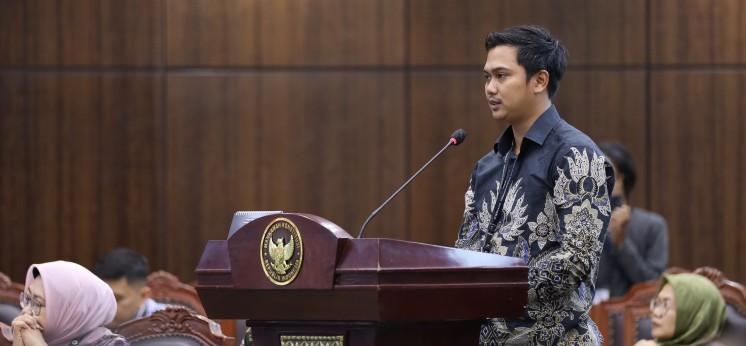
YLKI daily executive Rio Priambodo testifying as a Relevant Party for case on the amendment to the Telecommunication Law by the Job Creation Law, Thursday (5/21//2026). Photo by MKRI/Ifa.
JAKARTA (MKRI) — The Constitutional Court held another plenary hearing for the material review of Article 71 point 2 of Law No. 6 of 2023 on the Stipulation of Government Regulation in Lieu of Law No. 2 of 2022 on Job Creation into Law, which amends Law No. 36 of 1999 on Telecommunications, on Thursday, May 21, 2026. Today the constitutional justices heard the Indonesian Consumers Foundation (YLKI) and the National Consumer Protection Agency (BPKN) as Relevant Parties for Cases No. 273/PUU-XXIII/2025 and No. 33/PUU-XXIV/2026.
In his presentation, YLKI daily executive Rio Priambodo emphasized that internet access has now evolved into a basic necessity for the public for work, education, and access to public services. YLKI argued that the issue of expired data quotas raised by the Petitioners is not merely a technical business matter, but rather concerns fundamental principles of digital consumer protection.
“Consumers must receive what they are entitled to, based on what they have paid for; it should not be reduced unilaterally,” Rio stated at the hearing in the plenary courtroom.
YLKI recorded that in 2025, the telecommunications sector ranked among the ten highest categories of public complaints, with 106 cases. It presented various real-life cases in which consumers lost dozens of gigabytes (GB) of data due to confusing package usage priority rules or automatic deletion when reloading on the same day without clear prior notification.
In addition, it emphasized the importance of transparency regarding quota usage history. Telecommunications operators, according to YLKI, should be required to provide records of usage data covering at least the previous year so that consumers may independently evaluate their usage.
“Digital transformation should not be oriented solely toward industry growth, but must also respect the rights of consumers as legitimate and sovereign users of services,” Rio stated.
Similarly, BPKN highlighted the weak bargaining position of consumers in legal relations with telecommunications operators. BPKN member Heru Sutadi argued that internet quota expiration has so far been based on standard clauses unilaterally determined by business actors, which potentially violates Article 18 of the Consumer Protection Law.
“Therefore, the State must ensure that telecommunications regulations do not position the public merely as business objects, but rather as legal subjects whose rights must be protected,” he stated.
BPKN argued that this practice implicates three constitutional rights of citizens as guaranteed by the 1945 Constitution, namely: the right to self-development through access to technology (Article 28C paragraph (1)); the right to fair legal certainty regarding validity periods and remaining quota balances (Article 28D paragraph (1)); and the right to protection of consumers’ economic value (Article 28H paragraph (4)). The elimination of benefits from services that have already been paid for, without a reasonable protection mechanism, is detrimental to consumers’ private economic rights.
BPKN urged the Court to provide a constitutional interpretation of Article 28 of the Telecommunications Law. It also encouraged the Government and regulators to promptly issue implementing regulations requiring operators to provide more equitable quota models, such as rollover systems (carrying over unused quotas to the next period), extensions of validity periods, or compensation and refund mechanisms.
BPKN requested that the constitutional justices declare Article 28 of the Telecommunications Law conditionally constitutional insofar as it is interpreted to mean that tariff-setting and service schemes must incorporate principles of consumer protection, transparency, and proportionate remedial mechanisms. It also requested strict sanctions against telecommunications operators that violate standards concerning the provision of information on validity periods and real-time quota deletion mechanisms.
Also read:
Two Citizens File Petition Over Expired Unused Internet Quota
Petitioners Revise Petition Over Expired Unused Internet Quota
Govt’s Response on Non-refundable Unused Internet Quota
Mobile Network Operator Explains Expired Internet Quota
Telecommunications Provider Refutes Term “Expired Quota”
Article 71 point 2 of the Job Creation Law stipulates that: “(1) The tariffs for the provision of Telecommunications Networks and/or Telecommunications Services shall be determined by the providers of Telecommunications Networks and/or Services based on a formula established by the Central Government. (2) The Central Government may set upper and/or lower tariff limits for the provision of Telecommunications Services by considering public interest and fair business competition.”
Also read:
Student Questions Internet Quota Forfeiture Without Compensation
Petitioner Revises Petition on Internet Quota Forfeiture
House Maintains Telecommunications Tariffs Be Left to the Market
Telecommunications Providers Association Explain Internet Tariffs
Case No. 273/PUU-XXIII/2025 was petitioned by online motorcycle taxi driver Didi Supandi and online culinary vendor Wahyu Triana Sari, while Case No. 33/PUU-XXIV/2026 was filed by university student TB Yaumul Hasan Hidayat.
They are challenging the practice where unused internet data quotas expire at the end of their validity period as determined by telecommunications service providers or operators. They argued that the 2023 amendment to Article 28 of the Telecommunications Law, as contained in Article 71 point 2 of the Job Creation Law, failed to consider developments in information technology, particularly the evolution of internet services.
The Petitioners believe that any unilateral forfeiture of quotas without consent and adequate compensation is considered contrary to the principles of legal certainty and justice. They therefore request that the Constitutional Court declare Article 71 point 2 of the Job Creation Law conditionally unconstitutional if not interpreted in accordance with the respective meanings they seek, as set out in the petitums of their petitions.
Explore cases No. 273/PUU-XXIII/2025 and 33/PUU-XXIV/2026 (in Indonesian).
Author : Mimi Kartika
Editor : N. Rosi
Translator : Yuniar Widiastuti (NL)
Disclaimer: The original version of the news is in Indonesian. In case of any differences between the English and the Indonesian versions, the Indonesian version will prevail.
Thursday, May 21, 2026 | 15:54 WIB 50