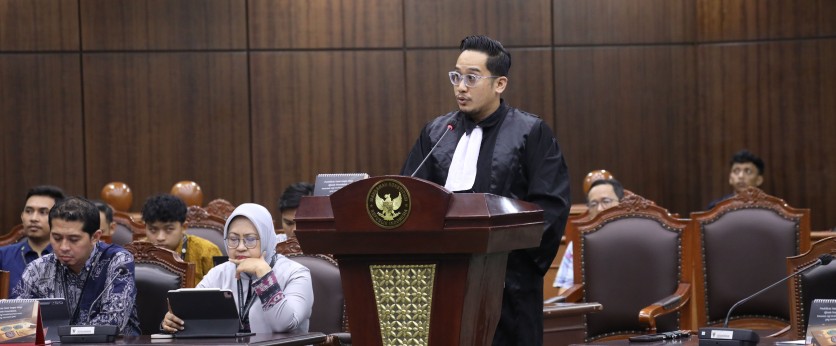
Counsel for the Indonesian Telecommunications Providers Association (ATSI) Fadhil Muhammad Indrapraja testifying as a Relevant Party at a hearing for the amendment to the Telecommunication Law by the Job Creation Law, Thursday (4/16/2026). Photo by MKRI/Panji.
JAKARTA (MKRI) — The Constitutional Court held the fourth hearing for the material judicial review of Article 71 point 2 of Law No. 6 of 2023 on the Stipulation of Government Regulation in Lieu of Law No. 2 of 2022 on Job Creation as Law, as it amends Article 28 of Law No. 36 on Telecommunications on Thursday, April 16, 2026 in the plenary courtroom. The hearing for Case No. 33/PUU-XXIV/2026, to hear the Indonesian Telecommunications Providers Association (ATSI) as the Relevant Party, was presided over by Chief Justice Suhartoyo and the other constitutional justices.
Representing ATSI, counsel Fadhil Muhammad Indrapraja emphasized the importance of understanding the characteristics of the telecommunications sector before discussing internet access services, which in practice are offered through data packages or quotas. He explained that reforming the telecommunications sector from a monopoly to a competitive market is necessary to keep pace with global technological developments. He argued that competition encourages innovation, service diversity, and more affordable and inclusive pricing for the public. Moreover, the involvement of business actors accelerates network expansion and improve the quality of telecommunications services across Indonesia.
From a regulatory perspective, Indrapraja noted that the Telecommunications Law in conjunction with the Job Creation Law has established a framework for healthy competition while still prioritizing the public interest. Telecommunications operators are also subject to contribution obligations, such as universal service obligations (USO) and spectrum usage fees (BHP), which form part of non-tax state revenue (PNBP).
“These costs are allocated to support the equitable development of infrastructure and the provision of internet services, particularly in remote and underdeveloped areas,” he stated.
He further explained that the Government has the authority to regulate telecommunications service tariffs, including setting upper and/or lower price limits to maintain a balance between public interest and fair business competition. Tariff supervision is carried out through mandatory reporting by mobile operators to the Ministry of Communication and Digital, as well as through public complaint.
With regard to internet access, Indrapraja stated that the main challenges do not lie in pricing, but rather in the limitations of devices and digital literacy. Meanwhile, the factors of high tariffs and lack of network availability account for a relatively small proportion.
He also pointed out that internet tariffs in Indonesia are relatively low on a global scale. Based on a study by Cable.co.uk (BestBroadbandDeals.co.uk), the average cost of internet in Indonesia is around USD 0.28 per GB, significantly lower than the global average of USD 2.59 per GB.
Also read:
Student Questions Internet Quota Forfeiture Without Compensation
Petitioner Revises Petition on Internet Quota Forfeiture
House Maintains Telecommunications Tariffs Be Left to the Market
The Petitioner of Case No. 33/PUU-XXIV/2026, university student TB Yaumul Hasan Hidayat, has been undergoing online learning for his education. Accordingly, internet access constitutes a primary and indispensable means for the fulfillment of his right to education and self-development. The internet quota he purchased has economic value and constitutes a legitimate right to digital access.
In addition, the Petitioner is of the view that internet quotas constitute economic rights and digital access rights with proprietary value, and therefore fall within the protection of property rights. Any unilateral forfeiture of quotas without consent and adequate compensation is considered contrary to the principles of legal certainty and justice.
On this basis, the Petitioner requests that the Constitutional Court declare Article 71 point 2 of the Job Creation Law conditionally unconstitutional, insofar as it is not interpreted to mean that “internet quotas that have been paid for by consumers may not be deleted or forfeited unilaterally, and where a validity period is imposed, it must be accompanied by a fair, transparent, and proportional mechanism to ensure legal certainty and the protection of citizens’ constitutional rights,” or that “any limitation on the validity period of internet data services must be regulated in a clear, transparent, and fair manner, and must not result in the loss of the utility value of quotas that have been paid for by consumers without proportional compensation.”
Explore case No. 33/PUU-XXIV/2026 (in Indonesian).
Author : Utami Argawati
Editor : N. Rosi
PR : Raisa Ayuditha M.
Translator : Yuniar Widiastuti (NL)
Disclaimer: The original version of the news is in Indonesian. In case of any differences between the English and the Indonesian versions, the Indonesian version will prevail.
Thursday, April 16, 2026 | 14:55 WIB 209