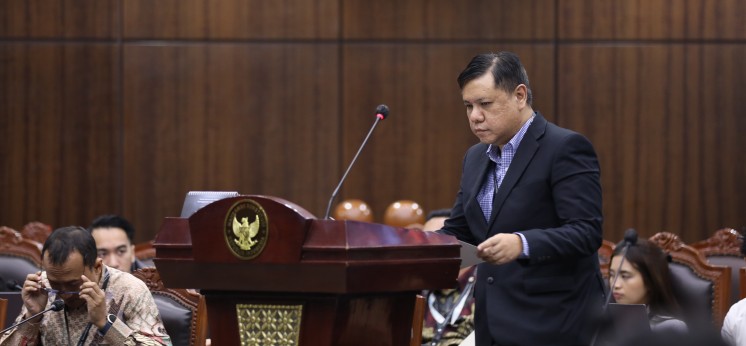
Nicholas Yulius Munandar testifying on behalf of PT Indosat Ooredoo Hutchison for case on the amendment to the Telecommunication Law by the Job Creation Law, Monday (5/4//2026). Photo by MKRI/Ifa.
JAKARTA (MKRI) — The Constitutional Court held another hearing for the material review of Article 71 point 2 of Law No. 6 of 2023 on the Stipulation of Government Regulation in Lieu of Law No. 2 of 2022 on Job Creation into Law, which amends Law No. 36 of 1999 on Telecommunications on Monday, May 4, 2026. The joint-session for Cases No. 273/PUU-XXIII/2025 and No. 33/PUU-XXIV/2026 was to hear the Indonesian Telecommunications Providers Association (ATSI); telecommunication providers Telkomsel, Indosat, and XL; and state-owned electric utility company and the sole provider of electricity infrastructure and distribution PT Perusahaan Listrik Negara (PLN) Persero as Relevant Parties.
PT Indosat Ooredoo Hutchison, represented by Vice President Head of Private Product and Pricing Strategy Nicholas Yulius Munandar, stated that the term “expired quota” (kuota hangus) is conceptually inaccurate. The expiration of an internet package reflects the completion of Indosat’s contractual obligation to provide access rights to customers for a specified data volume and period, as agreed, regardless of whether such access is fully utilized.
“What ends is the customer’s right of access to that capacity within the agreed duration, not a loss of ownership rights that can be asserted under property law,” Nicholas explained at the plenary courtroom of the Constitutional Court in Jakarta.
He further clarified that unused data quota does not “transfer” anywhere—neither to Indosat, other customers, nor to the “network” in any abstract sense—but instead indicates that network capacity had been made available and accessible during the service period. The legal relationship between Indosat and its customers is contractual in nature, where the object is not a tangible good but a service performance, namely the provision of access to network capacity within agreed volume and time parameters.
He emphasized that this contractual framework is clearly reflected in all service documentation provided to customers, who are expected to read and understand the applicable terms and conditions. The time parameter of each package is not a hidden or unilateral provision, but part of an agreement that has been transparently communicated prior to subscription.
Indosat has also ensured that such information is conveyed in multiple layers and is easily accessible, including through marketing materials, activation notices, mobile application, official website, and customer service channels.
Prepaid Token, Purchase of Electricity Without a Time Limit
PT PLN (Persero), represented by Customer Administration Reporting Manager Betty Cahya Melani, explained that electricity tariff schemes in practice are divided into two types: postpaid (regular) and prepaid. The distinction lies not in the nature of electricity as a commodity, but in the timing of payment and method of usage.
“In prepaid electricity, customers do not purchase access for a certain number of days or months, but rather purchase energy that can be used according to their needs until the purchased kilowatt-hours (kWh) are exhausted,” she stated.
Under the prepaid scheme, customers pay in advance by purchasing electricity tokens. These tokens do not represent time-based service access, but rather a quantified amount of electrical energy measured in kilowatt-hours (kWh). Once purchased, the value—after deductions such as administrative fees and local street lighting taxes—is converted into kWh and credited to the customer’s prepaid meter. Technically, the token is a 20-digit code that, when entered into the meter, is immediately converted into an energy balance.
When the token code is entered into the meter, the system does not treat it as a service voucher subject to a specific validity period, but instead directly converts it into an energy balance measured in kilowatt-hours (kWh) recorded on the customer’s meter. The kWh balance is then reduced solely based on the customer’s actual electricity consumption.
As long as the energy has not been used, the kWh balance remains stored in the meter. In other words, the measure of its depletion is energy consumption, not the passage of time. This characteristic fundamentally distinguishes prepaid electricity tokens from other services that are contractually based on duration or a period of validity.
In a prepaid electricity scheme, customers do not purchase access for a certain number of days or months; rather, they purchase energy that can be used according to their needs until the purchased kWh is fully consumed. For this reason, both from a system design perspective and transactional logic, the prepaid token mechanism is more accurately understood as an upfront purchase of energy, the utilization of which ends only when the purchased energy has been exhausted.
From a service perspective, the prepaid system provides greater control to customers. They can determine purchase amounts based on their needs, monitor remaining kWh directly, receive low-credit alerts, and top up at any time. When the balance is depleted, electricity usage stops automatically until a new token is purchased.
Moreover, prepaid customers are generally not subject to fixed charges or minimum billing requirements. They pay only for the energy they purchase and consume. This contrasts with postpaid schemes, which may include minimum billing obligations. As such, prepaid tokens function as a consumption-based mechanism, allowing customers to manage usage and expenses independently. This is why prepaid tokens are understood as an instrument for controlling electricity usage based on actual consumption.
From a regulatory standpoint, Betty noted, there is currently no legal provision in the electricity sector requiring prepaid tokens to have an expiration period that would cause purchased kWh to lapse solely due to the passage of time. As an implementing entity, PT PLN (Persero) does not have the authority to impose such limitations unilaterally. Therefore, the practice that prepaid electricity tokens remain valid until fully used is consistent with the existing regulatory framework.
Also read:
Two Citizens File Petition Over Expired Unused Internet Quota
Petitioners Revise Petition Over Expired Unused Internet Quota
Govt’s Response on Non-refundable Unused Internet Quota
Mobile Network Operator Explains Expired Internet Quota
Article 71 point 2 of the Job Creation Law stipulates that: “(1) The tariffs for the provision of Telecommunications Networks and/or Telecommunications Services shall be determined by the providers of Telecommunications Networks and/or Services based on a formula established by the Central Government. (2) The Central Government may set upper and/or lower tariff limits for the provision of Telecommunications Services by considering public interest and fair business competition.”
Also read:
Student Questions Internet Quota Forfeiture Without Compensation
Petitioner Revises Petition on Internet Quota Forfeiture
House Maintains Telecommunications Tariffs Be Left to the Market
Telecommunications Providers Association Explain Internet Tariffs
Case No. 273/PUU-XXIII/2025 was petitioned by online motorcycle taxi driver Didi Supandi and online culinary vendor Wahyu Triana Sari, while Case No. 33/PUU-XXIV/2026 was filed by university student TB Yaumul Hasan Hidayat.
They are challenging the practice where unused internet data quotas expire at the end of their validity period as determined by telecommunications service providers or operators. They argued that the 2023 amendment to Article 28 of the Telecommunications Law, as contained in Article 71 point 2 of the Job Creation Law, failed to consider developments in information technology, particularly the evolution of internet services.
The Petitioners believe that any unilateral forfeiture of quotas without consent and adequate compensation is considered contrary to the principles of legal certainty and justice. They therefore request that the Constitutional Court declare Article 71 point 2 of the Job Creation Law conditionally unconstitutional if not interpreted in accordance with the respective meanings they seek, as set out in the petitums of their petitions.
Explore cases No. 273/PUU-XXIII/2025 and 33/PUU-XXIV/2026 (in Indonesian).
Author : Mimi Kartika
Editor : N. Rosi
Translator : Yuniar Widiastuti (NL)
Disclaimer: The original version of the news is in Indonesian. In case of any differences between the English and the Indonesian versions, the Indonesian version will prevail.
Monday, May 04, 2026 | 15:15 WIB 209