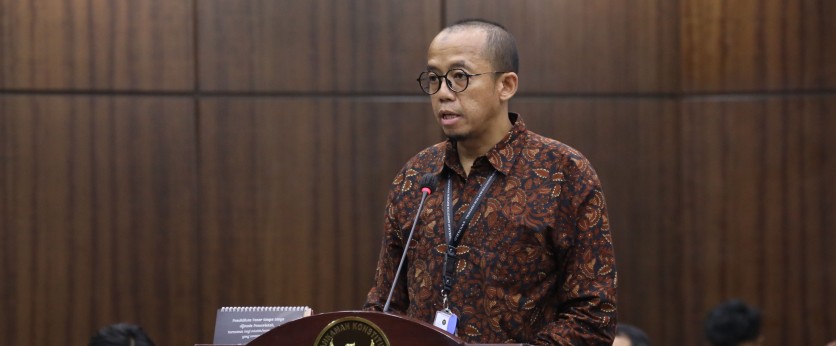
Vice President of SIMPATI Product Marketing Adhi Putranto testifying on behalf of Telkomsel for case on the amendment to the Telecommunication Law by the Job Creation Law, Thursday (4/16/2026). Photo by MKRI/Panji.
JAKARTA (MKRI) — PT Telekomunikasi Selular (Telkomsel), PT Indosat Tbk, PT XLSMART Telecom Sejahtera Tbk, PT Perusahaan Listrik Negara (PLN) Persero, as well as the Indonesian Telecommunications Providers Association (ATSI) presented their statements as Relevant Parties in Case No. 273/PUU-XXIII/2025 before the Constitutional Court at the fourth hearing on the judicial review of Article 71 point 2 of Law No. 6 of 2023 on the Stipulation of Government Regulation in Lieu of Law No. 2 of 2022 on Job Creation into Law, which amends Law No. 36 of 1999 on Telecommunications on Thursday, April 16, 2026.
Representing Telkomsel, Vice President of SIMPATI Product Marketing Adhi Putranto stated that the terminology “expired internet package or quota” or “unilateral quota forfeiture” circulating in the community is inaccurate. He explained that what actually occurs is the termination of a contract of the provision of internet services between the mobile network operator (MNO) and the customer, based on the volume and duration initially selected by the customer.
“Terminology such as expired packages or unilateral quota forfeiture currently circulating among the public is, in our view, not accurate,” Adhi stated at the plenary hearing at the Constitutional Court.
He further explained that, technically, unused data volume—representing access rights to telecommunications network capacity—cannot be stored, transferred, or accumulated. As such, it cannot be reused or resold by the operator. Therefore, mobile operators do not obtain any additional benefit from unused data within the agreed period selected by the customer.
Customers are given the freedom to choose internet service packages according to their needs and purchasing power. Once the selected data volume is fully used and/or the validity period expires, the provision of internet access and services also ends.
“The expiration of a package is not a forced forfeiture or reduction of benefits, but rather a consequence of the completion of the agreed access duration,” Adhi noted.
He emphasized that what is provided to customers is a service in the form of access rights to network capacity for a specific volume and period. The network capacity itself never becomes the property of the customer but remains under the management of the MNO as a telecommunications service provider.
In other words, the notion that purchased internet packages or quotas become the customer’s property as a tangible commodity is inaccurate. Operators do not sell goods in the form of data quotas that transfer ownership to customers upon payment. Instead, they provide access and services enabling customers to utilize network capacity managed by the operator.
A similar view was expressed by Vice President Head of Prepaid Product & Pricing Strategy of Indosat Nicholas Yulius Munandar. He explained that the network capacity used to provide mobile internet services is not a single entity but an integration of various interdependent technical elements, including radio frequency spectrum, which is a limited resource; base transceiver stations (BTS) as radio access points for customer devices; the radio access network that connects customer devices to the operator’s network; the transport network that carries data traffic from the access network to the core network; the core network that manages data processing, authentication, routing, and service control; data centers as facilities for data storage, processing, and supporting service applications; as well as network management systems and other operational support systems that ensure all these components function in an integrated manner.
All these components require substantial investment, both in initial development and in continuous maintenance and upgrades. Network management also demands careful technical planning, including traffic projections, load distribution, and gradual capacity expansion.
“Therefore, Indosat must manage its network capacity in an optimal, measurable, and sustainable manner to ensure service availability, maintain customer experience quality, and ensure equitable access without disrupting the overall network,” Nicholas explained.
Electricity Tariffs
Meanwhile, PT PLN Persero, represented by Tariff Evaluation Manager Dwi Yanti Lestari, stated that electricity tariff policy is fully regulatory in nature, rather than a corporate policy. The Government determines electricity tariffs under two schemes: postpaid (regular) and prepaid.
The regular tariff, commonly known as postpaid electricity, allows consumers to use electricity first and pay later within a specified billing period, typically from the 1st to the 20th of each month. In contrast, the prepaid system—commonly referred to as token electricity—requires consumers to pay in advance by purchasing electricity credits (kWh) according to their needs.
“As long as prepaid consumers continue purchasing tokens, they will remain PLN customers,” Dwi stated.
She added that these different tariff schemes reflect alternative service mechanisms available to consumers without altering the basic tariff structure set by the Government. The implementation of electricity tariffs is carried out in accordance with Minister of Energy and Mineral Resources Regulation No. 7 of 2024.
Also read:
Two Citizens File Petition Over Expired Unused Internet Quota
Petitioners Revise Petition Over Expired Unused Internet Quota
Govt’s Response on Non-refundable Unused Internet Quota
Article 71 point 2 of the Job Creation Law stipulates that: “(1) The tariffs for the provision of Telecommunications Networks and/or Telecommunications Services shall be determined by the providers of Telecommunications Networks and/or Services based on a formula established by the Central Government. (2) The Central Government may set upper and/or lower tariff limits for the provision of Telecommunications Services by considering public interest and fair business competition.”
Online motorcycle taxi driver Didi Supandi and online culinary vendor Wahyu Triana Sari are challenging the practice where unused internet data quotas expire at the end of their validity period as determined by telecommunications service providers or operators. They brought the issue before the Constitutional Court by filing a petition for judicial review of Article 71 point 2 of Law No. 6 of 2023 on Job Creation.
According to the Petitioners, the 2023 amendment to Article 28 of the Telecommunications Law, as contained in Article 71 point 2 of the Job Creation Law, failed to consider developments in information technology, particularly the evolution of internet services. In the current era of digital transformation, telecommunications services have shifted from being merely a secondary need to a basic necessity (public utility), comparable to water, electricity, and fuel.
In their petitums, the Petitioners requested the Court to declare Article 71 point 2 of the Job Creation Law, insofar as it amends Article 28 of the Telecommunication Law, conditionally unconstitutional and without binding legal force unless it is interpreted to mean that the determination of tariffs and schemes for telecommunications services must guarantee the accumulation of unused quota (data rollover) that has been paid for by consumers; or, alternatively, unless it is interpreted to mean that any remaining quota purchased by consumers remains valid and usable for as long as the prepaid card is active, regardless of the validity period of the package set by the operator; or, alternatively, unless it is interpreted to mean that unused quota must be converted back into prepaid credit value or refunded proportionally to the consumer’s account upon the expiration of the package validity period.
Explore case No. 273/PUU-XXIII/2025 (in Indonesian).
Author : Mimi Kartika
Editor : N. Rosi
Translator : Yuniar Widiastuti (NL)
Disclaimer: The original version of the news is in Indonesian. In case of any differences between the English and the Indonesian versions, the Indonesian version will prevail.
Thursday, April 16, 2026 | 15:05 WIB 298