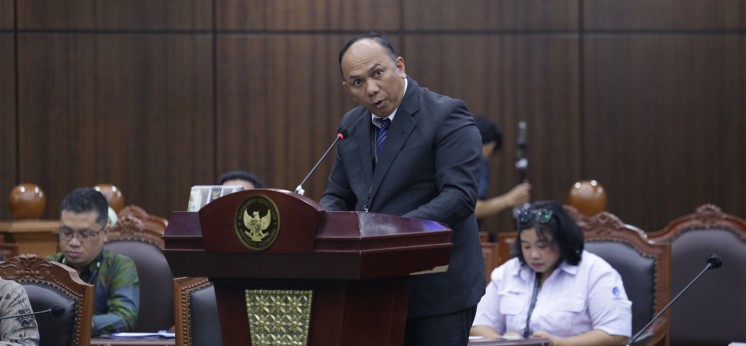
Director-General of Digital Infrastructure of the Ministry of Communication and Digital Wayan Toni Supriyanto testifying for Case No. 273/PUU-XXIII/2025 on the amendment to the Telecommunication Law by the Job Creation Law, Wednesday (2/18/2026). Photo by MKRI/Bayu.
JAKARTA (MKRI) — Director-General of Digital Infrastructure of the Ministry of Communication and Digital Wayan Toni Supriyanto stated that imposing a mandatory accumulation or refund mechanism for unused internet data could potentially create unmeasurable capacity burdens and additional costs for telecommunications providers. He conveyed this at a hearing on the judicial review of Article 71 point 2 of Law No. 6 of 2023 on the Stipulation of Government Regulation in Lieu of Law No. 2 of 2022 on Job Creation into Law, which amends Law No. 36 of 1999 on Telecommunications.
“This condition could lead to tariff adjustments, reduced availability of affordable package options, declining service quality due to network congestion, and disruption to network capacity planning,” he said. He represented the President’s proxies, Law Minister Supratman Andi Agtas and Minister of Communication and Digital Meutya Viada Hafid, at a session to hear statements from the House of Representatives (DPR) and the President in Case No. 273/PUU-XXIII/2025 on Wednesday, February 18, 2026 in the plenary courtroom.
Toni explained that the telecommunications sector is a capital-intensive industry requiring substantial and continuous investment for network infrastructure development, radio frequency spectrum management, service quality improvement, and technological innovation. Internet quota is part of network capacity, which is dynamic and limited, and therefore must be managed efficiently and in a planned manner. The implementation of a validity period for internet quotas serves to maintain efficient network utilization, prevent artificial capacity buildup, provide certainty for investment planning, and safeguard public service quality.
He emphasized that treating internet quota as a right without a time limit could create uncertainty in network management, increase operational costs, and reduce service quality, ultimately harming the broader public. Therefore, regulating quota validity periods is considered a rational and proportionate economic policy.
He argued that the Government continues to prioritize consumer protection in telecommunications services. Such protection is ensured through mandatory transparency, prohibition of misleading practices, complaint mechanisms, and administrative supervision by the Government.
Regarding tariffs, he stressed that pricing is neither arbitrary nor entirely left to cellular operators. Instead, tariffs must follow a government-determined formula, stipulated by the Government in the provision a quo, which takes into account cost components, inflation, public purchasing power, and industry sustainability. Under Government Regulation (PP) No. 46 of 2021 on Postal Services, Telecommunications, and Broadcasting and Ministerial Regulation No. 5 of 2021 on Telecommunications Operations, tariffs consist of activation fees, monthly subscription fees, and usage charges. The formula for usage tariffs is: usage tariff = basic service provision cost + supporting service activity cost + profit.
From a private law perspective, Toni explained, when consumers purchase a service package, there is already an agreement regarding the data volume and validity period. Requests for internet data to remain valid indefinitely or to follow the SIM card’s active period could create legal uncertainty and imbalance of obligations for providers, as there would be no clear endpoint for service responsibility.
The Government emphasized that the issue raised in the petition primarily concerns the execution of agreements between consumers and mobile cellular network operators. Toni argued that the Petitioners essentially have a policy preference for a different telecommunications service model than the contractual terms they agreed upon.
“And that is not a matter of a norm that violates the 1945 Constitution,” he stressed.
He further clarified that internet quota is not a personal asset right. Rather, it is a right to access telecommunications networks (i.e., the internet), allowing users to access, download, and upload content according to the agreed service terms and conditions. The quota is limited by the maximum volume of content that may be accessed or transmitted.
Finally, he asserted that the expiration of an internet package does not constitute forced deprivation under the challenged provision. Instead, it is a consequence of the agreed access duration having ended. Article 71 point 2 of Law No. 6 of 2023, he concluded, does not allow for confiscation of property rights, but merely regulates the mechanism for setting telecommunications tariffs under state supervision based on a government-established formula.
Also read:
Two Citizens File Petition Over Expired Unused Internet Quota
Petitioners Revise Petition Over Expired Unused Internet Quota
Article 71 point 2 of the Job Creation Law stipulates that: “(1) The tariffs for the provision of Telecommunications Networks and/or Telecommunications Services shall be determined by the providers of Telecommunications Networks and/or Services based on a formula established by the Central Government. (2) The Central Government may set upper and/or lower tariff limits for the provision of Telecommunications Services by considering public interest and fair business competition.”
Online motorcycle taxi driver Didi Supandi and online culinary vendor Wahyu Triana Sari are challenging the practice where unused internet data quotas expire at the end of their validity period as determined by telecommunications service providers or operators. They brought the issue before the Constitutional Court by filing a petition for judicial review of Article 71 point 2 of Law No. 6 of 2023 on Job Creation.
“The normative provision of Article 71 point 2 of the Job Creation Law effectively grants operators the carte blanche to impose an ‘expired quota’ scheme without any obligation to provide accumulative (rollover) unused data to consumers,” Didi said at the preliminary hearing for Case No. 273/PUU-XXIII/2025, alongside Sari and their legal counsel Viktor Santoso Tandiasa, on Tuesday, January 13, 2026.
According to the Petitioners, the 2023 amendment to Article 28 of the Telecommunications Law, as contained in Article 71 point 2 of the Job Creation Law, failed to consider developments in information technology, particularly the evolution of internet services. In the current era of digital transformation, telecommunications services have shifted from being merely a secondary need to a basic necessity (public utility), comparable to water, electricity, and fuel.
In their petitums, the Petitioners requested the Court to declare Article 71 point 2 of the Job Creation Law, insofar as it amends Article 28 of the Telecommunication Law, conditionally unconstitutional and without binding legal force unless it is interpreted to mean that the determination of tariffs and schemes for telecommunications services must guarantee the accumulation of unused quota (data rollover) that has been paid for by consumers; or, alternatively, unless it is interpreted to mean that any remaining quota purchased by consumers remains valid and usable for as long as the prepaid card is active, regardless of the validity period of the package set by the operator; or, alternatively, unless it is interpreted to mean that unused quota must be converted back into prepaid credit value or refunded proportionally to the consumer’s account upon the expiration of the package validity period.
Explore case No. 273/PUU-XXIII/2025 (in Indonesian).
Author : Mimi Kartika
Editor : N. Rosi
Translator : Yuniar Widiastuti (NL)
Disclaimer: The original version of the news is in Indonesian. In case of any differences between the English and the Indonesian versions, the Indonesian version will prevail.
Wednesday, February 18, 2026 | 15:54 WIB 389