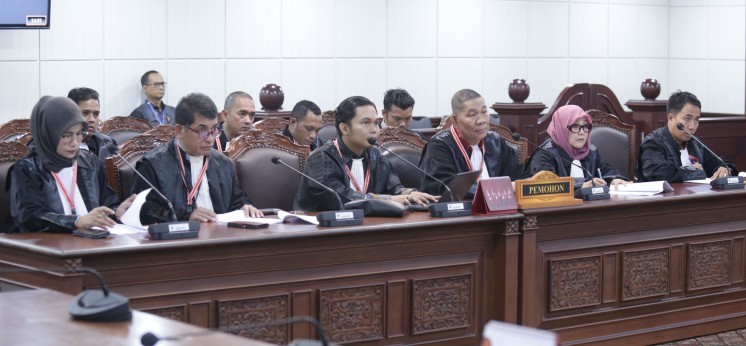
The Petitioner’s counsels at the preliminary hearing for the amendment to the Telecommunication Law by the Job Creation Law in Case No. 33/PUU-XXIV/2026, Wednesday (1/28/2026). Photo by MKRI/Bayu.
JAKARTA (MKRI) — University student TB Yaumul Hasan Hidayat has filed for the constitutional review of Article Article 71 point 2 of Law No. 6 of 2023 on the Stipulation of Government Regulation in Lieu of Law No. 2 of 2022 on Job Creation as Law, as it amends Article 28 of Law No. 36 on Telecommunications.
The preliminary hearing for case No. 33/PUU-XXIV/2026 took place on Wednesday, January 28, 2026 and was presided over by Chief Justice Suhartoyo (panel chair) alongside Constitutional Justices Daniel Yusmic P. Foekh and M. Guntur Hamzah.
The Petitioner’s counsel Mivan Pattiwangi explained that the Petitioner undergoes online learning for his education. Accordingly, internet access constitutes a primary and indispensable means for the fulfillment of his right to education and self-development.
The internet quota he purchased has economic value and constitutes a legitimate right to digital access. However, the application of the contested norm, which is interpreted as permitting the forfeiture of internet quota that has been fully paid for, has given rise to actual and tangible constitutional losses.
Such losses include, among others, the interruption of access to online lectures due to the unilateral forfeiture of quota; the loss of opportunities to participate fully in educational process; and obstacles to the fulfillment of the right to benefit from science and technology.
According to the Petitioner, at the time of its initial enactment the Telecommunications Law was designed in the context of conventional voice-based telecommunications services, when the internet had not yet become a central infrastructure of social and educational life. Along with technological developments, the internet has now evolved into a system of continuous data transmission and has become the backbone of public services, including education.
Nevertheless, the Petitioner argued that Article 71 point 2 of the Job Creation Law maintains, and even expands, the old regulatory framework without making an adequate distinction between conventional telecommunications services and internet data services as an essential form of digital access. This allows for interpretations that justify the forfeiture of internet quotas that have already been paid for by users.
“Dependence on the internet as a means of fulfilling the right to education has become increasingly evident, particularly since the COVID-19 pandemic, when the State shifted the education process to an online learning system. This simultaneously underscores the State’s recognition of the internet as essential educational infrastructure,” said Pattiwangi.
The Petitioner also highlighted the more severe impact on students and communities in disadvantaged, frontier, and outermost (3T) regions. Limited network coverage, a lack of service provider options, and the high cost of quotas place these groups in a more vulnerable position.
“For students in 3T regions, every internet quota purchased constitutes the primary capital for maintaining the continuity of their education. The forfeiture of paid quotas not only causes economic losses but also directly cuts off access to education,” Pattiwangi emphasized.
In addition, the Petitioner is of the view that internet quotas constitute economic rights and digital access rights with proprietary value, and therefore fall within the protection of property rights. The unilateral forfeiture of quotas without consent and adequate compensation is considered contrary to the principles of legal certainty and justice.
On this basis, the Petitioner requested that the Constitutional Court declare Article 71 point 2 of the Job Creation Law conditionally unconstitutional, insofar as it is not interpreted to mean that “internet quotas that have been paid for by consumers may not be deleted or forfeited unilaterally, and where a validity period is imposed, it must be accompanied by a fair, transparent, and proportional mechanism to ensure legal certainty and the protection of citizens’ constitutional rights,” or that “any limitation on the validity period of internet data services must be regulated in a clear, transparent, and fair manner, and must not result in the loss of the utility value of quotas that have been paid for by consumers without proportional compensation.”
In response to the Petitioner’s petition, Constitutional Justice Enny Nurbaningsih advised the Petitioner to pay attention to the manner of citing provisions of the Job Creation Law. “Do not directly refer to Article 71 paragraph (2); clarify which article this is, within which law. That must be emphasized in the mention of the Job Creation Law,” she advised.
Furthermore, Justice Enny continued, with regard to the requirement of constitutional loss, it is first necessary to clearly identify which rights are granted by statute. She observed that the petition contains inconsistencies in the identification of those rights. Initially, the Petitioner referred to constitutional rights derived from Article 28D paragraph (1), Article 28F, and Article 28H paragraph (4) of the 1945 Constitution. Subsequently, however, the petition shifted to refer to Article 28C paragraph (1). This inconsistency is evident, inter alia, in points 4 and 10 of the petition, which refer to different rights. Therefore, Justice Enny advised, the rights believed to be granted by statute must first be clearly and consistently identified, before explaining which rights are considered to have been impaired by the operation of the challenged norm.
The panel of justices gave the Petitioner 14 days to revise the petition. The revised the petition must have been received by the Court no later than 12:00 WIB on Tuesday, February 10, 2026.
Explore case No. 33/PUU-XXIV/2026 (in Indonesian).
Author : Utami Argawati
Editor : N. Rosi
Translator : Yuniar Widiastuti (NL)
Disclaimer: The original version of the news is in Indonesian. In case of any differences between the English and the Indonesian versions, the Indonesian version will prevail.
Wednesday, January 28, 2026 | 16:57 WIB 127