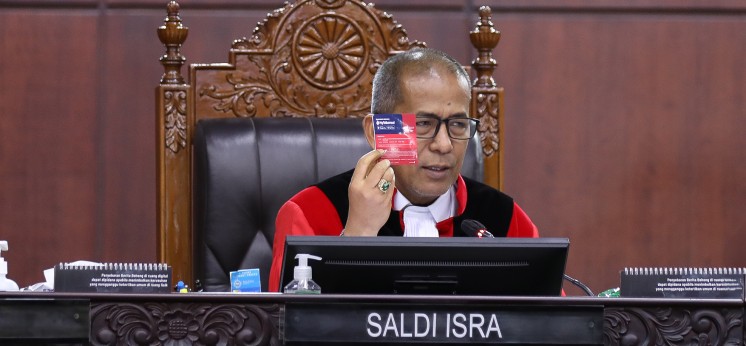
The third hearing for the amendment to the Telecommunication Law by the Job Creation Law in Case No. 33/PUU-XXIV/2026, Wednesday (3/4/2026). Photo by MKRI.
JAKARTA (MKRI) — The Constitutional Court held the third hearing for the material judicial review of Article 71 point 2 of Law No. 6 of 2023 on the Stipulation of Government Regulation in Lieu of Law No. 2 of 2022 on Job Creation as Law, as it amends Article 28 of Law No. 36 on Telecommunications on Wednesday, March 4, 2026 in the plenary courtroom. The hearing for Case No. 33/PUU-XXIV/2026 had been scheduled to hear the House of Representatives’ (DPR) and the Government’s responses to the petition.
Before Chief Justice Suhartoyo and the other constitutional justices, House Commission III member I Wayan Sudirta explained that in order to understand the original intent of the legislatures with respect to Article 28 of the Telecommunications Law before its amendment through the Job Creation Law, the House had first reviewed its legislative history as reflected in the minutes of meetings discussing the Telecommunications Bill.
“From the outset, the legislatures intended that tariff levels be left to market, to be determined by network operators and/or telecommunications service providers,” he stated.
However, he continued, the State nevertheless established a formula as the basis for determining tariffs in order to prevent two risks within the market: excessively high tariffs due to the dominance of certain business actors, as well as excessively low tariffs.
In addition to tracing the legislative history of Article 28 prior to its amendment, the House also explained the regulatory developments following its amendment through the Job Creation Law, particularly with the addition of a new provision in Article 28 paragraph (2).
“This amendment must be understood as strengthening the State’s control instruments over market stability, preventing unfair competition practices, and ensuring that telecommunications services remain affordable and of good quality for the public,” Sudirta explained.
He added that the urgency of amending Article 28 of the Telecommunications Law had also been elaborated in the academic paper of the Job Creation Bill, which emphasized the importance of setting upper and lower tariff limits to maintain the wellbeing of the telecommunications industry.
“The establishment of tariff limits is necessary to prevent underpricing practices that could lead to unhealthy industry conditions and potentially reduce operators’ capacity to invest in technological development and services for the public,” he stated.
At the same hearing, the justices also heard the Government’s statement delivered by the legal affairs advisor to the Minister of Communication and Digital Affairs Cahyaning Nuratih Widowati.
She conveyed that the amendment introduced by the Job Creation Law, which added paragraph (2) to Article 28 of the Telecommunications Law, reflects a regulatory direction whereby tariff determination is based on a formula set by the Central Government, taking into account public interests and fair business competition.
“This amendment in fact clarifies the policy direction for tariffs in the provision of telecommunications networks and services, namely maintaining a balance between market mechanisms and the State’s regulatory function,” she stated.
She further added that the policy aims to provide legal certainty in tariff formulation, prevent predatory pricing and excessive tariffs, and ensure consumer protection as well as the sustainability of the telecommunications industry. The Government maintained that the norm constitutes a proportional regulatory framework for the telecommunications sector, which is strategic and concerns the public interest.
“The State still has corrective instruments through the determination of upper and/or lower tariff limits where necessary in the public interest,” Cahyaning explained.
The Government also emphasized that the Telecommunications Law does not specifically regulate product features or types of services, including quota rollover mechanisms. Such matters form part of product innovation and business strategies of mobile cellular network operators, which remain within the framework of consumer protection and industry sustainability.
Also read:
Student Questions Internet Quota Forfeiture Without Compensation
Petitioner Revises Petition on Internet Quota Forfeiture
In Case No. 33/PUU-XXIV/2026, it is said that university student TB Yaumul Hasan Hidayat has been undergoing online learning for his education. Accordingly, internet access constitutes a primary and indispensable means for the fulfillment of his right to education and self-development. The internet quota he purchased has economic value and constitutes a legitimate right to digital access.
In addition, the Petitioner is of the view that internet quotas constitute economic rights and digital access rights with proprietary value, and therefore fall within the protection of property rights. Any unilateral forfeiture of quotas without consent and adequate compensation is considered contrary to the principles of legal certainty and justice.
On this basis, the Petitioner requests that the Constitutional Court declare Article 71 point 2 of the Job Creation Law conditionally unconstitutional, insofar as it is not interpreted to mean that “internet quotas that have been paid for by consumers may not be deleted or forfeited unilaterally, and where a validity period is imposed, it must be accompanied by a fair, transparent, and proportional mechanism to ensure legal certainty and the protection of citizens’ constitutional rights,” or that “any limitation on the validity period of internet data services must be regulated in a clear, transparent, and fair manner, and must not result in the loss of the utility value of quotas that have been paid for by consumers without proportional compensation.”
Explore case No. 33/PUU-XXIV/2026 (in Indonesian).
Author : Utami Argawati
Editor : N. Rosi
Translator : Yuniar Widiastuti (NL)
Disclaimer: The original version of the news is in Indonesian. In case of any differences between the English and the Indonesian versions, the Indonesian version will prevail.
Wednesday, March 04, 2026 | 14:21 WIB 114