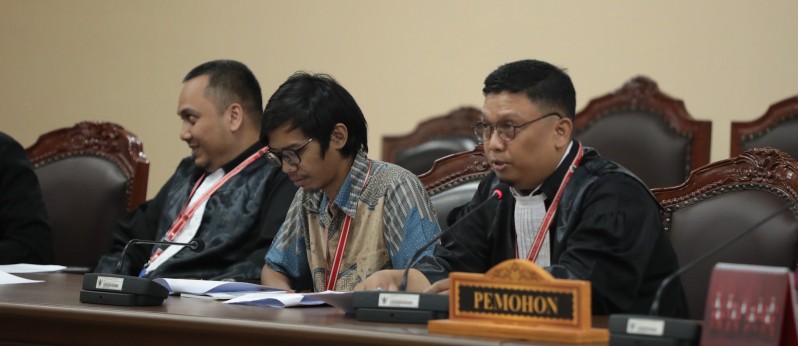
The Petitioners challenging the amendment to the Telecommunication Law by the Job Creation Law presenting the revised petition, Monday (1/26/2026). Photo by MKRI/Ilham W. M.
JAKARTA (MKRI) — The Constitutional Court held the second hearing for case No. 273/PUU-XXIII/2025 on the judicial review of Article 71 point 2 of Law No. 6 of 2023 on the Stipulation of Government Regulation in Lieu of Law No. 2 of 2022 on Job Creation into Law, which amends Law No. 36 of 1999 on Telecommunications, on Monday, January 26, 2026. The petition revision hearing was presided over by Deputy Chief Justice Saldi Isra (chair) and Constitutional Justices Ridwan Mansyur and Asrul Sani.
At the hearing, the Petitioners’ counsel Viktor Santoso Tandiasa presented the revisions to the petition. “[The Petitioners] have rearranged new evidence, exhibits P-1 through P-15, and combining them into the evidence we previously declared withdrawn,” he explained.
He also presented editorial revisions concerning the formulation of the object of the petition, which had previously been considered confusing, particularly with regard to amendments to the Job Creation Law. He explained that the Petitioners had reaffirmed the object of constitutional review as Article 71 point 2 of Law No. 6 of 2023 on the Stipulation of Government Regulation in Lieu of Law No. 2 of 2022 on Job Creation into Law, insofar as it amends Article 28 paragraph (1) of Law No. 36 of 1999 on Telecommunications.
Tandiasa also explained that the Petitioners use Article 28D paragraphs (1) and (2), Article 28F, and Article 28H paragraph (4) of the 1945 Constitution as benchmarks.
Also read: Two Citizens File Petition Over Expired Unused Internet Quota
Online motorcycle taxi driver Didi Supandi and online culinary vendor Wahyu Triana Sari are challenging the practice where unused internet data quotas expire at the end of their validity period as determined by telecommunications service providers or operators. They brought the issue before the Constitutional Court by filing a petition for judicial review of Article 71 point 2 of Law No. 6 of 2023 on Job Creation.
“The normative provision of Article 71 point 2 of the Job Creation Law effectively grants operators the carte blanche to impose an ‘expired quota’ scheme without any obligation to provide accumulative (rollover) unused data to consumers,” Didi said at the preliminary hearing for Case No. 273/PUU-XXIII/2025, alongside Sari and their legal counsel Viktor Santoso Tandiasa, on Tuesday, January 13, 2026.
Article 71 point 2 of the Job Creation Law amends Article 28 of Law No. 36 of 1999 on Telecommunications. As amended, the provision reads as follows: “(1) The tariffs for the provision of Telecommunications Networks and/or Telecommunications Services shall be determined by the providers of Telecommunications Networks and/or Services based on a formula established by the Central Government. (2) The Central Government may set upper and/or lower tariff limits for the provision of Telecommunications Services by considering public interest and fair business competition.”
According to the Petitioners, the 2023 amendment to Article 28 of the Telecommunications Law, as contained in Article 71 point 2 of the Job Creation Law, failed to consider developments in information technology, particularly the evolution of internet services. In the current era of digital transformation, telecommunications services have shifted from being merely a secondary need to a basic necessity (public utility), comparable to water, electricity, and fuel.
The Petitioners explained that consumers fulfill their obligations by making advance (prepaid) payments for a certain volume of internet data. In return, service providers have the obligation to deliver full access to telecommunications services commensurate with the value that has been fully paid.
“I lost 20 gigabytes. For around sixty to seventy thousand rupiah, you get 30 gigabytes, but I only used 10 gigabytes and the remaining 20 gigabytes expired,” Didi recounted.
The unilateral policy of expiring unused internet quotas upon the end of the validity period, the Petitioners asserted, is a violation of consumers’ property rights over the remaining quota that has already been fully paid for. They argued that service providers hide behind the freedom to determine tariff schemes granted by Article 71 point 2 of the Job Creation Law to legitimize practices that are detrimental to consumers.
In their petitums, the Petitioners requested the Court to declare Article 71 point 2 of the Job Creation Law, insofar as it amends Article 28 of the Telecommunication Law, conditionally unconstitutional and without binding legal force unless it is interpreted to mean that the determination of tariffs and schemes for telecommunications services must guarantee the accumulation of unused quota (data rollover) that has been paid for by consumers; or, alternatively, unless it is interpreted to mean that any remaining quota purchased by consumers remains valid and usable for as long as the prepaid card is active, regardless of the validity period of the package set by the operator; or, alternatively, unless it is interpreted to mean that unused quota must be converted back into prepaid credit value or refunded proportionally to the consumer’s account upon the expiration of the package validity period.
Explore case No. 273/PUU-XXIII/2025 (in Indonesian).
Author : Utami Argawati
Editor : N. Rosi
Translators : Yuniar Widiastuti (NL)
Disclaimer: The original version of the news is in Indonesian. In case of any differences between the English and the Indonesian versions, the Indonesian version will prevail.
Monday, January 26, 2026 | 20:07 WIB 297