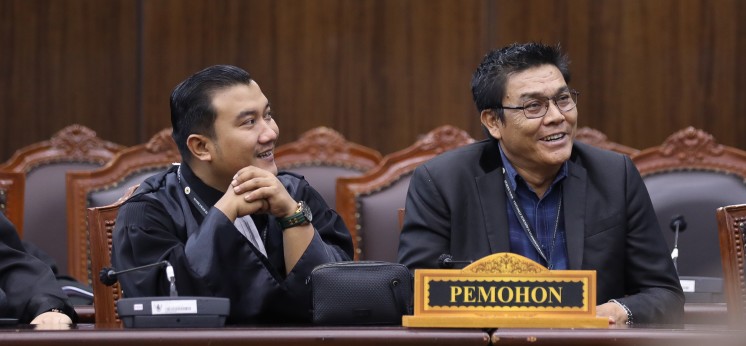
Petitioner Sandi Ebenezer Situngkir and his legal counsel listening to the verdict hearing on the judicial review of Law No. 37 of 2004 on Bankruptcy and Suspension of Debt Payment Obligations (PKPU), Monday (5/25/2026). Photo by MKRI/Ifa.
JAKARTA (MKRI) — The Constitutional Court (MK) partially granted a petition challenging the Elucidation of Article 292 of Law No. 37 of 2004 on Bankruptcy and Suspension of Debt Payment Obligations (PKPU). The Court ruled that a debtor’s bankruptcy estate enters a state of insolvency only after the supervisory judge, during a creditors’ meeting, declares it insolvent and the declaration is recorded in the minutes.
“Verdict: Adjudicating, 1. To partially grant the Petitioners’ petition,” Chief Justice Suhartoyo said while reading out Decision No. 181/PUU-XXIII/2025 in the Plenary Courtroom of the Constitutional Court on Monday, May 25, 2026.
The Court further ruled that the Elucidation of Article 292 of Law No. 37 of 2004 is contrary to the 1945 Constitution and conditionally unconstitutional insofar as it is not interpreted as follows: “The provision in this article means that a bankruptcy declaration causes the debtor’s bankruptcy estate to immediately enter a state of insolvency, effective from the time it is declared by operation of law by the supervisory judge during a creditors’ meeting and recorded in the minutes.”
Previously, the Elucidation of Article 292 stated that “the provision in this article means that a bankruptcy declaration causes the debtor’s bankruptcy estate to immediately enter a state of insolvency.”
Delivering the Court’s legal considerations, Constitutional Justice Daniel Yusmic P. Foekh explained that the substance of the Elucidation of Article 292 cannot be separated from the principal norm contained in Article 292 of the Bankruptcy Law.
Article 292 of Law No. 37 of 2004 stipulates that when a bankruptcy declaration results from the rejection of a composition plan, the failure of creditors to approve a composition plan, or the annulment of a composition agreement, no further composition may be proposed. Therefore, the essence of Article 292 lies in a bankruptcy declaration issued after attempts to reach a settlement with creditors have failed.
As a legal consequence of the unsuccessful composition process, no additional composition plan may be offered in the PKPU proceedings. Consequently, a bankruptcy declaration under Article 292 results in the debtor’s bankruptcy estate entering a state of insolvency.
Justice Foekh further noted that the legal issue concerns the consequences of insolvency, particularly the point at which interested parties may exercise their rights. This is especially relevant to secured creditors, who are granted only two months from the commencement of insolvency to sell collateral. If the collateral remains unsold after that period, it must be handed over to the curator for sale through a public auction.
However, under Articles 178 paragraph (1) and 291 of the Bankruptcy Law, a state of insolvency requires a formal declaration by operation of law that the bankruptcy estate is insolvent. Such a declaration must be expressly made by the supervisory judge during a creditors’ meeting.
According to the Court, this legal framework creates a constitutional issue when read alongside the Elucidation of Article 292, which states that a bankruptcy declaration immediately places the debtor’s estate in a state of insolvency. On one hand, the elucidation suggests that insolvency arises automatically upon the issuance of a bankruptcy ruling. On the other hand, insolvency must still be formally declared by the supervisory judge during a creditors’ meeting and documented in official minutes, which constitute a fundamental requirement for establishing the debtor’s insolvency status.
“Such a declaration serves as juridical evidence that provides binding legal certainty for interested parties and fulfills the function of publicity. Therefore, a bankruptcy declaration does not automatically place the debtor’s bankruptcy estate in a state of insolvency. A further legal act by the supervisory judge in a creditors’ meeting remains necessary,” Foekh said.
Also Read:
Government Expert: Insolvency Issue Relates to Curator Practice
Expert: Insolvency Threshold Rules Create Legal Uncertainty
MK Postpones Expert Testimony in Judicial Review Hearing on Bankruptcy Law
Court Hears DPR and Government Explanations on Insolvency Interpretation
Petitioner Adds New Legal Arguments and Co-Petitioner in Bankruptcy Law Review Hearing
Petitioner Questions Lack of Defined Insolvency Threshold in Bankruptcy Law
The petition was filed by Sandi Ebenezer Situngkir, an advocate, curator, and administrator. He argued that the Elucidation of Article 292 of the Bankruptcy Law creates legal uncertainty because it does not clearly determine when a state of insolvency begins. According to the Petitioner, this uncertainty affects creditors’ legal rights, particularly those of secured creditors, in exercising the statutory period available to sell collateral once a debtor enters a state of insolvency.
Author: Mimi Kartika
Editor: Lulu Anjarsari P.
PR: Andhini S.F.
Translator: Yuanna Sisilia
Disclaimer: The original version of the news is in Indonesian. In case of any differences between the English and the Indonesian versions, the Indonesian version will prevail.
The Complete Decision: Decision No. 181/PUU-XXIII/2025 (in Bahasa Indonesia)
Monday, May 25, 2026 | 15:46 WIB 63