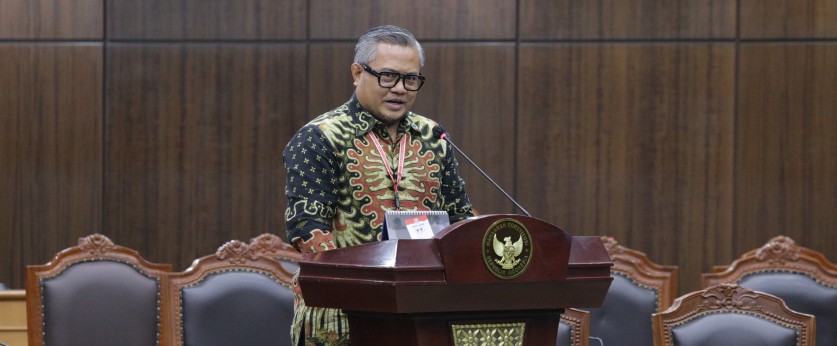
Expert testimony by the Petitioner’s witness, Dean of the Faculty of Law of the Christian University of Indonesia Hendri Jayadi, during the judicial review hearing of Law No. 37 of 2004 on Bankruptcy and Suspension of Debt Payment Obligations, Tuesday (12/9/2025). Photo by MKRI/Bay.
JAKARTA (MKRI) — The Constitutional Court (MK) held another judicial review hearing of Law No. 37 of 2004 on Bankruptcy and Suspension of Debt Payment Obligations on Tuesday, December 9, 2025. Petition No. 181/PUU-XXIII/2025, filed by Sandi Ebenezer Situngkir, challenges the constitutionality of the elucidation to Article 292 of the Bankruptcy Law concerning the lack of clarity on when the state of insolvency is deemed to begin in bankruptcy proceedings.
The session proceeded to hear expert testimony presented by the Petitioner. Hendri Jayadi, Dean of the Faculty of Law of the Christian University of Indonesia, explained that insolvency in bankruptcy law refers to a condition where a debtor is unable to meet debt obligations as they fall due, thus factually being in a state of financial inability to pay. He emphasized that the concept of insolvency is objective and does not relate to fault or fraudulent intent, but instead reflects a genuine financial incapacity requiring a collective settlement mechanism through bankruptcy or reorganization through PKPU (Suspension of Debt Payment Obligations).
“This concept does not concern a debtor’s fault or malicious intent but constitutes an objective condition of financial inability that necessitates a collective settlement mechanism through bankruptcy or restructuring under PKPU,” he stated.
Elaborating further, Hendri described that insolvency doctrine has long been understood through assessments of a debtor’s cash-flow insufficiency and balance-sheet imbalance. He also highlighted the doctrine of presumptive insolvency, in which inability to pay may be inferred from circumstances such as repeated defaults, recurring debt restructuring, or unreasonable delays in meeting obligations despite the debts being due and collectible.
Hendri asserted that the elucidation to Article 292 contains a normative defect because it provides no formal mechanism to ascertain insolvency, even though its legal consequences mirror those of Article 178. He pointed out the disharmony between the statute and Supreme Court Decree No. 109/KMA/SK/IV/2020, which requires an official record confirming insolvency in the context of peace agreement annulment. The elucidation to Article 292, however, does not explicitly require such documentation. This ambiguity, he warned, generates legal uncertainty that may disadvantage curators and other creditors, especially as it creates opportunities for separatist creditors to exploit inconsistencies regarding the commencement of the insolvency period.
He added that the absence of a clear requirement to record insolvency renders the application of Article 292 dependent solely on the bankruptcy declaration, with no obligation to prepare an official report. As a result, separatist creditors may end up with a longer execution window than permitted when they fail to auction off collateral in the first attempt. In practice, Hendri noted, such situations illustrate that legal uncertainty surrounding the application of insolvency remains a persistent issue in Indonesia’s bankruptcy framework.
“Article 292 does not require a record of examination; in practice, this leads to the absence of legal certainty. When the insolvency record becomes mandatory, it should be treated as such,” he explained.
Also read:
MK Postpones Expert Testimony in Judicial Review Hearing on Bankruptcy Law
Court Hears DPR and Government Explanations on Insolvency Interpretation
Petitioner Adds New Legal Arguments and Co-Petitioner in Bankruptcy Law Review Hearing
Petitioner Questions Lack of Defined Insolvency Threshold in Bankruptcy Law
Earlier, the Petitioner argued that the elucidation to Article 292 creates legal uncertainty by stating that a debtor’s estate immediately enters insolvency without clarifying when this condition begins. Article 178, by contrast, expressly sets out three circumstances in which a debtor is deemed insolvent: absence of a peace proposal, rejection of the peace proposal, or denial of its ratification by the court.
The Petitioners contend that this ambiguity creates uncertainty for curators and creditors in determining the timeline for liquidating the bankruptcy estate. The phrase “no peace can be offered” in Article 292 instantly classifies a debtor as insolvent, yet the exact moment this status begins is not defined.
According to the Petitioner, such ambiguity opens the door to multiple interpretations and constitutional harm, particularly for curators who must determine liquidation deadlines and for separatist creditors whose enforcement rights are governed by Articles 55(1) and 159(1) of the Bankruptcy Law.
One case example involved PT Bank Mandiri Tbk, which, as a separatist creditor, proceeded with an asset auction shortly after the debtor was declared bankrupt, while the creditors’ meeting only confirmed insolvency several days later. This, the Petitioner claimed, demonstrates a legal inconsistency that may adversely affect various parties.
The Petitioner also noted that Supreme Court Decree No. 109/KMA/SK/IV/2020 on Guidelines for Bankruptcy and PKPU Case Resolution does not clearly regulate when insolvency begins as referred to in Article 292, leading many judges and practitioners to apply Articles 178 and 292 interchangeably despite their fundamental differences.
Explore the Case: Case No. 181/PUU-XXIII/2025
Author: Utami Argawati
Editor: Lulu Anjarsari P.
PR: Andhini S. F.
Translator: Yuanna Sisilia
Disclaimer: The original version of the news is in Indonesian. In case of any differences between the English and the Indonesian versions, the Indonesian version will prevail.
Tuesday, December 09, 2025 | 13:49 WIB 237