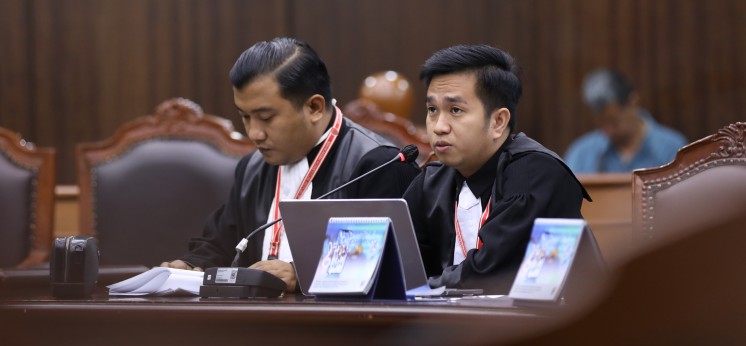
The Petitioner’s counsels Eliadi Hulu and Simeon Fernandes Marolop delivering the petition at the preliminary hearing for the judicial review of the Bankruptcy Law, Friday (10/10/2025). Photo by MKRI/Ifa.
JAKARTA (MKRI) — The provision regarding the commencement of an insolvency state, as contained in the elucidation to Article 292 of Law No. 37 of 2004 on Bankruptcy and Suspension of Debt Payment (the PKPU Law or Bankruptcy Law), has been brought before the Constitutional Court (MK) for judicial review. The preliminary hearing for Case No. 181/PUU-XXIII/2025, filed by Sandi Ebenezer Situngkir, was held on Friday, October 10, 2025.
The elucidation to Article 292 of the Bankruptcy Law states: “The provision in this article shall mean that the decision on bankruptcy declaration shall directly cause the Debtor’s assets to be insolvent.” Meanwhile, Article 57 paragraph (1) of the same law defines insolvency as a state of inability to pay. According to the Petitioner, this provision creates legal uncertainty regarding the determination of when an insolvency state begins in bankruptcy proceedings, thus violating Article 28D paragraph (1) of the 1945 Constitution.
The Petitioner explained that Article 178 of the Bankruptcy Law explicitly provides three circumstances that render a debtor insolvent: the absence of a composition plan, the rejection of a composition plan, or the denial of its ratification through a final and binding court decision. However, unlike Article 178, the elucidation to Article 292 of the Bankruptcy Law automatically declares the debtor insolvent immediately upon the declaration of bankruptcy, without going through the composition plan stage.
“The phrase ‘a composition cannot be offered’ in Article 292 implies that the debtor is immediately in a state of insolvency. However, the provision does not specify precisely when this state begins, creating uncertainty for both the curator and creditors,” said Simeon Fernandes Marolop, the Petitioner’s legal counsel, before the panel of constitutional justices.
The Petitioner argued that this uncertainty directly affects the work of curators in determining the timing of asset liquidation. It also impacts the rights of secured creditors, as regulated in Article 55 paragraph (1) and Article 159 paragraph (1) of Law No. 37 of 2004, which require the execution of such rights no later than two months after the debtor enters a state of insolvency.
In his petition, the Petitioner cited a case he had experienced, in which PT Bank Mandiri Tbk, acting as a secured creditor, auctioned collateral immediately after the debtor was declared bankrupt. However, at the same time, the minutes of the creditors’ meeting indicated that the insolvency state was only recognized several days later. This situation, according to the Petitioner, reflects a legal gap and dual interpretation that harm both curators and creditors.
The Petitioner also noted that the Decree of the Chief Justice of the Supreme Court (SK KMA) No. 109/KMA/SK/IV/2020 has not provided clarity on when insolvency begins as referred to in Article 292. As a result, judges, practitioners, and academics often equate the application of Article 178 and Article 292, even though the two provisions are fundamentally different.
“The determination of the commencement of insolvency as regulated in Article 178 differs from that in Article 292 and its elucidation, yet experts, judges, and other practitioners often treat them as the same,” said Eliadi Hulu, the Petitioner’s legal counsel.
The Petitioner believes the reason Article 178 has been used as a reference to determine the commencement of insolvency under Article 292 is that the aforementioned SK KMA, which serves as the guidelines for the settlement of bankruptcy and suspension of debt payment obligation cases, does not elaborate further on the timing of insolvency as stipulated in Article 292.
As a consequence, he continued, judges, experts, and practitioners handling bankruptcy and PKPU cases have relied on Article 178 as the basis for determining when insolvency begins under Article 292. Yet, Articles 178 and 292 are fundamentally different, as previously elaborated in the Petitioner’s arguments.
Responding to the petition, Constitutional Justice Daniel Yusmic P. Foekh advised the Petitioner to consider the potential implications of introducing a new interpretation. Meanwhile, Constitutional Justice M. Guntur Hamzah urged the Petitioner to strengthen their claim of legal standing. “It is necessary to further substantiate and deepen the issue of legal standing with regard to the alleged constitutional harm and the presumed loss resulting from the enforcement of the challenged norm,” he stated.
The panel of justices gave the Petitioners 14 days to revise the petition. The petition must be received by the Court no later than Thursday, October 23, 2025.
Author : Utami Argawati
Editor : Lulu Anjarsari P.
PR : Andhini S. F.
Translator : Yuniar Widiastuti (NL)
Disclaimer: The original version of the news is in Indonesian. In case of any differences between the English and the Indonesian versions, the Indonesian version will prevail.
Friday, October 10, 2025 | 10:50 WIB 436