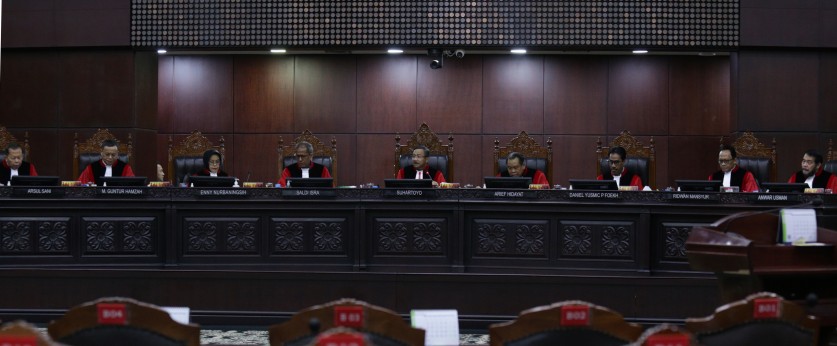
MK postponing the Petitioner’s expert testimony in the judicial review hearing of Law No. 37 of 2004 on Bankruptcy and Suspension of Debt Payment Obligations, Tuesday (11/25/2025). Photo by MKRI/Bay.
JAKARTA (MKRI) — The Constitutional Court (MK) resumed the judicial review hearing of Law No. 37 of 2004 on Bankruptcy and Suspension of Debt Payment Obligations (the Bankruptcy Law) on Tuesday, November 25, 2025, for case No. 181/PUU-XXIII/2025. The petition was filed by Sandi Ebenezer Situngkir, who challenges the constitutionality of the elucidation of Article 292 concerning the commencement of an insolvent estate.
The hearing was scheduled to hear the President’s statement as well as expert testimony from the Petitioner. However, Chief Justice Suhartoyo informed the courtroom that the Petitioner had requested a postponement to present the expert.
“The agenda for this morning is to hear the President’s statement and the expert testimony for case No. 181/PUU-XXIII/2025. But the Petitioner for 181 has requested a postponement for their expert, correct? We will give you one more opportunity,” Suhartoyo stated during the hearing.
With this postponement, the Court granted the Petitioner additional time to present the expert at the next hearing. The schedule for the subsequent hearing will be determined and announced in due course.
Also read:
Court Hears DPR and Government Explanations on Insolvency Interpretation
Petitioner Adds New Legal Arguments and Co-Petitioner in Bankruptcy Law Review Hearing
Petitioner Questions Lack of Defined Insolvency Threshold in Bankruptcy Law
Earlier, the Petitioner argued that the elucidation of Article 292 of the Bankruptcy Law creates legal uncertainty by declaring that a debtor’s assets immediately enter a state of insolvency without clarifying when such a state begins. In contrast, Article 178 clearly delineates three conditions giving rise to insolvency, no composition plan, a rejected composition plan, or the court’s refusal to ratify the plan.
According to the Petitioner, this inconsistency results in uncertainty for both curators and creditors when determining the timeline for settling the bankrupt estate. The phrase “a composition cannot be offered” in Article 292, they asserted, causes the debtor to be deemed insolvent instantly, with no explicit point of commencement.
This ambiguity, the Petitioner further argued, invites conflicting interpretations and may trigger constitutional harm, particularly for curators who must calculate the time limit for asset settlement, as well as for secured creditors whose execution rights are governed by Article 55(1) and Article 159(1) of the Bankruptcy Law.
In one example presented, PT Bank Mandiri Tbk, acting as a secured creditor, auctioned collateral shortly after the debtor was declared bankrupt, whereas the creditors’ meeting only confirmed the state of insolvency several days later. This, the Petitioner emphasized, demonstrates a legal incongruity that risks disadvantaging multiple parties.
The Petitioner also noted that Chief Justice of the Supreme Court Decree No. 109/KMA/SK/IV/2020 on Guidelines for Bankruptcy and PKPU Case Resolution does not explicitly regulate the determination of when insolvency begins as intended under Article 292. As a result, many judges and legal practitioners have treated Articles 178 and 292 as interchangeable despite their distinct substance. (*)
Explore the Case: Tracking Case No. 181/PUU-XXIII/2025
Author: Utami Argawati
Editor: Lulu Anjarsari P.
PR: Andhini S.F.
Translator: Yuanna Sisilia
Disclaimer: The original version of the news is in Indonesian. In case of any differences between the English and the Indonesian versions, the Indonesian version will prevail.
Tuesday, November 25, 2025 | 13:40 WIB 124