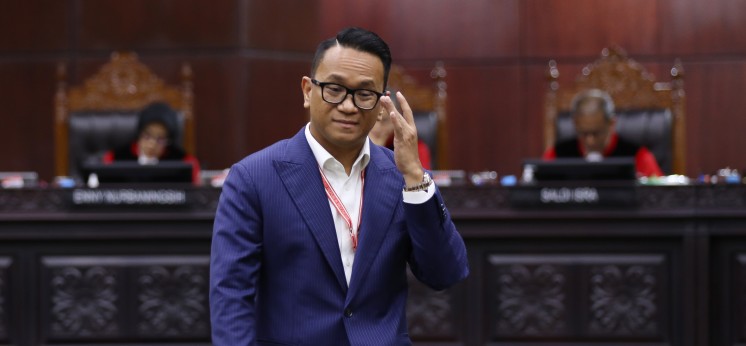
Government expert Nien Rafles Siregar testifying at the follow-up hearing on the judicial review of Law No. 37 of 2004 on Bankruptcy and Suspension of Debt Payment Obligations, Tuesday (12/16/2025). Photo by MKRI/Ifa.
JAKARTA (MKRI) — The Constitutional Court of the Republic of Indonesia held another hearing on the judicial review of Law No. 37 of 2004 on Bankruptcy and Suspension of Debt Payment Obligations (the Bankruptcy Law) on Tuesday (December 16, 2025). The petition, registered as Case No. 181/PUU-XXIII/2025 and filed by Sandi Ebenezer Situngkir, questions the constitutionality of the Elucidation of Article 292 of the Bankruptcy Law, particularly the alleged ambiguity regarding the commencement of a debtor’s insolvency in bankruptcy proceedings.
At the hearing, the Government called Nien Rafles Siregar, the Secretary-General of the Indonesian Association of Receivers and Administrators (Asosiasi Kurator dan Pengurus Indonesia, or AKKPI) for the 2022–2025 term, as an expert. He explained that the issue raised by the Petitioner does not concern a conflict of norms between the Bankruptcy Law and the 1945 Constitution, but rather relates to the implementation of a curator’s authority in administering and liquidating the bankrupt estate during the debtor’s insolvency period.
“The issue described does not concern a normative conflict between the Bankruptcy Law and the 1945 Constitution, but rather differences in implementation or application of the law in practice,” Nien stated.
According to him, the principal norm set out in the Elucidation of Article 292 of the Bankruptcy Law being challenged does not contradict Article 28D paragraph (1) of the 1945 Constitution. This is because Article 292 has been consistently formulated and maintains continuity between the provisions governing the suspension of debt payment obligations and bankruptcy within the integrated legal system.
Nien further explained that the regulation of minutes of creditors’ meetings and or certificates of insolvency as evidentiary documents proving a debtor’s insolvency, as provided for under the Chief Justice of the Supreme Court Decree No. 109 of 2020 and Supreme Court Regulation No. 122 of 2023, ensures legal certainty for secured creditors, both in terms of timing and the exercise of their rights to execute collateral.
He also emphasized that the Elucidation of Article 292 cannot be separated from its principal norm, namely Article 292 of the Bankruptcy Law. The article stipulates that a bankruptcy declaration arises when a suspension of debt payment obligations is imposed by the court and the court does not approve a settlement plan, or when the court annuls a settlement, placing the debtor in a state of insolvency. In such circumstances, secured creditors who do not agree to the settlement are not bound by it, and the debtor may no longer propose another settlement plan to creditors.
Nien stressed that this provision does not adversely affect the Petitioner in his capacity as a curator. Instead, it primarily impacts debtors who seek to settle with their creditors but fail to obtain approval of the settlement.
Also read:
Expert: Insolvency Threshold Rules Create Legal Uncertainty
MK Postpones Expert Testimony in Judicial Review Hearing on Bankruptcy Law
Court Hears DPR and Government Explanations on Insolvency Interpretation
Petitioner Adds New Legal Arguments and Co-Petitioner in Bankruptcy Law Review Hearing
Petitioner Questions Lack of Defined Insolvency Threshold in Bankruptcy Law
Previously, the Petitioners argued that the Elucidation of Article 292 creates legal uncertainty by stating that the debtor’s bankrupt estate immediately enters a state of insolvency without clearly defining when such a state begins. They referred to Article 178 of the Bankruptcy Law, which explicitly sets out three conditions under which a debtor becomes insolvent, namely the absence of a settlement plan, the rejection of a settlement plan, or the court’s refusal to ratify a settlement.
According to the Petitioners, this situation generates uncertainty for curators and creditors in determining the timing of liquidation of the bankrupt estate. The phrase “cannot offer a settlement” in Article 292, they contended, causes the debtor to be deemed insolvent instantly, without clarity as to the precise commencement of insolvency. They warned that this ambiguity could lead to multiple interpretations and potential constitutional harm, particularly for curators who must determine liquidation deadlines and for secured creditors whose execution rights are governed by Article 55 paragraph (1) and Article 159 paragraph (1) of the Bankruptcy Law.
As an example, the Petitioners cited a case involving PT Bank Mandiri Tbk, a secured creditor that conducted an auction of collateral shortly after the debtor was declared bankrupt. In contrast, the creditors’ meeting only formally confirmed the debtor’s insolvency several days later. Such circumstances, they argued, demonstrate legal inconsistency that may prejudice various parties.
The Petitioners also pointed out that Chief Justice of the Supreme Court Decree No. 109/KMA/SK/IV/2020 on Guidelines for the Settlement of Bankruptcy and Suspension of Debt Payment Obligation Cases does not clearly regulate the determination of when insolvency begins as referred to in Article 292. As a result, many judges and legal practitioners tend to equate the application of Article 178 and Article 292, despite their fundamental differences.
Author: Utami Argawati
Editor: Lulu Anjarsari P.
PR: Andhini S.F.
Translator: Yuanna Sisilia
Disclaimer: The original version of the news is in Indonesian. In case of any differences between the English and the Indonesian versions, the Indonesian version will prevail.
Tuesday, December 16, 2025 | 15:43 WIB 127