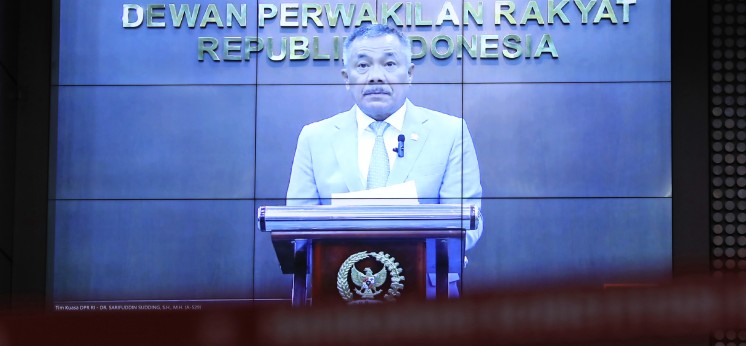
Member of the House of Representatives (DPR) Sarifuddin Sudding delivering his statement at the judicial review hearing of Law No. 37 of 2004 on Bankruptcy and Suspension of Debt Payment Obligations, Tuesday (11/11) in the Courtroom of the Constitutional Court. Photo by MKRI/Ifa.
JAKARTA (MKRI) — The Constitutional Court (MK) convened another judicial review hearing of Law No. 37 of 2004 on Bankruptcy and Suspension of Debt Payment Obligations (the Bankruptcy Law) on Tuesday, November 11, 2025. Case No. 181/PUU-XXIII/2025, filed by Sandi Ebenezer Situngkir, challenges the constitutionality of the Explanatory Section of Article 292 concerning the timeframe marking the commencement of insolvency status.
At the hearing, which heard statements from the House of Representatives (DPR) and the Government, the DPR, represented by Member of Commission III Sarifuddin Sudding, clarified that insolvency status under the Bankruptcy Law arises from two scenarios related to the possibility of reaching a settlement (composition).
The first scenario concerns a settlement proposed after a debtor is declared bankrupt, as regulated in Article 178 of the Bankruptcy Law. In this context, insolvency may occur automatically without requiring a court ruling when no settlement proposal is submitted, the proposal is rejected, or the court refuses to homologate it, with the decision having obtained permanent legal force.
“In certain circumstances, insolvency status may arise instantaneously, for example, when a settlement proposal is not submitted, is rejected, or fails to obtain homologation from the court,” Sarifuddin conveyed before the panel of constitutional justices.
He added that in the context of Suspension of Debt Payment Obligations (PKPU) as regulated in Article 292, a debtor may be declared bankrupt by court ruling if the proposed settlement is rejected or annulled under Articles 285, 286, or 291. In such circumstances, all avenues for settlement are closed, and the debtor is deemed to have immediately entered insolvency status.
Meanwhile, the Government, represented by Sucipto, emphasized that bankruptcy arising from PKPU proceedings bears a distinct legal character from ordinary bankruptcy. PKPU is a preventive restructuring mechanism, allowing debtors an opportunity to prepare a settlement plan under Article 222 of the Bankruptcy Law and PKPU. Throughout the PKPU process, the debtor is not yet in a state of insolvency, as negotiations toward settlement remain possible.
“The phrase ‘immediately enters into insolvency’ in the Explanatory Section of Article 292 is a logical consequence of the finality of the PKPU process,” Sucipto stated. Once all opportunities for settlement are foreclosed through judicial rejection or annulment, insolvency is deemed to occur at the moment the bankruptcy ruling is delivered.
According to the Government, interpreting “immediately” as “instantaneously” is the only reading consistent with the bankruptcy system and the legislative intent. Such an interpretation ensures legal certainty and prevents disharmony between Article 178 and Article 292 of the Bankruptcy Law.
Furthermore, the Government asserted that clarity on the exact moment insolvency begins is essential for ensuring orderly implementation of the powers of curators, the execution rights of secured creditors, and subsequent liquidation stages. Therefore, the Explanatory Section of Article 292 is not considered to create legal uncertainty nor to contravene Article 28D(1) of the 1945 Constitution.
Also read:
Petitioner Adds New Legal Arguments and Co-Petitioner in Bankruptcy Law Review Hearing
Petitioner Questions Lack of Defined Insolvency Threshold in Bankruptcy Law
Earlier, the Petitioner argued that the Explanatory Section of Article 292 creates legal uncertainty, as it stipulates that a debtor’s bankrupt estate “immediately enters insolvency” without clarifying when such status begins. This lack of clarity, the Petitioner claimed, is inconsistent with Article 178, which explicitly identifies three conditions that give rise to insolvency: the absence of a settlement plan, rejection of the plan, or judicial refusal to confirm the settlement.
The Petitioners argued that this ambiguity affects certainty for curators and creditors in determining the timeframe for liquidation. The phrase “when no settlement can be proposed” in Article 292 results in the debtor being deemed insolvent immediately, but the provision fails to specify the precise point in time when this occurs.
According to the Petitioners, this ambiguity creates interpretive divergence and potential constitutional harm, particularly for curators who must determine liquidation deadlines and for secured creditors whose execution rights are governed under Articles 55(1) and 159(1) of the Bankruptcy Law.
The Petitioners presented an example involving PT Bank Mandiri Tbk, a secured creditor that auctioned collateral immediately after the debtor was declared bankrupt, whereas the creditors’ meeting only confirmed the insolvency status several days later. Such situations, they argued, reveal legal inconsistencies detrimental to various parties.
The Petitioners also highlighted that Chief Justice of the Supreme Court Decree No. 109/KMA/SK/IV/2020 on Guidelines for Bankruptcy and PKPU Case Settlement does not clearly regulate the determination of when insolvency begins under Article 292. Consequently, many judges and practitioners treat Articles 178 and 292 as interchangeable, despite their fundamental distinction.
Author: Utami Argawati
Editor: Lulu Anjarsari P.
PR: Andhini S.F.
Translator: Yuanna Sisilia
Disclaimer: The original version of the news is in Indonesian. In case of any differences between the English and the Indonesian versions, the Indonesian version will prevail.
Tuesday, November 11, 2025 | 14:52 WIB 227