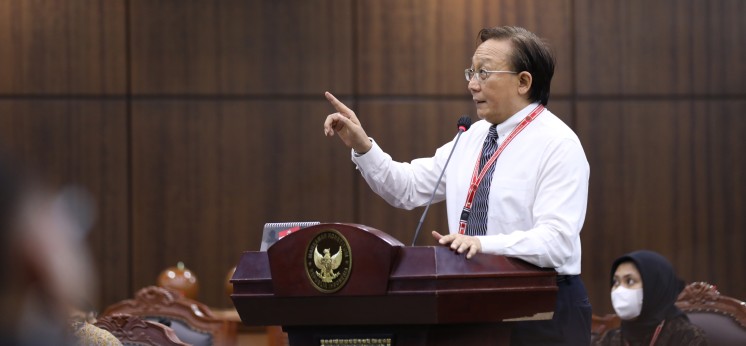
Government’s expert, Steven Tanner, delivering his testimony during the resumed material judicial review hearing of Law No. 4 of 2023 on the Development and Strengthening of Financial Sectors, Monday (15/12) at the Plenary Courtroom. Photo by MKRI/Ifa.
Jakarta (MKRI) – The Constitutional Court (MK) resumed the material judicial review hearing of Article 161 paragraph (2) and Article 164 paragraph (2) of Law No. 4 of 2023 on the Development and Strengthening of Financial Sectors (P2SK Law). The joint hearing of Cases No. 139/PUU-XXIII/2025 and No. 164/PUU-XXIII/2025 was held in the Plenary Courtroom on Monday, December 15, 2025, to hear testimony from the government’s expert.
Steven Tanner, an actuary, presented by the government at the hearing, explained the pension system in Indonesia in the context of international practice.
Steven said that pension systems in various countries generally refer to the recommendations of the World Bank and the International Labor Organization (ILO), which divide pension systems into several pillars, consisting of mandatory and voluntary pillars. According to him, Indonesia also implements a similar system, where the issue in question, in this case, relates to the third pillar, which is voluntary. “Indonesia also implements this. What we are highlighting in this case is the third pillar, which is voluntary,” he said.
He explained that severance pay is a mandatory payment given to workers when their employment ends, generally for reasons beyond the worker's control. The amount of severance pay is usually calculated based on length of service and salary, with the aim of providing financial protection for workers and their families during the transition period while they search for new jobs.
However, Steven highlighted the low level of compliance among employers in Indonesia in paying severance pay. According to World Bank calculations, only about 27.6 percent of eligible workers ultimately receive severance pay. Of that number, only 16.7 percent receive full severance pay. This means that of all workers who experience termination of employment, only about 0.5 percent receive full severance pay in accordance with the provisions of the law.
Furthermore, in his written statement, Steven explains that regulations governing labor and pension funds have long anticipated the risk of double payments between pension benefits and severance pay. This is regulated, among others, in Article 29 of Government Regulation No. 3 of 1996, Article 31 of Minister of Manpower Decree No. 150 of 2000, and Article 32A of Minister of Manpower Decree No. 78 of 2001. These provisions stipulate that pension benefits obtained from the Employer Pension Fund (DPPK) or Financial Institution Pension Fund (DPLK) can be compensated by the company's severance pay obligations. This regulation was subsequently maintained in Article 167 of Law No. 13 of 2003 concerning Manpower and Article 58 of Government Regulation No. 35 of 2021.
Steven emphasized that even though the pension program is voluntary, workers who have become participants are still bound by the applicable pension fund provisions. He also stressed the importance of a clear agreement on the mechanism for paying pension benefits, including deferral of payment before a certain age, periodic payment of benefits, and calculation of the present value of pension benefits for comparison with severance pay obligations.
According to him, failure to reach an agreement could have serious consequences, including reduced interest among companies in establishing or maintaining pension fund programs, low certainty of severance pay, and stunted growth of the national pension fund industry.
“Here we provide some illustrations of people saving for 35 years. Let's say that on average we can simulate longer or shorter savings periods with varying wages. If he saves at a bank, he only gets 9.6, but if he saves in a pension fund, he gets 100 million,” Steven said.
Also read:
Workers Challenge P2SK Law, Demand Right to Lump-Sum Pension Disbursement
Workers Revise Petition on the Pension Fund Disbursement in P2SK Law
House Explains Periodic Pension Benefit Payments
Govt: Periodic Pension Payments for Maintaining Sustainable Income
Expert: Periodical Pension Payment Harms Workers
Case No. 164/PUU-XXIII/2025 was filed by eight workers and retirees, including Lukas Saleo, Warjito, and Haeruddin Fallah, who are employees of PT Freeport Indonesia, current and former employees of PT Kuala Pelabuhan Indonesia, and employees of PT Unilever Indonesia. They are challenging provisions on pension benefit payments in Article 161 paragraph (2), Article 164 paragraph (1) letter d, and Article 164 paragraph (2) of the P2SK Law.
The Petitioners argued that the harm they suffered is real, specific, and potentially ongoing. Petitioners I–VI and VIII, who are still employed, could be disadvantaged because they cannot receive their pension benefits in a lump sum upon retirement. Meanwhile, Petitioner VII, who retired on December 1, 2024, has already suffered harm for not receiving their lump-sum pension benefits.
At the preliminary hearing on Wednesday, September 24, counsel Zen Mutowali emphasized that there is a fundamental difference between the mandatory public pension program and privately managed pension funds, which are meant to complement the public scheme. He argued that current regulations unfairly limit private pension participants’ right to receive their retirement benefits as a lump sum payment.
“The contested provisions have identical substance and result in constitutional losses or potential losses because the Petitioners are deprived of the right to receive pension benefits in a lump sum, although these benefits are complementary and voluntary from the outset of participation, and therefore constitute private property that cannot be diminished by the State,” he said in court.
The Petitioners also argued that Article 164 paragraph (1) letter d and Article 164 paragraph (2) of the P2SK Law, which restrict pension disbursement to a maximum of 20 percent as a lump sum, contravene the constitutional principles protecting citizens’ rights under the 1945 Constitution.
Accordingly, the Petitioners requested the Court to declare the phrase “must be paid periodically” in Article 161 paragraph (2) of the P2SK Law unconstitutional and non-binding, unless interpreted to mean, “The payment of Pension Benefits for Participants, Widows/Widowers, or children in private, complementary pension programs may be made periodically or in a lump-sum based on the choice of the Participant, Widow/Widower, or children.”
Also read:
Freeport Employees Challenge Periodic Pension Benefit Payments
Freeport Employees Demand Pension Benefits to Be Paid Once in Full
Judicial Review of P2SK Law Postponed as Parliament and President Not Ready to Testify
Government Explains 20 Percent Cap on First Pension Payment
Manpower Ministry: Severance Pay or Pension Must Be Paid in a Lump Sum
Expert Questions Guarantee of Pensioners’ Rights for Pension in Installments
Petition No. 139/PUU-XXIII/2025 was filed by several employees of PT Freeport Indonesia. PT Freeport Indonesia enrolled the Petitioners in the Freeport Indonesia Pension Fund Program, with all contributions paid in full by company as employer. Under PT Freeport Indonesia’s applicable regulations, the Petitioners are no longer entitled to severance pay or long service awards upon termination of employment due to retirement if the total pension fund contributions and their investment gains—borne by the company—exceed the amount of calculated severance and long service compensation.
The Petitioners requested the Court to declare Article 161 paragraph (2) of Law No. 4 of 2023, which reads, “Payment of pension benefits to participants, widows/widowers, or children shall be made periodically,” and Article 164 paragraph (2), which reads, “Pension fund regulations may contain provisions allowing an initial lump-sum pension payment of up to 20% (twenty percent) of the pension benefits” unconstitutional and not legally binding. They argued that the enforcement of the articles has harmed their constitutional rights to just legal certainty and to a proper livelihood, as well as to just and adequate payment, thus contrary to Article 28D paragraph (1) of the 1945 Constitution.
Therefore, in their petitums, the Petitioners requested the Constitutional Court to reinterpret the two challenged provisions. They asked that Article 161 paragraph (2) of Law No. 4 of 2023 be read as: “Pension benefit payments for participants, surviving spouses, or children may be made periodically; however, if the participant chooses a lump‑sum payment, it must be paid in full.” Meanwhile, they proposed that Article 164 paragraph (2) be reinterpreted as: “Pension Fund Regulations may contain provisions allowing the option for pension benefits to be paid in a single lump sum of 100 percent of the total benefits.” (*)
Author : Mimi Kartika
Editor : Lulu Anjarsari P.
PR : Raisa Ayuditha M.
Translators : Rizky Kurnia Chaesario, Yuniar Widiastuti
Disclaimer: The original version of the news is in Indonesian. In case of any differences between the English and the Indonesian versions, the Indonesian version will prevail.
Monday, December 15, 2025 | 15:40 WIB 217