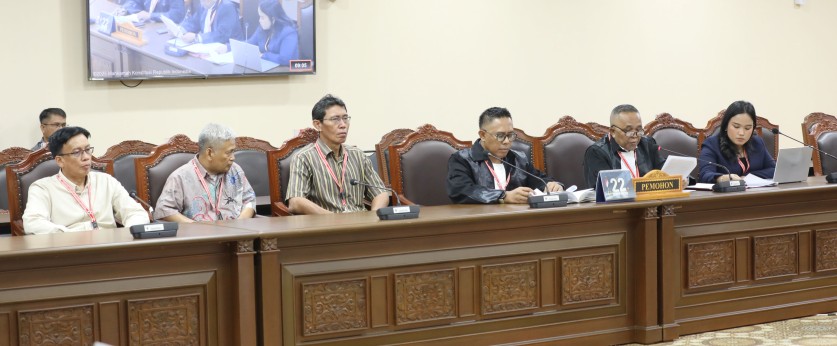
Legal counsel Harris Manalu and Petitioners of the judicial review of Law No. 4 of 2023 on the Development and Strengthening of the Financial Sector (P2SK Law) delivering the subject matter of the petition at the Panel Courtroom, Friday (22/8). Photo by MKRI/Panji.
Jakarta (MKRI) - Three employees of PT Freeport Indonesia—Alfonsius Londoran, Nurman, and Abdul Rahman—filed a material judicial review of Article 161 paragraph (2) and Article 164 paragraph (2) of Law No. 4 of 2023 on the Development and Strengthening of the Financial Sector (P2SK Law) against the 1945 Constitution of the Republic of Indonesia to the Constitutional Court (MK). The Petitioners questioned the provisions mandating periodic pension benefit payments for participants as well as a cap of 20 percent on lump-sum initial pension payments.
“The applicants face potential losses that, according to reasonable reasoning, are certain to occur when they reach retirement age in 2026 or 2027. They cannot accept receiving their entire pension benefits as a lump sum,” the petitioners’ legal counsel, Harris Manalu, stated during the preliminary hearing of Case No. 139/PUU-XXIII/2025 on Friday, August 22, 2025.
Article 161 paragraph (2) of P2SK Law states, “Payment of pension benefits to participants, widows/widowers, or children must be made periodically.” Article 164 paragraph (2) adds, “Pension fund regulations may contain provisions allowing an initial lump-sum pension payment of up to 20 percent of the pension benefits.”
PT Freeport Indonesia includes the Petitioners in the Freeport Indonesia Pension Fund program, with all contributions borne by the company as the employer. Under the terms applied by PT Freeport Indonesia, the Petitioners are not entitled to severance pay or long-service awards upon termination due to retirement if the total pension contributions and investment returns paid by the company exceed the severance and long-service pay calculations.
As a consequence of Articles 161 paragraph (2) and 164 paragraph (2) of P2SK Law, the petitioners can no longer receive full 100 percent pension benefits or severance payments accumulated during their employment when terminated due to retirement in the future. The petitioners argued that pension benefit payments should not be restricted because participation in the pension program is voluntary, not mandatory.
Since participation in the pension program is voluntary—meaning individuals may choose whether or not to join—the petitioners argued that, based on legal logic aimed at rational and consistent interpretation and application, the pension fund payment regulations at Freeport Indonesia should not limit or mandate periodic pension payments to participants, widows/widowers, or children. Likewise, there should be no cap limiting the initial lump-sum pension payment to 20 percent of total benefits.
Therefore, the petitioners’ petitioned the Court to declare that Article 161 paragraph (2) of P2SK Law is unconstitutional and lacks binding legal force unless interpreted as: “Payment of pension benefits to participants, widows/widowers, or children may be made periodically, but if participants opt for lump-sum payments, the payment must be made in full.” The petitioners also requested the Court to declare Article 164 paragraph (2) unconstitutional and unenforceable unless interpreted as: “Pension fund regulations may include provisions allowing participants to choose to receive 100 percent of their pension benefits as a lump sum.”
The case was heard by a panel of justices led by Deputy Chief Justice Saldi Isra, accompanied by Justice Ridwan Mansyur and Justice Arsul Sani. The justices agreed that the petitioners must present arguments convincing the Court to overturn its previous decisions in the Court Decisions No. 155/PUU-XXII/2024 and 61/PUU-XXIII/2025, which involved the same legal provisions.
“Even if the provisions had been ruled on before, if they are still deemed unconstitutional, the Court must be convinced. This requires clarity beyond just the wording of the articles,” Justice Arsul said.
Before adjourning, Deputy Chief Justice Saldi informed the petitioners that they have 14 days to revise their petition. The revised petition, both soft and hard copies, must be submitted to the Court no later than Thursday, September 4, 2025, at 12.00 local time.
Author: Mimi Kartika
Editor: Lulu Anjarsari P.
PR: Raisa Ayuditha M.
Translator: Rizky Kurnia Chaesario
Disclaimer: The original version of the news is in Indonesian. In case of any differences between the English and the Indonesian versions, the Indonesian version will prevail.
Friday, August 22, 2025 | 13:01 WIB 311