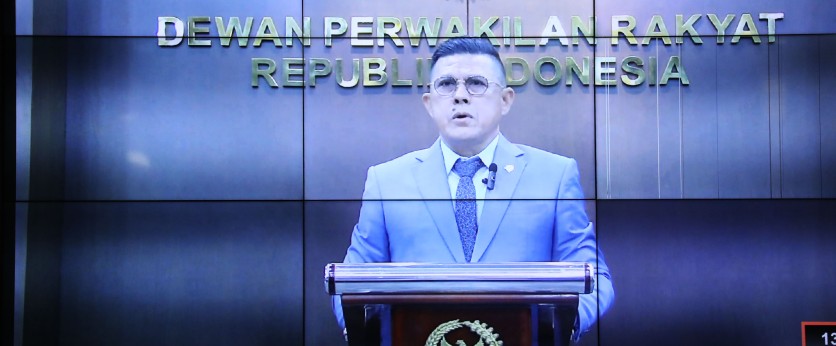
Commission III Member of the House of Representatives, Soedeson Tandra, delivering the House’s statement during the judicial review hearing of Law No. 4 of 2023 on the Development and Strengthening of the Financial Sector, Wednesday (22/10). Photo by MKRI/Panji.
JAKARTA (MKRI) – The Constitutional Court (MK) continued hearings on the judicial review of Law No. 4 of 2023 on the Development and Strengthening of the Financial Sector (P2SK Law) against the 1945 Constitution, on Wednesday, October 22, 2025. The plenary hearing, chaired by Chief Justice Suhartoyo and attended by eight constitutional justices, heard the statement of the House of Representatives (DPR) on Case No. 164/PUU-XXIII/2025.
Representing the DPR, Commission III Member, Soedeson Tandra, delivered the House’s explanation regarding the mechanism for periodic pension benefit payments under the national pension system. Soedeson explained that the periodic payment scheme serves as a fair and balanced form of social and legal protection. “This mechanism aligns with the objectives of the pension system, namely to ensure pension benefits that are adequate, affordable, sustainable, and resilient to economic fluctuations,” Soedeson stated.
He added that through regular and long-term income, periodic pension payments provide certainty so participants can meet their post-retirement living needs without facing income losses.
Nevertheless, Soedeson emphasized that lump‑sum pension payments remain permissible for certain participants or categories as determined by the Financial Services Authority (OJK). He explained that this rule balances flexibility with prudential principles in pension fund management.
“If all pension benefits were paid out at once without restriction, the core function of pensions as a social protection instrument could be undermined and even cause future risks of misuse and economic vulnerability,” he noted.
Therefore, the limitations on lump‑sum payments are intended as a legal protection and an expression of the prudential principle in pension fund management aimed at protecting participants’ interests.
Responding to the petitioners’ claim that the P2SK Law restricts pension benefit payments, the DPR declared that pension regulations in Indonesia have evolved in line with developments in the national financial system. Since the enactment of Law No. 11 of 1992, the pension system has recognized two primary institutional forms: Employer Pension Funds and Financial Institution Pension Funds.
He also explained that the existence of the voluntary pension fund program essentially serves as a long‑term savings instrument provided by the state as an alternative for workers and employers. To help workers prepare for financial security in old age, participation in this program is voluntary, so it does not create any legal obligation for individuals or employers to take part. Through the voluntary pension fund program, the state provides flexibility for all parties to determine their level of participation according to their respective needs and financial capacity.
Also read:
Workers Challenge P2SK Law, Demand Right to Lump-Sum Pension Disbursement
Workers Revise Petition on the Pension Fund Disbursement in P2SK Law
Case No. 164/PUU-XXIII/2025 was filed by eight workers and retirees, including Lukas Saleo, Warjito, and Haeruddin Fallah. The petitioners include employees of PT Freeport Indonesia, current and former employees of PT Kuala Pelabuhan Indonesia, and employees of PT Unilever Indonesia. They are challenging provisions on pension benefit payments in Article 161 paragraph (2), Article 164 paragraph (1) letter d, and Article 164 paragraph (2) of the P2SK Law.
According to the petition, the harm suffered by the applicants is real, specific, and potentially ongoing. Petitioners I–VI and VIII, who are still employed, could be disadvantaged because they cannot receive their pension benefits in a lump sum upon retirement. Meanwhile, Petitioner VII, who retired on December 1, 2024, has already suffered harm for not receiving their lump-sum pension entitlement.
During the first hearing on Wednesday, September 24, 2025, the petitioners’ counsel, Zen Mutowali, emphasized that there is a fundamental difference between the mandatory public pension program and privately managed pension funds, which are meant to complement the public scheme. He argued that current regulations unfairly limit private pension participants’ right to receive their retirement benefits as a lump sum payment.
“The contested provisions have identical substance and result in constitutional losses or potential losses because the petitioners are deprived of the right to receive pension benefits in a lump sum, although these benefits are complementary and voluntary from the outset of participation, and therefore constitute private property that cannot be diminished by the state,” Zen stated in court.
The petitioners also argued that Article 164 paragraph (1) letter d and Article 164 paragraph (2) of the P2SK Law, which restrict pension disbursement to a maximum of 20 percent as a lump sum, contravene the constitutional principles protecting citizens’ rights under the 1945 Constitution.
Accordingly, the petitioners requested the Court to declare the phrase “must be paid periodically” in Article 161 paragraph (2) of the P2SK Law unconstitutional and non-binding, unless interpreted to mean, “The payment of Pension Benefits for Participants, Widows/Widowers, or children in private, complementary pension programs may be made periodically or in a lump-sum based on the choice of the Participant, Widow/Widower, or child.”
Author: Utami Argawati.
Editor: Nur R.
PR: Tiara Agustina
Translator: Rizky Kurnia Chaesario
Disclaimer: The original version of the news is in Indonesian. In case of any differences between the English and the Indonesian versions, the Indonesian version will prevail.
Wednesday, October 22, 2025 | 14:46 WIB 396