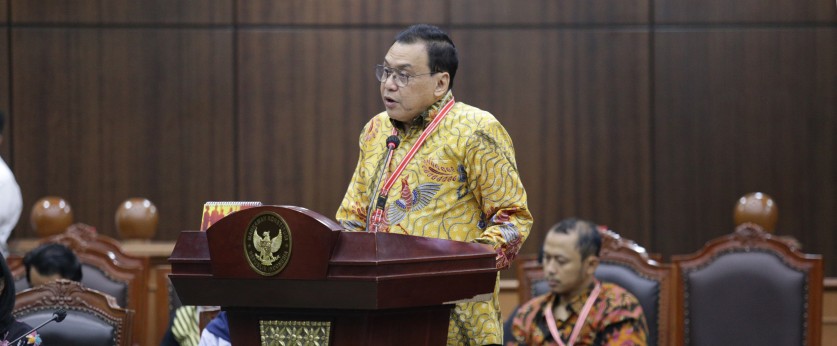
Finance Minister’s advisor on financial services and capital market Arief Wibisono delivering the Government’s testimony at a hearing on the Law on Financial Sector Development and Reinforcement, Tuesday (11/4/2025). Photo by MKRI/Bayu.
JAKARTA (MKRI) — The Constitutional Court (MK) held the fourth material judicial review of Law No. 4 of 2023 on Financial Sector Development and Reinforcement (P2SK Law) on Tuesday, November 4, 2025. The hearing for case No. 164/PUU-XXIII/2025 was presided over by Chief Justice Suhartoyo and the other constitutional justices.
This time, the Court heard the President (Government), whose testimony was delivered by the Finance Minister’s advisor on financial services and capital market Arief Wibisono. He said that the Petitioners did not suffer any constitutional harm as a result of the enforcement of Article 161 paragraph (2), Article 164 paragraph (1) letter d, and Article 164 paragraph (2) of the P2SK Law.
He explained that these provisions do not impede citizens’ constitutional rights, as participation in pension funds is voluntary, not mandatory. This is in accordance with Article 145 paragraph (1) of the P2SK Law, which stipulates that employees have the right—not obligated—to become participants in pension funds.
“There is no direct causal relationship between the alleged harm and the enforcement of the articles being reviewed, because the P2SK Law does not make participation in pension funds mandatory, but voluntary,” Arief stated before the justices.
Furthermore, the Government explained that the technical implementation of pension benefit payments is regulated in the Financial Services Authority Regulation (POJK) No. 27 of 2023 on the Operation of Pension Fund Businesses. Therefore, any objections regarding the procedure for payment of pension benefits should be directed at the implementing policy, not at the provisions of the law itself.
Sustainable Income
The Government also emphasized that the primary objective of the pension fund program is to ensure the continuity of participants’ income in old age, as a form of state social protection against economic risks in later life. The policy of paying pension benefits periodically is considered to be more consistent with the principles of a welfare state and with the mandate of Article 27 paragraph (2) of the 1945 Constitution.
“The periodic payment of pension benefits is not a restriction of rights, but rather a form of protection to ensure that participants continue to have a sustainable income after retirement,” Arief explained.
The Government further clarified that the limitation on the lump-sum payment of pension benefits to a maximum of 20 percent is a policy designed to balance the participants’ initial post-retirement needs with long-term protection. This provision is intended to maintain retirees’ economic stability and prevent the rapid depletion of their funds. Therefore, the Government contended that if the Petitioners’ request were granted, it would result in legal uncertainty and weaken the State’s responsibility to guarantee economic protection for workers after retirement.
Arief added that Indonesia’s pension system still faces challenges, as the average pension income amounts to only 10–15 percent of income earned during productive years, far below the International Labour Organization (ILO) standard of 40 percent. Hence, the periodic payment of pension benefits is considered essential to ensure the continuity of participants’ income.
Open Legal Policy
Furthermore, the Government stressed that the regulation of pension funds through the POJK is part of an open legal policy intended to strengthen the national financial sector. The mandate given to the Financial Services Authority (OJK) to regulate the implementation of pension funds allows for policy adjustments in line with developments in the financial services industry while safeguarding participants’ interests.
“This regulation constitutes a form of strengthening a national financial system that is resilient, inclusive, and sustainable, aimed at realizing a just and prosperous Indonesian society based on Pancasila and the 1945 Constitution,” he asserted.
Also read:
Workers Challenge P2SK Law, Demand Right to Lump-Sum Pension Disbursement
Workers Revise Petition on the Pension Fund Disbursement in P2SK Law
House Explains Periodic Pension Benefit Payments
Case No. 164/PUU-XXIII/2025 was filed by eight workers and retirees, including Lukas Saleo, Warjito, and Haeruddin Fallah, who are employees of PT Freeport Indonesia, current and former employees of PT Kuala Pelabuhan Indonesia, and employees of PT Unilever Indonesia. They are challenging provisions on pension benefit payments in Article 161 paragraph (2), Article 164 paragraph (1) letter d, and Article 164 paragraph (2) of the P2SK Law.
The Petitioners argued that the harm they suffered is real, specific, and potentially ongoing. Petitioners I–VI and VIII, who are still employed, could be disadvantaged because they cannot receive their pension benefits in a lump sum upon retirement. Meanwhile, Petitioner VII, who retired on December 1, 2024, has already suffered harm for not receiving their lump-sum pension benefits.
At the preliminary hearing on Wednesday, September 24, counsel Zen Mutowali emphasized that there is a fundamental difference between the mandatory public pension program and privately managed pension funds, which are meant to complement the public scheme. He argued that current regulations unfairly limit private pension participants’ right to receive their retirement benefits as a lump sum payment.
“The contested provisions have identical substance and result in constitutional losses or potential losses because the Petitioners are deprived of the right to receive pension benefits in a lump sum, although these benefits are complementary and voluntary from the outset of participation, and therefore constitute private property that cannot be diminished by the State,” he said in court.
The Petitioners also argued that Article 164 paragraph (1) letter d and Article 164 paragraph (2) of the P2SK Law, which restrict pension disbursement to a maximum of 20 percent as a lump sum, contravene the constitutional principles protecting citizens’ rights under the 1945 Constitution.
Accordingly, the Petitioners requested the Court to declare the phrase “must be paid periodically” in Article 161 paragraph (2) of the P2SK Law unconstitutional and non-binding, unless interpreted to mean, “The payment of Pension Benefits for Participants, Widows/Widowers, or children in private, complementary pension programs may be made periodically or in a lump-sum based on the choice of the Participant, Widow/Widower, or children.”
Author : Utami Argawati
Editor : Nur R.
PR : Fauzan F.
Translators : Yuniar Widiastuti, Rizky Kurnia C. (NL)
Disclaimer: The original version of the news is in Indonesian. In case of any differences between the English and the Indonesian versions, the Indonesian version will prevail.
Tuesday, November 04, 2025 | 12:28 WIB 1646