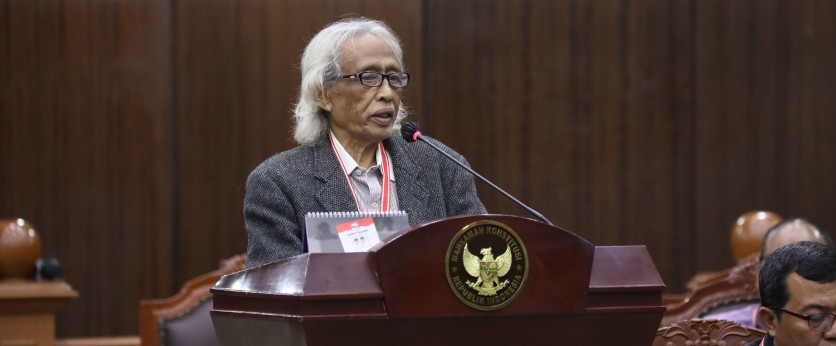
Petitioners’ expert, Hasbullah Thabrani, delivering his testimony on the judicial review of P2SK Law at the Plenary Courtroom on Monday (1/12). Photo by MKRI/Panji.
Jakarta (MKRI) – The Constitutional Court (MK) resumed the material judicial review of Article 161 paragraph (2) and Article 164 paragraph (2) of Law No. 4 of 2023 on the Development and Strengthening of Financial Sectors (P2SK Law). The hearing combining Cases No. 139/PUU-XXIII/2025 and No. 164/PUU-XXIII/2025 was held on Monday, December 1, 2025, in the Plenary Courtroom.
The agenda was to hear testimony from the Petitioners’ experts in Case No. 164/PUU-XXIII/2025: Toto Tohir Suriaatmadja, a professor of law at Universitas Islam Bandung (Unisba), and Hasbullah Thabrany, a senior researcher at the Social Security Study Center of Universitas Indonesia. Toto explained that pension funds are private or civil-law entities, not state entities. He asserted that the pension fund's task is to manage participants' contributions, both personal and employer contributions, without using government funds.
“So it's purely private, there's no government money involved. It's different from those managed by the state,” he said.
Toto added that the contributions belong entirely to the participants and are managed to provide additional benefits during retirement. The pension fund's authority ends when participants enter retirement, and all accumulated funds, including profits, become the participants' rights.
Meanwhile, Hasbullah Thabrany said that the provisions on Pension Funds in Chapter XII of Law No. 4 of 2023 tend to continue those in Law No. 11/1992 without taking into account the amendments to the 1945 Constitution related to Social Security. He considered these provisions to be “overregulated” and no longer necessary because there is already a Pension Security program with guaranteed benefits through the Employment Social Security Agency (BPJS Ketenagakerjaan).
“In my opinion, this is overregulated and no longer needs to be provided periodically because there is already a defined benefit pension program within the Employment Social Security Agency (BPJS Ketenagakerjaan),” he said.
According to Hasbullah, the Pension Fund in the P2SK Law is not a pension guarantee as referred to in the 1945 Constitution, but rather a private pension scheme that is business-oriented and voluntary, and therefore does not aim to fulfill the constitutional rights of workers. He believes that the provision requiring periodic pension benefit payments could be detrimental to workers, because participants' ownership rights should be managed independently according to their needs.
Hasbullah also reminded that Article 28H paragraph (1) and Article 34, paragraph (2), of the 1945 Constitution emphasize the state's obligation to provide periodic pension benefits to meet the basic needs of workers throughout their lives.
Thus, he assessed that the provisions of Article 161 paragraph (2) of Law No. 4 of 2023, which requires the provision of periodic pension benefits, do not have a strong basis for protection and, in fact, violate the rights of participants in managing their ownership rights. Therefore, he concluded that this article should be declared contrary to the 1945 Constitution.
Also read:
Workers Challenge P2SK Law, Demand Right to Lump-Sum Pension Disbursement
Workers Revise Petition on the Pension Fund Disbursement in P2SK Law
House Explains Periodic Pension Benefit Payments
Govt: Periodic Pension Payments for Maintaining Sustainable Income
Case No. 164/PUU-XXIII/2025 was filed by eight workers and retirees, including Lukas Saleo, Warjito, and Haeruddin Fallah, who are employees of PT Freeport Indonesia, current and former employees of PT Kuala Pelabuhan Indonesia, and employees of PT Unilever Indonesia. They are challenging provisions on pension benefit payments in Article 161 paragraph (2), Article 164 paragraph (1) letter d, and Article 164 paragraph (2) of the P2SK Law.
The Petitioners argued that the harm they suffered is real, specific, and potentially ongoing. Petitioners I–VI and VIII, who are still employed, could be disadvantaged because they cannot receive their pension benefits in a lump sum upon retirement. Meanwhile, Petitioner VII, who retired on December 1, 2024, has already suffered harm for not receiving their lump-sum pension benefits.
At the preliminary hearing on Wednesday, September 24, counsel Zen Mutowali emphasized that there is a fundamental difference between the mandatory public pension program and privately managed pension funds, which are meant to complement the public scheme. He argued that current regulations unfairly limit private pension participants’ right to receive their retirement benefits as a lump sum payment.
“The contested provisions have identical substance and result in constitutional losses or potential losses because the Petitioners are deprived of the right to receive pension benefits in a lump sum, although these benefits are complementary and voluntary from the outset of participation, and therefore constitute private property that cannot be diminished by the State,” he said in court.
The Petitioners also argued that Article 164 paragraph (1) letter d and Article 164 paragraph (2) of the P2SK Law, which restrict pension disbursement to a maximum of 20 percent as a lump sum, contravene the constitutional principles protecting citizens’ rights under the 1945 Constitution.
Accordingly, the Petitioners requested the Court to declare the phrase “must be paid periodically” in Article 161 paragraph (2) of the P2SK Law unconstitutional and non-binding, unless interpreted to mean, “The payment of Pension Benefits for Participants, Widows/Widowers, or children in private, complementary pension programs may be made periodically or in a lump-sum based on the choice of the Participant, Widow/Widower, or children.”
Case tracking
Author : Utami Argawati
Editor : Nur R.
PR : Fauzan F.
Translators : Rizky Kurnia Chaesario, Yuniar Widiastuti
Disclaimer: The original version of the news is in Indonesian. In case of any differences between the English and the Indonesian versions, the Indonesian version will prevail.
Monday, December 01, 2025 | 15:21 WIB 190