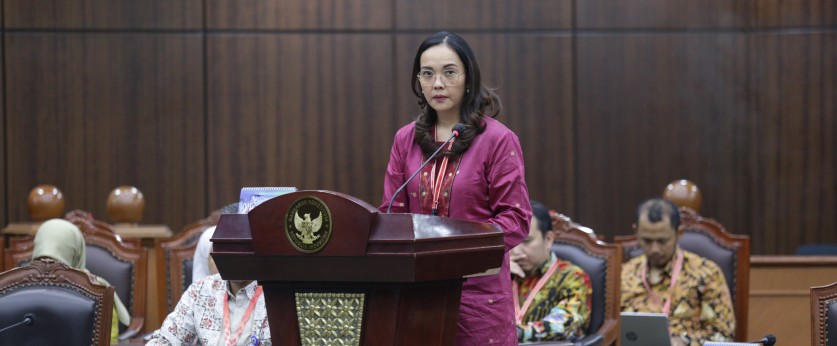
The government testimony on Case No. 139/PUU-XXIII/2025 on the material judicial review of Law No. 4 of 2023 on the Development and Strengthening of the Financial Sector, Wednesday (8/10).
Jakarta (MKRI) – The Constitutional Court (MK) resumed hearings on the judicial review of Article 161 paragraph (2) and Article 164 paragraph (2) of Law No. 4 of 2023 on the Development and Strengthening of the Financial Sector (P2SK Law), scheduled to hear statements from the House of Representatives (DPR) and the President on Wednesday, October 8, 2025. Representing the President, Masyita Crystallin, Director General of Financial Sector Stability and Development at the Ministry of Finance, explained that the government’s policy capping the initial lump-sum pension payment at 20 percent is intended to protect the long-term welfare of pension recipients.
“If one-time pension benefit payments (lump sum) were allowed, there is a risk that the funds would be exhausted rapidly, leaving individuals who should be receiving a steady monthly income without a sufficient source of retirement income, and unable to meet their basic daily needs,” Masyita said in the Constitutional Court Plenary Room, Jakarta.
She added that restricting the first lump-sum pension payment to a maximum of 20 percent strikes a balance between the need for large immediate funds at the start of retirement and the need to protect pension participants from losing their entire pension savings quickly. It also aims to reduce legal uncertainty regarding the value or amount of pension benefits that participants are entitled to receive.
This approach aligns with the Constitutional Court’s legal consideration in Decision No. 152/PUU-XXII/2024, which found that periodic pension payments help guarantee continuity of income for recipients. According to Masyita, this differs from the petitioners’ view, who want lump-sum pension payments to be used as business capital or “fresh money” to start ventures.
She emphasized that periodic pension payments under the P2SK Law are a means by which the state fulfills its responsibilities as a welfare state, as mandated by the 1945 Constitution. It is designed to ensure retirees continue to enjoy decent livelihoods. “This is in accordance with Article 27 paragraph (2) of the 1945 Constitution: ‘Every citizen has the right to work and to a decent living for humanity,’” Masyita said.
Pension Funds Are Voluntary
Masyita emphasized that both Law No. 11 of 1992 on Pension Funds and the P2SK Law state that the formation of pension funds and participation in pension fund programs are voluntary, not mandatory. Private sector employees’ participation in employer pension funds (DPPK) or financial institution pension funds (DPLK) is optional.
“This is confirmed by Article 145 paragraphs (1) and (2) of the P2SK Law,” she said.
She also explained that the regulation of severance pay and long-service awards is governed by Government Regulation No. 35 of 2021, not by the P2SK Law. Therefore, the petitioners’ arguments are not constitutional issues subject to review. According to her, the claim that pension funds serve as replacements for severance pay and long-service awards—and thus disqualify petitioners from receiving these payments under Article 52 paragraph (3) of the 2024–2026 Collective Labor Agreement between PT Freeport Indonesia and the workers’ union—actually raises concerns with norms established in PP 35/2021.
Meanwhile, the petitioners—employees of PT Freeport Indonesia including Alfonsius Londoran, Nurman, Abdul Rahman, and Munir Tjaya—argued that the requirement for pension benefits to be paid periodically and the regulation limiting the initial lump-sum payment to 20 percent of their pension entitlement infringed upon their constitutional rights. In their petition, they stated that as a result of Article 161 paragraph (2) and Article 164 paragraph (2) of the P2SK Law, they could no longer enjoy the full 100 percent of their accumulated pension benefits, severance pay, or long-service awards when their employment ends due to retirement. The petitioners stressed that pension benefits should not be restricted, as their pension program is voluntary rather than mandatory.
Given the voluntary nature of their pension arrangement—meaning employees may choose whether to participate—the petitioners contended that, based on rational and consistent legal reasoning, rules for the Freeport Indonesia pension fund should not restrict or require periodic payments to participants, or to spouses and children. Nor should there be a cap on the initial lump-sum payment to only 20 percent of the total pension benefits.
Also read:
Freeport Employees Challenge Periodic Pension Benefit Payments
Freeport Employees Demand Pension Benefits to Be Paid Once in Full
Judicial Review of P2SK Law Postponed as Parliament and President Not Ready to Testify
PT Freeport Indonesia includes the Petitioners in the Freeport Indonesia Pension Fund program, with all contributions borne by the company as the employer. Under the terms applied by PT Freeport Indonesia, the Petitioners are not entitled to severance pay or long-service awards upon termination due to retirement if the total pension contributions and investment returns paid by the company exceed the severance and long-service pay calculations.
To accommodate their wishes, the Petitioners requested the Court to declare Article 161 paragraph (2) of Law No. 4 of 2023, which reads, “Payment of pension benefits to participants, widows/widowers, or children must be made periodically,” and Article 164 paragraph (2) of Law No. 4 of 2023, which reads, “Pension fund regulations may contain provisions allowing an initial lump-sum pension payment of up to 20 percent of the pension benefits” contrary to the 1945 Constitution of the Republic of Indonesia and have no legally binding force. The enactment of the articles was considered to harm the constitutional rights of the petitioners to have just legal certainty and the right to a proper livelihood, and just and adequate payment. Therefore, the articles were deemed contrary to Article 28D paragraph (1) of the 1945 Constitution of the Republic of Indonesia.
In their petitum, the Petitioners requested the Court to provide a new interpretation of the two articles being tested, namely Article 161 paragraph (2) of Law No. 4 of 2023 to read, “Payment of pension benefits to participants, widows/widowers, or children may be made periodically, but if participants opt for lump-sum payments, the payment must be made in full.”. Meanwhile, Article 164, paragraph (2) of Law No. 4 of 2023 was requested to be interpreted as “Pension fund regulations may include provisions allowing participants to choose to receive 100 percent of their pension benefits as a lump sum.”
Author: Mimi Kartika
Editor: Lulu Anjarsari P.
PR: Raisa Ayuditha M.
Translator: Rizky Kurnia Chaesario
Disclaimer: The original version of the news is in Indonesian. In case of any differences between the English and the Indonesian versions, the Indonesian version will prevail.
Wednesday, October 08, 2025 | 15:30 WIB 1329