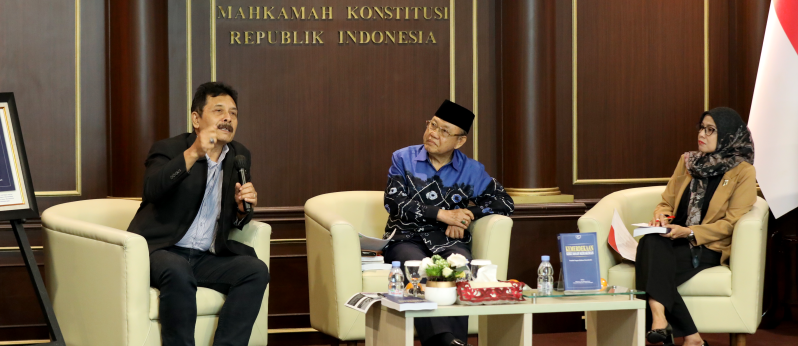
I Dewa Gede Palguna and Wahiduddin Adams as source persons, with Ana Triningsih moderating the Constitutional Literacy Discussion "Judicial Independence: The Foundation of a Democratic Rule of Law." Photo by MKRI/Fauzan.
JAKARTA (MKRI) – Chair of the Honorary Ethic Council of the Constitutional Court (MKMK) I Dewa Gede Palguna and Constitutional Justice for the 2014–2024 term Wahiduddin Adams served as source persons at the 13th series of the Constitutional Literacy Discussion (Diksi), held by the Constitutional Court (MK) both in person and online on Thursday, June 25, 2026. This edition of Diksi discussed the book Judicial Independence, which was published specifically to commemorate the 70th anniversary of Jimly Asshiddiqie.
In his presentation, I Dewa Gede Palguna explained that judicial independence generally requires structural independence and functional independence. In the book, Jimly argues that judicial independence must also be supported by personal independence.
“When discussing judicial independence, as Prof. Jimly outlines in this book, we typically refer to two forms: structural independence and functional independence. These are the standard concepts, yet he introduces a third: personal independence. So, while an institution may be structurally independent, meaning it is no longer under a ministry, for instance, as is the case in Indonesia, and functionally independent as well, Prof. Jimly argues that this is insufficient; it must be supported by that third element: personal independence,” Palguna explained to the audience.
Palguna further stated that when Indonesia gained independence, the Preamble to the 1945 Constitution envisioned the establishment of a constitutional democratic state, as reflected in the fourth paragraph of the Preamble. "The key point is that Indonesia's national independence was to be organized under a Constitution establishing a sovereign Republic based on the sovereignty of the people. Therefore, our goal is to establish a republican state founded upon popular sovereignty," Palguna said.
According to him, there can be no sovereignty without democracy. However, democracy must be safeguarded by the rule of law, which requires constitutional supremacy. "For constitutional supremacy to become a reality rather than merely an aspiration, there must be an institution entrusted with safeguarding it. That is why the Constitutional Court was established," Palguna stated.
Palguna cited the example of the Federal Republic of Germany, where safeguarding the Constitution requires the commitment of all stakeholders. In 2024, legislators and members of the executive branch agreed to enact two new laws aimed at strengthening Germany's Federal Constitutional Court. Although Germany's Constitutional Court is widely regarded as one of the world's leading constitutional courts and serves as a model for constitutional courts globally, lawmakers remained concerned that its authority could be weakened by the legislative and executive branches themselves. "German politicians, as recently as October 2024, still considered it necessary to strengthen the Constitutional Court. Why? The Minister of the Domestic Affairs explained that they had observed developments in several Eastern European countries where Constitutional Courts had gradually been weakened, and they wanted to prevent that from happening in Germany," Palguna said.
At the same time, Palguna noted that Indonesia's lawmakers were close to passing amendments to the Constitutional Court Law that, in his view, would instead weaken the Court. "The amendment concerns only one provision, Article 23A. Once again, the focus is solely on the tenure of constitutional justices," Palguna remarked. According to him, such a proposal constitutes a form of court packing, namely altering the composition of constitutional justices. He argued that this represents a far more dangerous threat to democracy. He also referred to the concept of court curbing, which involves changing the rules governing the judiciary by restricting its authority, reducing its budget, or limiting its jurisdiction.
In addition, Constitutional Justice for the 2014–2024 term Wahiduddin Adams explained that interference with judicial independence has a long history in Indonesia. During the Old Order era, judicial power was placed under the President within the cabinet. During the New Order era, although the judiciary formally stood as a separate institution, it remained administratively subordinate to the Ministry of Justice.
Speaking in the discussion moderated by Constitutional Justice Assistant Anna Triningsih, Wahid stated that judicial independence was expressly guaranteed in the Third Amendment to the 1945 Constitution. Previously, the principle had appeared only in the article elucidation of the Constitution before being incorporated into the body text itself through the amendment process.
Wahid further explained that judicial independence may be undermined through legislative amendments, the replacement of judges, or political intervention, all of which can weaken judicial independence. "There was once a proposal to amend the Supreme Court Law by introducing fixed terms for Supreme Court justices. Supreme Court justices currently serve from the age of 45 until 70, meaning up to 25 years. There was also a proposal requiring them to undergo re-selection every five years. It had already been included in the draft legislation and discussed, but ultimately no amendment was enacted," Wahid explained.
According to Wahid, judicial independence serves as the final safeguard for justice seekers and as a shield against political interference. Judicial power must also remain transparent and be respected by the other branches of government. Therefore, safeguarding judicial independence is a shared responsibility of all elements of the nation.
Wahid also noted that the judiciary has at times been criticized for allegedly interfering with legislative outcomes. However, he argued that no judicial institution anywhere in the world has ever staged a rebellion, unlike certain executive and legislative institutions. "I recall the discussions on the Juvenile Justice Law. The Supreme Court proposed several requirements regarding juvenile justice. During the debates chaired by the Coordinating Minister for Political and Security Affairs, Mr. Sudomo, the judiciary was accused of interfering in the legislative process. One Supreme Court justice responded by asking, 'Can anyone point to a single instance anywhere in the world where the judiciary has staged a rebellion? Legislatures have done so, executives have done so, but the judiciary never has,'" Wahid recalled. He therefore emphasized that judicial independence must always be protected while ensuring accountability.
Previously, Constitutional Court Secretary General Heru Setiawan, in his opening remarks, stated that the Diksi program reflects the Court's commitment to promoting and expanding constitutional literacy. He also encouraged participants attending both in person and online to deepen their knowledge of law and the Constitution not only by participating in discussions such as Diksi, but also by following the Constitutional Court's hearings.
Also Read :
Court Hosts the First Constitutional Literacy Discussion
Court Hosts Second Constitutional Literacy Discussion
Diksi Series 3: Discussing Open Legal Policy to Retroactive Principles in Constitutional Court Decisions
Court Launches 34 Reference Books
Diksi Volume 5: Economic Democracy and the Emergency of Democracy in the Constitution
The Possibility of Implementing Constitutional Complaint in Indonesia
Innovation in Law and Governance: E-Voting and Meta Court
Eighth Diksi: Interpreting Constitutional Rights
Author : Ilham W.M.
Editor : Lulu Anjarsari P.
Translator : Mauliza Ara Rizki/Donny Yuniarto
Disclaimer: The original version of this news article is in Indonesian. In the event of any inconsistency between the English version and the Indonesian version, the Indonesian version shall prevail.
Thursday, June 25, 2026 | 15:46 WIB 14