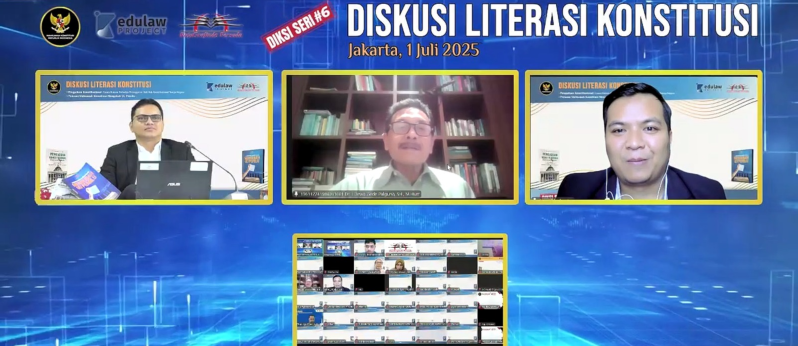
JAKARTA (MKRI) – Former Constitutional Justice (2003-2008 and 2015-2020), Professor I Dewa Gede Palguna explained about Constitutional Complaints (CC) in the 6th Series of Constitutional Literacy Discussion (DIKSI) on Tuesday (1/7/2025) which was held online by the Constitutional Court of the Republic of Indonesia (MKRI). He said that constitutional complaints are complaints or lawsuits filed by individual citizens to the court (c.q. Constitutional Court) against the actions (act) or omissions (omissions) of an institution or public official (public official) that result in violation of the basic rights or constitutional rights of the person concerned.
"Such complaints can only be made if all available legal remedies have been exhausted, meaning that no legal remedies are available for the problem," said Palguna, who is also a Professor of Law at Udayana University. According to him, the absence of the Constitutional Court's authority to adjudicate constitutional complaints results in the unavailability of legal remedies through the constitutional adjudication mechanism for violations of citizens' basic rights that occur not because of the unconstitutionality of statutory norms, but because of the actions or negligence of state institutions or public officials. Meanwhile, all available legal remedies based on the current system have been taken by the complainant.
One of the consequences is that many petition filed to the Constitutional Court, which are substantially constitutional complaints, are declared “inadmissible” (niet ontvankelijk verklaard) on the grounds that the Constitutional Court is not authorized to adjudicate them. This is because the current system assumes that violations of citizens’ constitutional rights only occur if the legislators (House of Representative Council together with the President) make laws that turn out to violate citizens’ constitutional rights.
In fact, violations of the constitutional rights of citizens do not only occur due to "errors" in the law but can also occur due to the actions or negligence of public officials. In his book entitled Constitutional Complaints and Protection of Citizens' Constitutional Rights, Palguna offers the possibility of implementing a constitutional complaint mechanism in the Indonesian constitutional system by giving the authority to decide on constitutional complaint cases to the Constitutional Court of the Republic of Indonesia. He does not deny that Article 24C paragraph (1) and paragraph (2) of the 1945 Constitution have limitedly determined the authority of the Constitutional Court, so that additional authority is only possible by making changes to the 1945 Constitution. However, according to him, there is another alternative, namely a legal construction that can be used as a basis for granting authority to the Constitutional Court to decide on constitutional complaint cases without changing, or even by continuing to rely on Article 24C paragraph (1) of the 1945 Constitution.
If this is connected to Article 24C paragraph (1) of the 1945 Constitution, then constitutional complaints, in a limited way, can be included in the material for testing the law. It is said to be limited because what is being complained about is limited to the actions or negligence of public officials that harm the constitutional rights of citizens that arise from errors in interpreting statutory norms. Concretely, the request for constitutional complaints is still constructed as a request for testing the law, but the substance of the request is not questioning the constitutionality of the statutory norms requested for testing, but rather the constitutionality of the actions of public officials (or the inaction of public officials) as a result of an erroneous interpretation of the statutory norms that result in the violation or harming of the constitutional rights of citizens. So what is requested in the petition for the request is a statement from the Constitutional Court that the actions or negligence of the public officials are contrary to the constitution.
If the above thinking is acceptable, then changes are sufficient to be made to several articles in the Constitutional Court Law. For example, in Article 51 paragraph (1) which originally read, "The applicant is a party who considers that his constitutional rights and/or authorities have been harmed by the enactment of the law, namely...etc.", it is changed/added to become, "The applicant is a party who considers that his constitutional rights and/or authorities have been harmed by the enactment of the law and/or by the actions or negligence of public officials caused by a mistake in interpreting the intent of the law, namely...etc.". Then in the Explanation of this article, it is added that the public officials referred to include judges or courts.
"Because in order to be constructed as a request for judicial review, the act or omission is only as long as it concerns an act or omission that arises from an error in interpreting or applying the intent of the law. An incorrect interpretation or incorrect implementation of a law," said Palguna.
Constitutional Court Changes Election Law
In addition, the Head of the Legal and Administrative Bureau of the Registrar's Office Fajar Laksono Suroso also conveyed the idea of his book entitled "The Constitutional Court Changes the Election Law". He said that as of July 1, 2025, the Constitutional Court had issued 2,009 judicial review decisions with the verdict of 112 granted, 232 partially granted, 233 withdrawn, 772 rejected, 35 vacated, 16 not authorized, and 608 unacceptable.
Meanwhile, the 10 most frequently tested laws in the Constitutional Court are Law Number 7 of 2017 concerning General Elections (Election Law) with 160 times. This number is almost twice the law that is most frequently tested in the Constitutional Court in second place, namely Law 8 of 1981 concerning Criminal Procedure Law (KUHAP) as many as 86 times and Law 10 of 2016 concerning Regional Head Elections (Pilkada) as many as 84 times. Thus, according to Fajar, the Election Law has its own magnet to be tested in the Constitutional Court.
Of the 160 cases of the Election Law, 19 applications were partially granted and 3 applications were fully granted. "There is a constitutional mandate in addition to changing the Election Law itself, the legal policy is changed," said Fajar.
According to him, there are 8 areas of legal policy changes, including the verification requirements for political parties as election participants, requirements for candidates for members of the DPR, DPRD, and DPD, requirements for Presidential and Vice Presidential candidates, election mechanisms, election organizing institutions, the duration of the election process, campaign locations, and changes to the amount of the parliamentary threshold or percentage of the parliamentary threshold. Meanwhile, there are 4 (four) constitutional mandates, including the Constitutional Court sending mandate to the government to accelerate the process of recording electronic ID cards for citizens who have not yet recorded, especially those who already have the right to vote, so that it can be realized before the day; the Constitutional Court emphasized the mandate that the norms of the Law that have been decided and declared unconstitutional by the Constitutional Court, should not be 'resurrected' and re-included by the law makers in the new legislative process, in casu in the revision of the Election Law, in the future; the Constitutional Court reiterated that the process of forming or changing laws related to the Aceh government or plans to change laws must go through a consultation procedure and consideration from the Aceh DPR; and the Constitutional Court sent a constitutional mandate to the law makers to immediately make changes to the parliamentary threshold policy including the amount or percentage of the parliamentary threshold.
Meanwhile, Head of the Center for Research, Case Study and Library Management Kurniasih Panti Rahayu said that the 6th DIKSI was implemented in collaboration with the EduLaw Project and Publisher Raja Grafindo Persada. The discussion, which is regularly held once a month, is expected to be a dialectical space to encourage active participation in developing constructive thinking.
"Creating a constitutionally aware society, providing real benefits, and a spirit of literacy in constitutional and democratic values," said Rahayu.(*)
Author : Mimi Kartika
Editor : Lulu Anjarsari P.
Translator : SO
Disclaimer: The original version of the news is in Indonesian. In case of any differences between the English and the Indonesian versions, the Indonesian version will prevail.
Tuesday, July 01, 2025 | 14:35 WIB 993