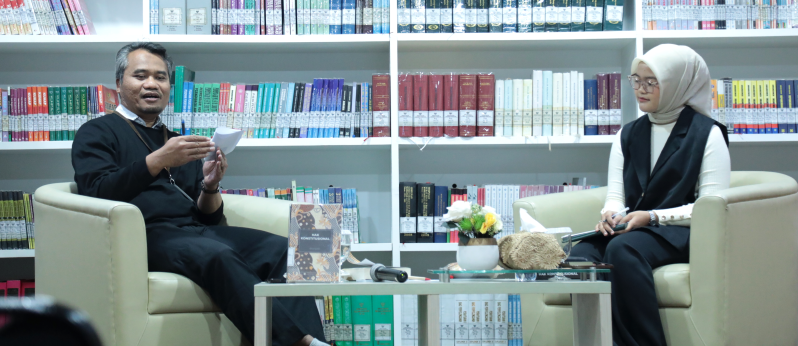
Advisor to constitutional justices Bisariyadi speaking at the eighth Constitutional Literacy Discussion to review his book “Constitutional Rights,” Thursday (9/11/2025). Photo by MKRI/Fauzan.
JAKARTA (MKRI) — To improve public awareness and understanding of constitutional values and the foundations of state law, the Constitutional Court’s Center for Research, Case Review, and Library Management (Puslitka MK) held the eighth Constitutional Literacy Discussion (Diksi) on Thursday, September 11, 2025. The event was a form of collaboration between the Constitutional Court (MK), law initiative EduLaw Project, and publisher PT Rajagrafindo Persada, conducted both online and onsite from the Court’s library and broadcast live via the Court’s YouTube channel.
The eighth Diksi featured Bisariyadi, often referred to as Bisar, an advisor to constitutional justice, who presented his scholarly work Hak Konstitusional (“Constitutional Rights”).
Bisar emphasized that in science, language has an essential role, especially diction that conveys concepts. The same applies in legal studies, where the concept of language precision affects legal science, including constitutional rights, which were adopted from Western law.
He noted that when adapting Western legal terms, different concepts often emerge. For instance, human rights and constitutional rights are often treated as synonymous in general legal discourse, but Bisar argued they are distinct. His book explores this through several points: the boundaries of constitutional rights and their connection to Constitutional Court’s procedure for judicial review.
“Regarding constitutional rights boundaries, we must first understand that fundamental rights (human rights) can be constructed into constitutional rights. For example, voting rights are not explicitly stated in the Constitution, but the Court has interpreted them as derivative constitutional rights,” Bisar explained in the session moderated by Sizil Azzahra Sa’dillah from EduLaw Project.
He further discussed how constitutional rights relate to the Constitutional Court’s procedure for judicial review. In determining legal standing, the Court classifies legal subjects such as individual citizens, state institutions, legal entities, and indigenous communities. He proposed that the Court should distinguish between rights and interests, focusing on whether a protected interest exists, rather than solely on constitutional losses.
“When the Constitutional Court considers legal standing, it should distinguish whether a right is simply an interest protected by law. What should be considered is whether or not such an interest exists. It should not be measured first by whether there is a constitutional loss. This is the idea I propose in this book to the Court. However, when this book was written in 2022 and up to 2025, the Court’s approach to legal standing has remained the same—judged from the parties involved and whether there is a constitutional loss,” explained Bisar, who completed his dissertation at Andalas University.
Constitutional Rights Are Relative
In the core section of his book, Bisar offered his ideas on how to interpret constitutional rights. He suggested a two-step approach. First, determine the scope. For example, the right to life as stated in Article 28A of the 1945 Constitution. He argued that it is necessary to define what is meant by “life.” For instance, in the United States, the right to life begins when a fetus reaches a certain age, and only then is the right attached to the fetus. Another example relates to freedom of expression: does making a humorous remark count as freedom of expression? Thus, boundaries must be set.
“So the definition of constitutional rights boundaries must be clearly interpreted. Then, after setting the boundaries, the second step is to assess whether a policy limits those rights or not. Therefore, constitutional rights must be understood according to their characteristics—some are absolute, while others are relative. In my view, constitutional rights are relative,” Bisar explained.
Diksi is held monthly by the Court through Puslitka, in collaboration with EduLaw Project and PT Rajagrafindo Persada. The program aims to promote the Court’s library as a center for legal and constitutional references. More importantly, it seeks to strengthen and cultivate constitutional literacy among the broader public. Each session sharpens literacy through discussions featuring book authors as speakers.
Let’s continue to expand our legal and constitutional insights by joining Diksi online. Stay tuned for Diksi #9 next month.
Also read:
Court Hosts the First Constitutional Literacy Discussion
Court Hosts Second Constitutional Literacy Discussion
Diksi Series 3: Discussing Open Legal Policy to Retroactive Principles in Constitutional Court Decisions
Court Launches 34 Reference Books
Diksi Volume 5: Economic Democracy and the Emergency of Democracy in the Constitution
The Possibility of Implementing Constitutional Complaint in Indonesia
Innovation in Law and Governance: E-Voting and Meta Court
Author : Sri Pujianti
Editor : N. Rosi
Translator : Jessica Rivena Meilania/YW
Disclaimer: The original version of the news is in Indonesian. In case of any differences between the English and the Indonesian versions, the Indonesian version will prevail.
Thursday, September 11, 2025 | 13:46 WIB 262