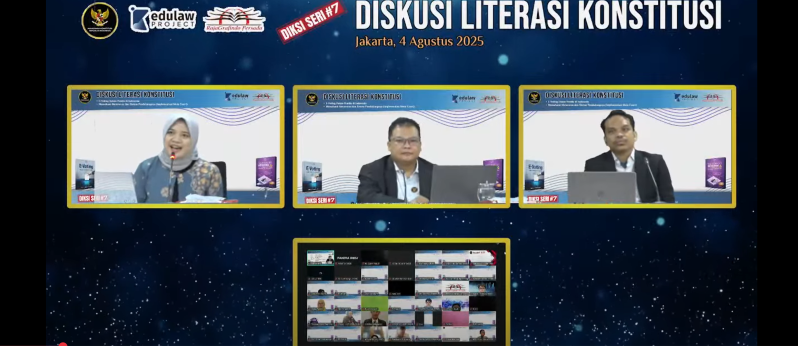
Research and Case Analysis Center and Library Management (Puslitka) of the Constitutional Court (MK) in collaboration with PT. RajaGrafindo Persada and the Edulaw Project holding the 7th Constitutional Literacy Discussion (Diksi) virtually, Monday (8/4/2025).
JAKARTA (MKRI) — The Research and Case Analysis Center and Library Management (Puslitka) of the Constitutional Court of the Republic of Indonesia (MKRI), in collaboration with PT. RajaGrafindo Persada and the Edulaw Project, convened the 7th Constitutional Literacy Discussion (Diksi) on Monday, August 4, 2025. The online discussion, streamed from the Court’s building in Jakarta, highlighted two works: E-Voting: Dalam Pemilu di Indonesia by Abdul Basid Fuadi, expert assistant to constitutional justice, and Memahami Metaverse dan Sistem Pendukungnya (Implementasi Meta Court) by Nanda Adytiansyah, senior computer analyst at the Court.
Fuadi argued that conventional elections in Indonesia remain inefficient, costly, and vulnerable to risks. As a remedy, he proposed electronic voting (e-voting) as a fast, accurate, cost-effective, and modern alternative. Still, he emphasized that its implementation requires solid technical preparation, a robust legal framework, and above all, public trust.
“E-voting in general elections is not merely a technical matter but an integral part of democratic engineering. It reflects a systematic attempt to design elections that are more efficient, transparent, and inclusive to strengthen the people’s sovereignty,” Fuadi stated.
He underscored that introducing e-voting faces formidable challenges, chiefly the absence of explicit provisions in the General Elections Law, as well as concerns regarding technological readiness, human resources, manipulation and security risks, and public confidence.
Nonetheless, e-voting promises significant benefits such as reducing costs and time, improving accuracy, being environmentally friendly, and potentially boosting voter participation. According to Fuadi, any adoption should begin with designing a reliable system while considering multiple aspects.
He recommended reforming the General Elections Law, initiating a national pilot project, certifying systems with independent audits, and conducting extensive public education. “Despite the persisting legal, technical, and trust-related hurdles, implementing e-voting is inevitable in the face of digital demands and the need for better electoral governance,” he said.
Fuadi concluded that “its successful adoption will depend on progressive political will, national infrastructure readiness, and an informed and engaged public. In that way, e-voting can serve as a bridge to elections that are not only technologically sound but also substantively humane.”
Meanwhile, Nanda elaborated on the concept of the metaverse, describing it as a digital realm replicating the physical world with interactive objects and activities. The term was first coined in Neil Stevenson’s 1982 novel Snow Crash. Later, Facebook’s founder, Mark Zuckerberg, introduced the idea of building the metaverse as a vision for the future, rebranding the company as Meta Platforms, Inc. on October 28, 2021.
He also highlighted the relevance of artificial intelligence (AI), augmented reality (AR), and virtual reality (VR). AR integrates computer-generated multimedia with real-world settings in real time, while VR creates digital experiences that simulate the real world. Additionally, blockchain technology, with its decentralized and verifiable data storage system, further assures transparency and accountability.
According to Nanda, these technologies could be applied in the legal sphere, particularly in judicial proceedings. For instance, a machine learning model could be trained using collections of the Court’s decisions to classify cases based on extracted semantics. This would enable justices to easily access references to past rulings, identifying issues or articles that had been previously reviewed.
He stressed that such innovations would help constitutional justices navigate complex cases by providing deeper insights into jurisprudence, even down to linguistic nuances.
Diksi is held monthly as part of the Court’s effort to promote and cultivate constitutional literacy among the broader public. It invites authors as resource persons to discuss current issues with participants, thereby sharpening public understanding of constitutional matters.
Author: Mimi Kartika
Editor: Lulu Anjarsari P.
Translator: Yuanna Sisilia
Disclaimer: The original version of the news is in Indonesian. In case of any differences between the English and the Indonesian versions, the Indonesian version will prevail.
Monday, August 04, 2025 | 14:14 WIB 196