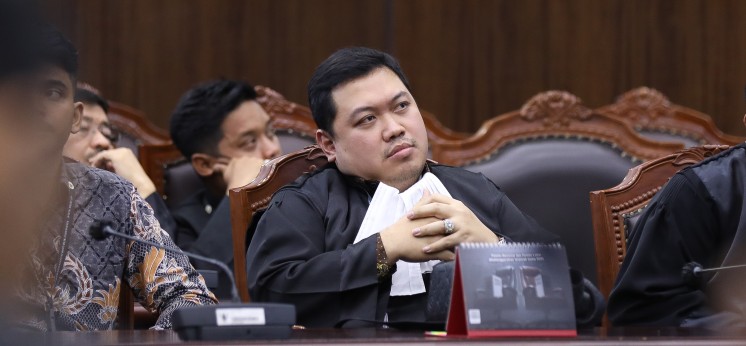
Petitioner Albert Riyadi Suwono attending the ruling hearing on the judicial review of Law No. 37 of 2004 on Bankruptcy and Suspension of Debt Payment Obligations (PKPU), Monday (5/25/2026), at the Constitutional Court courtroom. Photo by MKRI/Ifa.
JAKARTA (MKRI) — The Constitutional Court rejected in its entirety Petition No. 14/PUU-XXIV/2026 challenging Article 292 of Law No. 37 of 2004 on Bankruptcy and Suspension of Debt Payment Obligations (PKPU). The Court held that the essence of the provision is to regulate circumstances in which a settlement can no longer be achieved during the reconciliation stage, whether because no settlement proposal was submitted, the proposed settlement was rejected, or the settlement failed to obtain court approval.
“Therefore, the spirit of bankruptcy proceedings is expeditious resolution through a speedy trial,” Constitutional Justice M. Guntur Hamzah stated while reading out the Court’s legal considerations in Decision No. 14/PUU-XXIV/2026 on Monday, May 25, 2026, at the Plenary Courtroom of the Constitutional Court Building in Jakarta.
Guntur went on to explain that this principle is reflected in one of the defining characteristics of bankruptcy adjudication. Available legal remedies are limited to cassation or judicial review before the Supreme Court following a first-instance ruling, without any appellate review. Within the context of Article 292 of Law No. 37 of 2004, the provision embodies the same rationale. It expressly stipulates that no settlement may be proposed in relation to a bankruptcy declaration rendered pursuant to Article 285, Article 286, or Article 291 of the law.
In other words, Article 292 can no longer reopen the possibility of settlement because all stages of settlement efforts have already been exhausted, and reconciliation has, in essence, become unattainable. Furthermore, once the opportunity for settlement is foreclosed under Article 292, the bankrupt debtor’s assets immediately enter a state of insolvency.
The Court further reasoned that if the Petitioner were to challenge the phrase “no settlement may be proposed” in Article 292 on the grounds that it lacks legal certainty, such an interpretation would instead undermine the very essence of bankruptcy resolution, which is intended to proceed swiftly. This includes not only the available legal remedies but also the administration and liquidation of the bankruptcy estate. Accordingly, the Court emphasized that Article 292 is designed precisely to give effect to the principle of prompt and efficient resolution of bankruptcy cases.
Dissenting Opinion
Constitutional Justice Arsul Sani delivered a dissenting opinion. In essence, Arsul argued that Article 292 of Law No. 37 of 2004 should have been declared conditionally constitutional.
Also Read:
Ban on Renewed Settlement in Bankruptcy Declaration Ensures Legal Certainty
Government Expert Says Petitioner Suffers No Constitutional Loss from Bankruptcy Law
Curator Revises Legal Standing in Bankruptcy Law Challenge
Curator Challenges Bankruptcy Law Over Legal Uncertainty
For the record, the petition was filed by Albert Riyadi Suwono. The Petitioner argued that Article 292 of Law No. 37 of 2004 contravenes Article 28D paragraph (1) of the 1945 Constitution because it fails to provide legal certainty. Article 292 states: “In a bankruptcy declaration rendered pursuant to Article 285, Article 286, or Article 291, no settlement may be proposed.”
Author: Mimi Kartika
Editor: Lulu Anjarsari P.
PR: Fauzan Febriyan
Translator: Yuanna Sisilia
Disclaimer: The original version of the news is in Indonesian. In case of any differences between the English and the Indonesian versions, the Indonesian version will prevail.
The Complete Decision: Decision No. 14/PUU-XXIV/2026 (in Bahasa Indonesia)
Monday, May 25, 2026 | 15:49 WIB 37