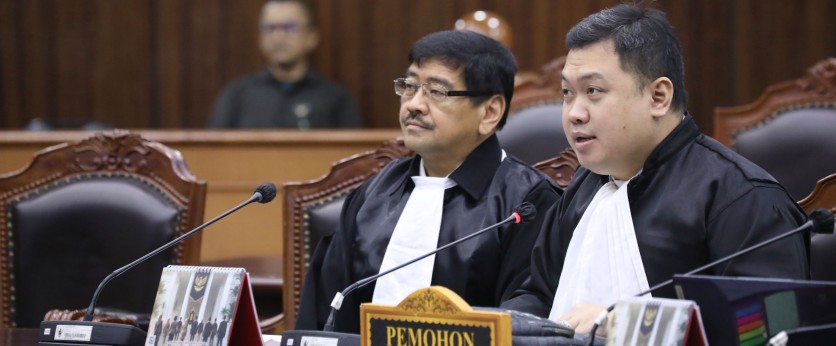
Albert Riyadi Suwono, petitioner in the judicial review of the Bankruptcy and Suspension of Debt Payment Obligations Law, presenting revisions to his petition before the constitutional justices in the Panel Courtroom, Friday (2/6/2026). Photo by MKRI/Panji.
JAKARTA (MKRI) — The Constitutional Court (MK) again convened a judicial review hearing on Article 292 of Law No. 37 of 2004 on Bankruptcy and Suspension of Debt Payment Obligations (Bankruptcy Law) on Friday, February 6, 2026, in the Panel Courtroom. The petition, registered as Case No. 14/PUU-XXIV/2026, was filed by Albert Riyadi Suwono. The hearing was presided over by Deputy Chief Justice Saldi Isra, accompanied by Constitutional Justices Ridwan Mansyur and Arsul Sani.
During the hearing, Albert explained that revisions had been made to the section concerning the Court’s authority, which had not been included in the previous submission.
“Second, regarding the Petitioner’s legal standing, previously we used the term ‘capacity.’ We have now aligned our formulation with the Constitutional Court Regulation (PMK). We have also clarified that the Petitioner is an Indonesian citizen, as evidenced by an identity card, who works as a curator and administrator,” he stated before the panel.
He further restructured the petition into two principal issues. One concerns the phrase “Article 286” in Article 292 of Law No. 37 of 2004, which he argues fails to provide legal certainty and therefore contravenes Article 28D paragraph (1) of the 1945 Constitution.
In his petitum, the Petitioner requests that the Court declare Article 292 of the Bankruptcy Law unconstitutional and not legally binding insofar as it is not interpreted to read:
“In a bankruptcy declaration decision rendered pursuant to the provisions referred to in Article 285, Article 289, or Article 291, the debtor shall by operation of law immediately be in a state of insolvency for the purpose of asset liquidation, and no further settlement may be offered.”
Also read: Curator Challenges Bankruptcy Law Over Legal Uncertainty
Previously, the Petitioner argued that Article 292 of the Bankruptcy Law contradicts Article 28D paragraph (1) of the 1945 Constitution because it does not guarantee legal certainty. The provision stipulates, “In a bankruptcy declaration decision rendered pursuant to the provisions referred to in Article 285, Article 286, or Article 291, no settlement may be offered.”
According to the Petitioner, who practices as a curator/administrator, the reference to “Article 286” in Article 292 is irrelevant, ambiguous, and open to multiple interpretations, thereby potentially disadvantaging curators and administrators in bankruptcy proceedings.
He further explained that bankruptcy declaration decisions under Law No. 37 of 2004 are essentially divided into two categories: those arising from bankruptcy petitions as regulated in Chapter II, and those resulting from the Suspension of Debt Payment Obligations (PKPU) process as governed in Chapter III, particularly Article 292. The a quo petition specifically concerns the legal consequences of bankruptcy decisions originating from the PKPU mechanism.
One of the principal issues raised is the inclusion of the phrase “Article 286” in Article 292. The Petitioner maintains that this reference is misplaced and confusing, as Article 286 regulates confirmed settlement agreements and does not pertain to bankruptcy declaration decisions as contemplated under Article 292. This formulation, he contends, creates legal uncertainty for curators and administrators in carrying out their duties.
Explore Case No. 14/PUU-XXIV/2026
Author : Utami Argawati
Editor : Lulu Anjarsari P.
PR : Fauzan Febriyan
Translator : Yuanna Sisilia
Disclaimer: The original version of the news is in Indonesian. In case of any differences between the English and the Indonesian versions, the Indonesian version will prevail.
Friday, February 06, 2026 | 09:37 WIB 81