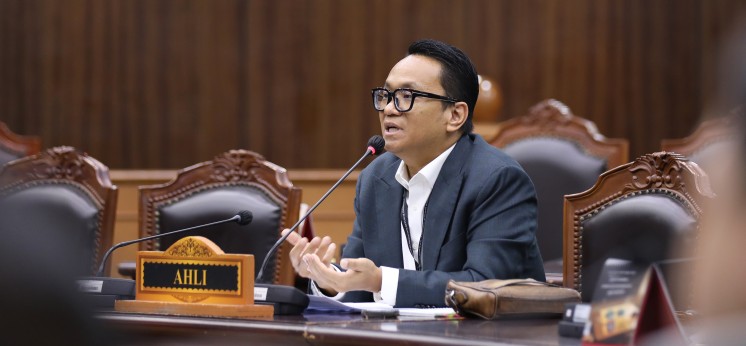
Government expert Nien Rafles Siregar delivering her testimony at a continued judicial review hearing of Law No. 37 of 2004 on Bankruptcy and Suspension of Debt Payment Obligations, Wednesday (4/8/2026), at the Constitutional Court’s courtroom. Photo by MKRI/Ifa.
JAKARTA (MKRI) — The Constitutional Court resumed the judicial review hearing of Article 292 of Law No. 37 of 2004 on Bankruptcy and Suspension of Debt Payment Obligations (PKPU Law) on Wednesday, April 8, 2026, at the Court’s plenary courtroom. The hearing of Case No. 14/PUU-XXIV/2026 was presided over by Chief Justice Suhartoyo alongside other constitutional justices.
During the hearing, the Government presented an expert in bankruptcy and PKPU law, Nien Rafles Siregar. She explained that Article 292 of the PKPU Law clearly delineates the circumstances under which a bankrupt debtor is no longer entitled to propose a settlement plan. These conditions include the court’s refusal to ratify a settlement, the rejection of the settlement plan by creditors, and the annulment of a settlement resulting in insolvency.
Siregar addressed the Petitioner’s concern regarding the phrase “Article 286” in Article 292. According to her, the phrase cannot be construed in isolation but must be interpreted systematically in conjunction with Article 281 paragraphs (1) and (2) of the Bankruptcy and PKPU Law. She elaborated that Article 281 governs the voting mechanism in PKPU proceedings, which requires cumulative approval from both concurrent creditors and secured creditors.
“In this context, the reference to ‘Article 286’ in Article 292 should be understood as the rejection of a settlement plan by secured creditors as contemplated under Article 281,” she stated during the hearing.
She further emphasized that the formulation of Article 292 remains consistent with its core intent, namely regulating the situation in which a bankrupt debtor is precluded from submitting a second settlement proposal.
Siregar also argued that the issue raised by the Petitioner does not constitute a conflict between statutory provisions and the 1945 Constitution. Rather, it pertains to the practical implementation of bankruptcy law. In her view, there is no causal nexus between the phrase “Article 286” and the alleged constitutional loss suffered by the Petitioner.
“There is no cause-and-effect relationship between the phrase in Article 292 of the Bankruptcy and PKPU Law and the loss claimed by the Petitioner,” she asserted.
Also read:
Curator Revises Legal Standing in Bankruptcy Law Challenge
Curator Challenges Bankruptcy Law Over Legal Uncertainty
Previously, the Petitioner argued that Article 292 of the Bankruptcy Law contravenes Article 28D paragraph (1) of the 1945 Constitution for failing to ensure legal certainty. Article 292 stipulates that “in a bankruptcy declaration decision rendered pursuant to the provisions as referred to in Article 285, Article 286, or Article 291, no settlement may be proposed.” The Petitioner, a court-appointed administrator (curator), contended that the inclusion of the phrase “Article 286” is irrelevant, ambiguous, and open to multiple interpretations, thereby potentially disadvantaging curators and administrators in practice.
The Petitioner further explained that bankruptcy declaration decisions under the PKPU Law generally fall into two categories: those arising from bankruptcy petitions as regulated in Chapter II, and those stemming from the PKPU process as governed in Chapter III, particularly Article 292. The a quo petition specifically focuses on the legal consequences of bankruptcy decisions originating from PKPU proceedings.
One of the key issues raised is the reference to “Article 286” in Article 292. The Petitioner argued that this reference is misplaced and confusing, as Article 286 governs ratified settlements and is not directly related to bankruptcy declaration decisions as intended in Article 292. According to the Petitioner, this creates legal uncertainty for curators and administrators in carrying out their duties.
Author: Utami Argawati
Editor: Lulu Anjarsari P.
PR: Fauzan Febriyan
Translator: Yuanna Sisilia
Disclaimer: The original version of the news is in Indonesian. In case of any differences between the English and the Indonesian versions, the Indonesian version will prevail.
Wednesday, April 08, 2026 | 15:15 WIB 87