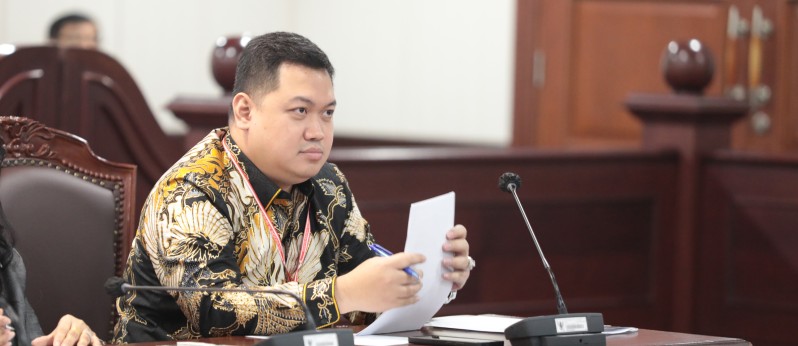
Albert Riyadi Suwono presenting the principal arguments of his petition at a preliminary hearing for the judicial review of the Bankruptcy and Suspension of Debt Payment Obligations Law, Thursday (1/22/2026). Photo by MKRI/IlhamWM.
JAKARTA (MKRI) — The Constitutional Court (MK) held a judicial review hearing on Article 292 of Law No. 37 of 2004 on Bankruptcy and Suspension of Debt Payment Obligations (Law 37/2004) on Thursday, January 22, 2026, in the Panel Courtroom. The petition, registered as Case No. 14/PUU-XXIV/2026, was filed by Albert Riyadi Suwono. The hearing was presided over by Deputy Chief Justice Saldi Isra, accompanied by Constitutional Justices Ridwan Mansyur and Arsul Sani.
The Petitioner contended that Article 292 of Law 37/2004 contravenes Article 28D paragraph (1) of the 1945 Constitution (UUD 1945) as it fails to guarantee legal certainty. Article 292 stipulates, “In a bankruptcy declaration decision rendered pursuant to the provisions referred to in Article 285, Article 286, or Article 291, no settlement may be offered.”
According to the Petitioner, who serves as a curator/administrator, the inclusion of the phrase “Article 286” in Article 292 is irrelevant, ambiguous, and susceptible to multiple interpretations, thereby potentially prejudicing curators and administrators in bankruptcy practice.
He explained that, in principle, bankruptcy decisions under Law 37/2004 fall into two categories: first, bankruptcy rulings arising from petitions for bankruptcy as regulated in Chapter II; and second, bankruptcy rulings resulting from the Suspension of Debt Payment Obligations (PKPU) process as governed in Chapter III. The a quo petition specifically concerns the legal consequences of bankruptcy decisions originating from the PKPU mechanism.
One of the core issues raised is the reference to “Article 286” in Article 292. The Petitioner argued that this reference is misplaced and confusing, as Article 286 regulates confirmed settlement agreements and bears no direct relation to bankruptcy declaration decisions as contemplated under Article 292. Such a formulation, he asserted, generates legal uncertainty for curators and administrators in the discharge of their professional duties.
“Article 292 is situated in Chapter III. The reference to Article 286 within that provision is entirely irrelevant and confusing, and does not provide legal certainty. Article 286 does not regulate bankruptcy declaration decisions or the elements referred to in Article 292. This situation inevitably creates confusion and fails to ensure legal certainty for me as a curator/administrator,” Albert stated before the panel.
Conversely, he maintained that Article 289 of Law 37/2004 constitutes a more appropriate reference, as it explicitly obliges the court to declare a debtor bankrupt if a proposed settlement plan is rejected. Accordingly, he proposed that the phrase “Article 286” in Article 292 be interpreted as “Article 289.”
The Petitioner further took issue with the phrase “no settlement may be offered” in Article 292, arguing that it likewise lacks clear normative certainty. In practice, the provision has given rise to two divergent interpretations among judges, curators/administrators, debtors, and creditors.
Under the first interpretation, a bankruptcy decision resulting from the PKPU process automatically places the debtor in a state of insolvency by operation of law, allowing the process to proceed directly to asset liquidation without repeating the administration phase. Under the second interpretation, the bankruptcy process must recommence from the initial administration stage, including creditor meetings and renewed discussions on settlement.
The Petitioner submitted that the first interpretation is more coherent and consistent with the bankruptcy framework as elucidated in the General Elucidation of Law 37/2004. He reasoned that the administration stage has essentially been undertaken during the PKPU proceedings, rendering its repetition inefficient and potentially opening the door to irregularities.
In his petitum, the Petitioner requested that the Court summon relevant parties—including the Speaker of the House of Representatives (DPR), the President, and the Chief Justice of the Supreme Court—to provide clarification on Article 292. He further petitioned the Court to declare Article 292 unconstitutional and not legally binding insofar as it is not interpreted to mean that a bankruptcy decision rendered pursuant to the PKPU provisions automatically places the debtor in insolvency for the purpose of asset liquidation and precludes any further settlement.
Responding to the petition, Constitutional Justice Ridwan Mansyur advised the Petitioner to refine and substantiate his legal standing, as well as to elaborate more systematically on the constitutional impairment he allegedly suffered due to the enactment of the contested norm.
“In your legal standing, the explanation remains insufficient. As a curator by profession, you should also state that you are an Indonesian citizen for clarity. You have not fully elaborated on how the enactment of this article has impaired your constitutional rights. You must clearly explain the loss incurred—whether it is actual and direct or merely potential—and how it affects your constitutional rights,” Justice Ridwan said.
The panel granted the Petitioner 14 days to revise his petition. The revised submission must be received by the Court no later than Wednesday, February 4, 2026, at 12:00 p.m. WIB.
Explore Case No. 14/PUU-XXIV/2026
Author : Utami Argawati
Editor : Lulu Anjarsari P.
PR : Fauzan Febriyan
Translator : N. Valentino Rahadityo/Yuanna Sisilia
Disclaimer: The original version of the news is in Indonesian. In case of any differences between the English and the Indonesian versions, the Indonesian version will prevail.
Thursday, January 22, 2026 | 17:33 WIB 86