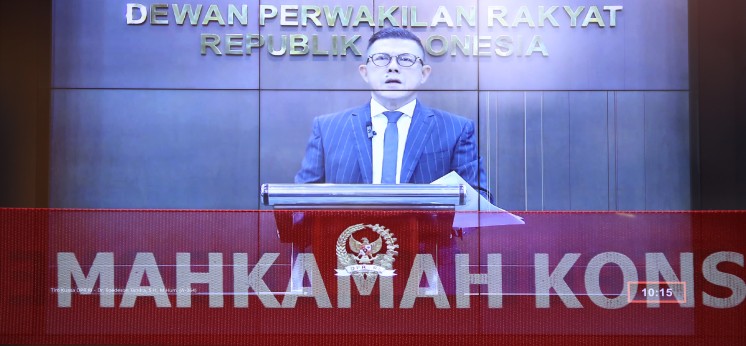
Soedeson Tandra representing the House of Representatives (DPR) giving testimony virtually at a continued hearing on the judicial review of Law No. 37 of 2004 on Bankruptcy and Suspension of Debt Payment Obligations, Tuesday (3/3/2026). Photo by MKRI/Ifa.
JAKARTA (MKRI) — The phrase “no settlement may be offered” in Article 292 of Law No. 37 of 2004 on Bankruptcy and Suspension of Debt Payment Obligations (PKPU Law) is intended to ensure legal certainty and constitutes a logical consequence of the failure of the settlement process. Reopening the possibility of settlement after it has been declared unsuccessful would create legal uncertainty and prolong the debt resolution process. The provision, therefore, preserves a balance between the interests of debtors and creditors.
This statement was delivered by the Government, represented by the Expert Staff for Inter-Institutional Affairs and Bureaucratic Reform Strengthening at the Ministry of Law of the Republic of Indonesia, Sucipto, during a hearing to examine Petition No. 14/PUU-XXIV/2026 on Tuesday, March 3, 2026, in the plenary courtroom of the Constitutional Court. The petition seeks a judicial review of Article 292 of Law No. 37 of 2004 on Bankruptcy and Suspension of Debt Payment Obligations, filed by Albert Riyadi Suwono.
Sucipto explained that Article 292 of the PKPU Law stipulates that, in bankruptcy cases arising from circumstances referred to in Articles 285 or 291 of the same law, the debtor is no longer permitted to propose a settlement plan. Consequently, there is no further legal mechanism to postpone the insolvency status, as the law has effectively closed all avenues for debt settlement through reconciliation.
“To date, the formulation of Article 292 remains consistent and ensures continuity between provisions governing the PKPU process and bankruptcy under the Bankruptcy and PKPU Law as a unified legal framework,” Sucipto stated in the hearing chaired by Chief Justice Suhartoyo.
He further emphasized that Article 292 of the PKPU Law does not arbitrarily eliminate the debtor’s rights. Instead, it represents a legal consequence of the debtor having previously utilized the opportunity for restructuring through the PKPU mechanism. According to the Government, a closer reading of the provision demonstrates that it actually reinforces legal certainty rather than creating uncertainty.
“This provision maintains the integrity of the bankruptcy stages by preventing the reopening of restructuring opportunities that have already failed and ensuring consistency among Articles 285, 291, and 292. The law has already provided sufficient opportunity for debtors to propose settlement plans to their creditors during the PKPU process,” Sucipto elaborated.
He added that the opportunity to propose a settlement is fully available during the PKPU stage, including drafting and submitting a settlement proposal, negotiating with creditors, voting, and court ratification (homologation). If the proposal is rejected, not ratified, or annulled, such failure constitutes the outcome of a lawful and participatory legal process.
Accommodating Creditors’ Interests
Meanwhile, the House of Representatives (DPR), represented by Soedeson Tandra, testified that the reference to Article 286 within Article 292 of the PKPU Law reflects a regulatory framework that accommodates the position of secured creditors and concurrent creditors in approving settlement plans proposed by debtors during the PKPU process.
According to the DPR, the reference was formulated to ensure that secured creditors who reject a settlement plan remain entitled to compensation as stipulated in Article 281 paragraph (2) of the PKPU Law. Furthermore, the transition to bankruptcy following the PKPU process is considered a juridical consequence of a court decision declaring the debtor bankrupt.
“The reference to Article 286 in the provision a quo was formulated to ensure that the rights of secured creditors who reject a settlement plan to receive compensation as regulated in Article 281 paragraph (2) of Law No. 37 of 2004 can be properly implemented,” he said.
The DPR also underscored that the management of bankruptcy assets after the PKPU process already has a clear procedural framework that can be optimized to ensure payment to creditors in accordance with the principle of pari passu pro rata parte.
“Such regulation provides a clear procedural framework for managing bankruptcy assets after the PKPU process so that they may be optimized for the repayment of creditors in accordance with the principle of pari passu pro rata parte,” Soedeson explained.
Based on these considerations, the DPR concluded that Article 292 of Law No. 37 of 2004 does not contradict the 1945 Constitution and remains legally binding. The DPR further emphasized that the phrase “no settlement may be offered” in the provision is intended to provide legal certainty and represents a logical consequence of the failure of the settlement process.
Curator Revises Legal Standing in Bankruptcy Law Challenge
Curator Challenges Bankruptcy Law Over Legal Uncertainty
The Petitioner argued that Article 292 of the Bankruptcy Law contradicts Article 28D paragraph (1) of the 1945 Constitution because it allegedly fails to guarantee legal certainty. Article 292 of Law No. 37 of 2004 states: “In a bankruptcy declaration decision rendered pursuant to the provisions referred to in Article 285, Article 286, or Article 291, no settlement may be offered.”
The Petitioner, who works as a curator/administrator, contended that the reference to “Article 286” in Article 292 is irrelevant, confusing, and open to multiple interpretations, potentially disadvantaging curators and administrators in bankruptcy practice.
The Petitioner further explained that bankruptcy declaration decisions under Law No. 37 of 2004 are essentially divided into two categories: bankruptcy decisions arising from a bankruptcy petition, as regulated in Chapter II, and those resulting from the PKPU process, as regulated in Chapter III, particularly Article 292. The petition in this case specifically addresses the legal consequences of bankruptcy declarations arising from the PKPU process.
One of the main issues raised by the Petitioner concerns the reference to “Article 286” in Article 292. The Petitioner argued that the reference is irrelevant and confusing because Article 286 regulates ratified settlements, which are not directly related to bankruptcy declaration decisions as referred to in Article 292. According to the Petitioner, this condition creates legal uncertainty for curators and administrators in carrying out their duties.
Explore the case: Case No. 14/PUU-XXIV/2026
Author: Utami Argawati
Editor: Lulu Anjarsari P.
PR: Fauzan Febriyan
Translator: Yuanna Sisilia
Disclaimer: The original version of the news is in Indonesian. In case of any differences between the English and the Indonesian versions, the Indonesian version will prevail.
Tuesday, March 03, 2026 | 12:06 WIB 93