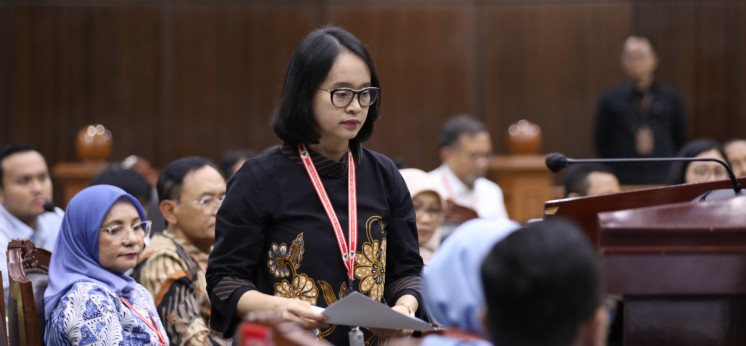
Cicendo Eye Hospital president director Antonia Kartika testifying as one of the Relevant Parties at a judicial review hearing of the Health Law for case No. 143/PUU-XXIII/2025, Monday (1/26/2026). Photo by MKRI/Ifa.
JAKARTA (MKRI) — The Constitutional Court held another judicial review hearing of Article 187 paragraph (4) and Article 209 paragraph (2) of Law No. 17 of 2023 on Health on Monday, January 26, 2026. The ninth session for case No. 143/PUU-XXIII/2025, chaired by Chief Justice Suhartoyo, was to hear Cicendo Eye Hospital, Soeharso Orthopedic Hospital, and the National Brain Center Hospital as Relevant Parties.
No Dualism
The president director of Cicendo Eye Hospital Bandung, Antonia Kartika, explained that in implementing medical education, her hospital continues to cooperate with the Faculty of Medicine of Padjadjaran University, as stipulated in a cooperation agreement that remains in force. The curriculum, unit rotations, duty schedules, teaching staff, facilities, time allocation, and educational regulations are applied uniformly to trainees of the hospital-based specialist training program primary provider (RSPPU) and to Padjadjaran University Faculty of Medicine.
This demonstrates that there is no dualism in the implementation of specialist residency training (PPDS) at Cicendo Eye Hospital. By way of example, the application of a maximum workload and learning limit of 80 hours per week for RSPPU trainees was subsequently adopted by the faculty, reflecting synergy in the conduct of education. The distinction between the ophthalmology specialist residency training at RSPPU and Padjadjaran University Faculty of Medicine lies in the certainty of post-graduation placement. All trainees admitted to the RSPPU ophthalmology PPDS cohorts I and II have designated post-education placement locations.
Another difference concerns the locations of affiliated network hospitals during the independent stage of the ophthalmology PPDS. For the Padjadjaran University Faculty of Medicine ophthalmology PPDS, affiliated hospitals are located in areas surrounding the educational institution or within West Java Province. By contrast, for the RSPPU ophthalmology PPDS, affiliated hospital locations are spread throughout Indonesia. Nevertheless, both programs—RSPPU and Padjadjaran University Faculty of Medicine—undertake educational rotations at several of the same sites, namely primary clinics under Cicendo Eye Hospital.
“In terms of quality assurance, RSPPU at Cicendo Eye Hospital Bandung follows the ACGME-I accreditation process in accordance with the direction of the Ministry of Health. ACGME-I conducted an accreditation preparedness assessment on June 26, 2024, followed by a site visit on April 23, 2025. The accreditation certificate as a sponsoring institution was received on July 17, 2025, as part of the 2nd International Conference on Advancing Postgraduate Medical Education taking place on August 27–28, 2025. Accordingly, the closeness between PPDS trainees from RSPPU and Padjadjaran University Faculty of Medicine is reflected in organizational activities and social media, including an integrated PPDS organizational structure,” Kartika explained from the Court’s plenary courtroom.
Improving Education Standards
The representative of Prof. Dr. R. Soeharso Orthopedic Hospital Surakarta as another Relevant Party, Romaniyanto, stated that the implementation of RSPPU is based on a memorandum of understanding between Prof. Dr. R. Soeharso Orthopedic Hospital and Universitas Sebelas Maret (UNS) Surakarta. All processes for specialist and subspecialist medical education conducted by the hospital are carried out by referring to accreditation and quality assurance systems, both for the hospital as an educational setting and for the educational programs delivered jointly with universities.
The Hospital is of the view that improving hospital-based PPDS within the framework of the national higher education system is a relevant and necessary step to address challenges in the equitable distribution of specialist doctors in Indonesia, particularly in underdeveloped, remote, and outermost regions (3T). The conduct of specialist education by RSPPU continues to refer to competency standards established by the collegium. Hospitals implement clinical education in accordance with these standards, with universities serving as partners. Thus, the collegium plays a role as quality controller in the implementation of Article 209 paragraph (2) of the Health Law.
“Accordingly, university-based education and hospital-based education are not two approaches that negate one another. University-based education strengthens the academic foundation, while hospital-based education strengthens clinical competence and service orientation. The two complement each other within the framework of the national higher education system and the national health system,” explained Romaniyanto, who is also a consultant orthopedic spine surgeon at Prof. Dr. R. Soeharso Orthopedic Hospital.
Quality Health Services
Adin Nulkhasanah, president director of the National Brain Center Hospital (RSPON) Jakarta, stated at the hearing that, in implementing RSPPU education, RSPON also cooperates with a network of hospitals. With respect to university-based quotas, the Hospital does not serve as a primary teaching hospital but rather as a satellite and affiliated teaching hospital. Accordingly, the quota for sending PPDS trainees is adjusted to the agreements set out in the relevant memoranda of understanding. Universities that continue to send neurology PPDS trainees for short rotations of 1–2 months at the Hospital include Andalas University and the University of North Sumatera. Thus, the implementation of RSPPU by RSPON does not result in a reduction of university-based quotas.
In this regard, Adin emphasized, there is absolutely no conflict of interest or tension in the implementation of RSPPU, which is alleged by the Petitioners, because whether in its role as RSPPU or within the university-based scheme, RSPON does not function as a Primary Teaching Hospital. Rather, it acts as an affiliated and satellite teaching hospital that conducts PPDS education for short periods in accordance with clinical rotation stages.
With respect to scholarships, Adin added that all neurology PPDS RSPPU trainees at RSPON currently receive scholarships from the Indonesia Endowment Fund for Education (LPDP), with financing components as specified in the letters issued by LPDP for each trainee. In addition to the facilities covered by LPDP financing, RSPPU PPDS trainees also receive accommodation as well as meals and refreshments during each duty shift. By contrast, university-based PPDS trainees at RSPON are subject to rotation fees as regulated under a joint decree between the Faculty of Medicine and RSPON.
“According to [RSPON], the implementation of RSPPU in fact brings far greater benefits in meeting public needs for high-quality health services provided by medical and health professionals who are experts in their fields, while also supporting the equitable distribution of medical personnel to regions in need. In this regard, it is evident that the Petitioners’ application is unfounded and should therefore be rejected in its entirety, or at the very least declared inadmissible,” Adin concluded.
Also read:
Dualism of Specialist Education Providers under Health Law Disputed
Petitioners Stress Dualism of Specialist Education Providers under Health Law
House: Transformation in Education Essential for Equitable Distribution of Specialists
Health Minister Talks Need for Innovation in Execution of Specialist Medical Education
Being President's Proxy, Ministry of Higher Education Refuses to Testify on Health Law
Collaboration between Teaching Hospitals and Universities Ensures Academic Quality
Expert: Hospitals as Partners of Universities in Health Education
Expert Explains Functional Capacity of Teaching Hospitals
Doctors and medical students Razak Ramadhan Jati Riyanto, M. Abdul Latif Khamdilah, M. Hidayat Budi Kusumo, and M. Mukhlis Rudi Prihatno are Petitioners I-IV in this case. At the preliminary hearing on Wednesday, August 28, the Petitioners through counsels Dimas Pradana and Arunega Dikta Widyatmaka argued that the provisions a quo contravene Article 28D paragraph (1) and Article 31 paragraph (3) of the 1945 Constitution. They contended that while the law purported to transform the system by providing an alternative pathway for specialist and subspecialist education through universities and teaching hospitals, it failed to harmonize and reconcile the provisions with Law No. 17 of 2023, as well as with the explicit mandates of Law No. 20 of 2003 and Law No. 12 of 2012.
The Petitioners acknowledge the Government’s declared need to accelerate the production of specialist and subspecialist doctors. However, they argued that this policy created contradictions and misconceptions, generating legal uncertainty that was neither fair nor clear when the legislature introduced a new system of primary organizers of specialist/subspecialist education (RSPPU).
In their view, the legislature acted irrationally in establishing the RSPPU by prioritizing the mass production of doctors without first empowering universities that already exist across Indonesia. They further contended that the system has led to conflicts of interest and tension between two different organizing systems: universities, which operate on a university-based system, and RSPPU, which functions on a hospital-based system. This divergence, they argued, resulted in unequal treatment of medical residents during and after their training.
The Petitioners asserted that Article 187 paragraph (4) and Article 209 paragraph (2) of Law No. 17 of 2023 violate Article 31 paragraph (3) of the 1945 Constitution because the Government introduced a dualism of professional education providers for specialist and subspecialist programs without first harmonizing the respective mandates concerning educational authority. They argued that this dualism could foster envy and conflicts of interest among both providers and medical residents.
Explore case No. 143/PUU-XXIII/2025 (in Indonesian).
Author : Sri Pujianti
Editor : N. Rosi
PR : Fauzan Febriyan
Translator : Yuniar Widiastuti (NL)
Disclaimer: The original version of the news is in Indonesian. In case of any differences between the English and the Indonesian versions, the Indonesian version will prevail.
Monday, January 26, 2026 | 14:12 WIB 138