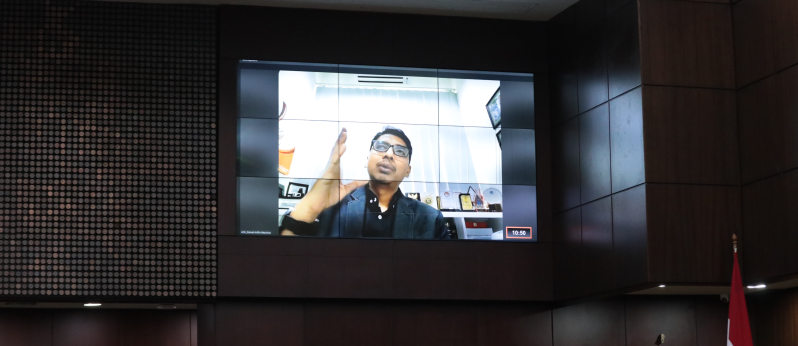
Constitutional law professor Zainal Arifin Mochtar testifying for the Petitioners at a judicial review hearing of the Health Law for case No. 143/PUU-XXIII/2025, Thursday (11/20/2025). Photo by MKRI/M. Nur.
JAKARTA (MKRI) — The provision of specialist/subspecialist medical education is part of formal education; therefore, the implementation of specialist/subspecialist medical education programs must be carried out by higher education institutions/universities. Article 21 paragraph (2) of the National Education System Law clearly and firmly regulates that education providers other than higher education institutions are prohibited from awarding academic, professional, or vocational degrees.
The statement was made by constitutional law professor of Gadjah Mada University Zainal Arifin Mochtar at the seventh material judicial review hearing of Article 187 paragraph (4) and Article 209 paragraph (2) of Law No. 17 of 2023 on Health on Thursday, November 20, 2025. The hearing for case No. 143/PUU-XXIII/2025, chaired by Chief Justice Suhartoyo, was to present the testimonies of expert and witness for the Petitioners—doctors and medical students Razak Ramadhan Jati Riyanto, M. Abdul Latif Khamdilah, M. Hidayat Budi Kusumo, and M. Mukhlis Rudi Prihatno (Petitioners I-IV).
“This means that the legal-policy direction for hospitals is not designed for them to serve as providers of specialist/subspecialist professional medical education. Instead, they are intended to provide public services and to serve as partners of universities in facilitating practice in the field of health education,” Zainal explained.
If breakthroughs are desired, Zainal believes that comprehensive reforms are needed, including changing the concept of the national education system mandated by the 1945 Constitution. Likewise, in technocratic terms, such measures must provide benefits for all Indonesians—not only fulfill the need for medical personnel, but also consider patient safety and security. This also includes fulfilling the need for teaching staff, which hospitals do not have because that falls under the domain of universities.
Ministry of Education’s Jurisdiction
Meanwhile, in her testimony as Vice Dean I of the Faculty of Medicine of the University of Indonesia, Dwiana Ocviyanti stated that the establishment of an academic program falls under the authority of the Ministry of Education, not the Ministry of Health. Although the aim of establishing hospital-based academic programs is acceleration, she noted that opening an academic program is not an easy task. There are standards set by the Ministry of Education, one of which—preparing lecturers—is particularly difficult.
“We always say that a soccer player cannot automatically become a soccer coach. And that is what happens with specialist programs—what is assessed is skills, but the effort to transfer those skills or to teach our colleagues to acquire a certain skill requires abilities beyond merely being a lecturer. For that reason, we at the faculty have training for becoming clinical lecturers,” she said.
Dwiana explained that clinical lecturers are lecturers trained to transfer their clinical skills while paying attention to patient safety, and therefore the requirements are very strict. This, she noted, has been an obstacle for the Faculty of Medicine of the University of Indonesia, especially when a ministerial regulation was issued after the program was set to open. In fact, the faculty was not consulted beforehand regarding its readiness to implement the program. As it turned out, both the academic program and the hospital were unprepared.
“That the Health Law states that teaching hospitals may open academic programs through a determination by the Minister of Health does not change the fact that the opening of academic programs must still follow the prevailing rules, namely those within the Education Law. If so many people misunderstand this, perhaps something is wrong with the law, so that it is perceived that the ministry overseeing hospitals may open or recommend the opening of an academic program,” she explained.
Also read:
Dualism of Specialist Education Providers under Health Law Disputed
Petitioners Stress Dualism of Specialist Education Providers under Health Law
House: Transformation in Education Essential for Equitable Distribution of Specialists
Health Minister Talks Need for Innovation in Execution of Specialist Medical Education
Being President's Proxy, Ministry of Higher Education Refuses to Testify on Health Law
Collaboration between Teaching Hospitals and Universities Ensures Academic Quality
At the preliminary hearing on Wednesday, August 28, the Petitioners through counsels Dimas Pradana and Arunega Dikta Widyatmaka argued that the provisions a quo contravene Article 28D paragraph (1) and Article 31 paragraph (3) of the 1945 Constitution. They contended that while the law purported to transform the system by providing an alternative pathway for specialist and subspecialist education through universities and teaching hospitals, it failed to harmonize and reconcile the provisions with Law No. 17 of 2023, as well as with the explicit mandates of Law No. 20 of 2003 and Law No. 12 of 2012.
The Petitioners acknowledge the Government’s declared need to accelerate the production of specialist and subspecialist doctors. However, they argued that this policy created contradictions and misconceptions, generating legal uncertainty that was neither fair nor clear when the legislature introduced a new system of primary organizers of specialist/subspecialist education (RSPPU).
In their view, the legislature acted irrationally in establishing the RSPPU by prioritizing the mass production of doctors without first empowering universities that already exist across Indonesia. They further contended that the system has led to conflicts of interest and tension between two different organizing systems: universities, which operate on a university-based system, and RSPPU, which functions on a hospital-based system. This divergence, they argued, resulted in unequal treatment of medical residents during and after their training.
The Petitioners asserted that Article 187 paragraph (4) and Article 209 paragraph (2) of Law No. 17 of 2023 violate Article 31 paragraph (3) of the 1945 Constitution because the Government introduced a dualism of professional education providers for specialist and subspecialist programs without first harmonizing the respective mandates concerning educational authority. They argued that this dualism could foster envy and conflicts of interest among both providers and medical residents.
Track the case No. 143/PUU-XXIII/2025 here.
Author : Sri Pujianti
Editor : Lulu Anjarsari P.
PR : Fauzan Febriyan
Translator : Yuniar Widiastuti (NL)
Disclaimer: The original version of the news is in Indonesian. In case of any differences between the English and the Indonesian versions, the Indonesian version will prevail.
Thursday, November 20, 2025 | 21:43 WIB 269