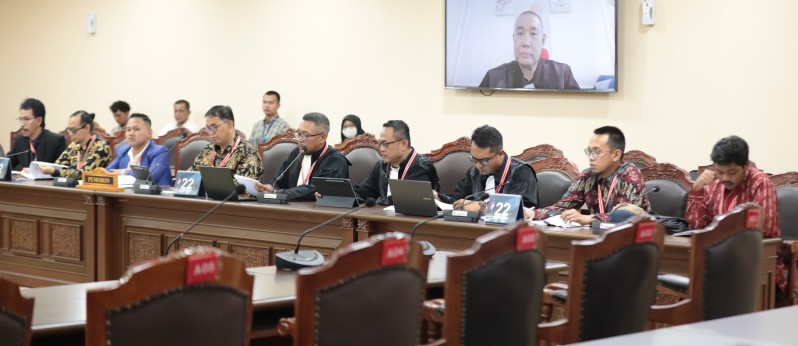
Academics, university students, medical graduates, and their legal counsels at the preliminary hearing for the judicial review of the Health Law, Wednesday (8/27/2025). Photo by MKRI/Ilham W.M.
JAKARTA (MKRI) — Doctors and medical students Razak Ramadhan Jati Riyanto, M. Abdul Latif Khamdilah, M. Hidayat Budi Kusumo, and M. Mukhlis Rudi Prihatno (Petitioners I-IV) challenge Article 187 paragraph (4) and Article 209 paragraph (2) of Law No. 17 of 2023 on Health against the 1945 Constitution to the Constitutional Court (MK). The preliminary hearing for case No. 143/PUU-XXIII/2025 was heard by Deputy Chief Justice Saldi Isra (panel chair) and Constitutional Justices Ridwan Mansyur and Asrul Sani on Wednesday, August 27, 2025.
Article 187 paragraph (4) of the Health Law stipulates: “Teaching Hospitals may organize specialist/subspecialist education programs as the primary organizer of education, while continuing to cooperate with universities.” Meanwhile, Article 209 paragraph (2) provides: “In addition to universities as referred to in paragraph (1), professional education in the health sector for specialist and subspecialist programs may also be organized by teaching Hospitals as the primary organizer, in cooperation with universities, the ministry responsible for education, and the ministry responsible for health, with the involvement of the relevant Collegium.”
Counsel for the Petitioners, Dimas Pradana and Arunega Dikta Widyatmaka, argued that these provisions contravene Article 28D paragraph (1) and Article 31 paragraph (3) of the 1945 Constitution. They contended that while the law purported to transform the system by providing an alternative pathway for specialist and subspecialist education through universities and teaching hospitals, it failed to harmonize and reconcile the provisions with Law No. 17 of 2023, as well as with the explicit mandates of Law No. 20 of 2003 and Law No. 12 of 2012.
The Petitioners acknowledged the Government’s declared need to accelerate the production of specialist and subspecialist doctors. However, they argued that this policy created contradictions and misconceptions, generating legal uncertainty that was neither fair nor clear when the legislature introduced a new system of primary organizers of specialist/subspecialist education (RSPPU).
“In the Petitioners’ view, the legislature acted irrationally in establishing the RSPPU by prioritizing the mass production of doctors without first empowering universities that already exist across Indonesia,” explained Azam Prasojo Kadir, another counsel for the Petitioners.
They further contended that the system has led to conflicts of interest and tension between two different organizing systems: universities, which operate on a university-based system, and RSPPU, which functions on a hospital-based system. This divergence, they argued, resulted in unequal treatment of medical residents during and after their training.
The Petitioners asserted that Article 187 paragraph (4) and Article 209 paragraph (2) of Law No. 17 of 2023 violate Article 31 paragraph (3) of the 1945 Constitution because the Government introduced a dualism of professional education providers for specialist and subspecialist programs without first harmonizing the respective mandates concerning educational authority. They argued that this dualism could foster envy and conflicts of interest among both providers and medical residents.
On this basis, the Petitioners requested the Court to declare Article 187 paragraph (4) of Law No. 17 of 2023 on Health conditionally unconstitutional and not legally binding insofar as it is not interpreted to mean: “Teaching hospitals may only serve as clinical implementation partners in the organization of professional education for specialist/subspecialist programs, while universities remain the primary organizers of education.”
They also requested that the Court declare Article 209 paragraph (2) of the same law conditionally unconstitutional and not legally binding insofar as it is not interpreted to mean: “Specialist and subspecialist professional education programs must remain within the framework of the higher education system, with universities serving as the primary provider, while educational Hospitals may only act as clinical implementation partners and not as the primary organizer of education.”
Constitutional Impairment
In response, Constitutional Justice Ridwan Mansyur underscored the need for the Petitioners to further elaborate on the constitutional harm each of them had suffered as a result of the contested provisions.
“This creates the impression of a dual system of education providers that causes confusion and psychological burdens. However, this must be substantiated with respect to the Petitioners’ legal standing—that these provisions will indeed result in constitutional harm. Therefore, the arguments need to be refined further, especially since these articles have never before been subject to constitutional review,” he advised.
At the end of the hearing, Deputy Chief Justice Saldi Isra announced that the Petitioner would have 14 days to revise the petition, which must be resubmitted no later than September 9 to the Registrar’s Office. The Court will then schedule the second hearing to examine the revisions to the petition.
Author : Sri Pujianti
Editor : Lulu Anjarsari P.
PR : Fauzan Febriyan
Translator : Yuniar Widiastuti (NL)
Disclaimer: The original version of the news is in Indonesian. In case of any differences between the English and the Indonesian versions, the Indonesian version will prevail.
Wednesday, August 27, 2025 | 16:32 WIB 252