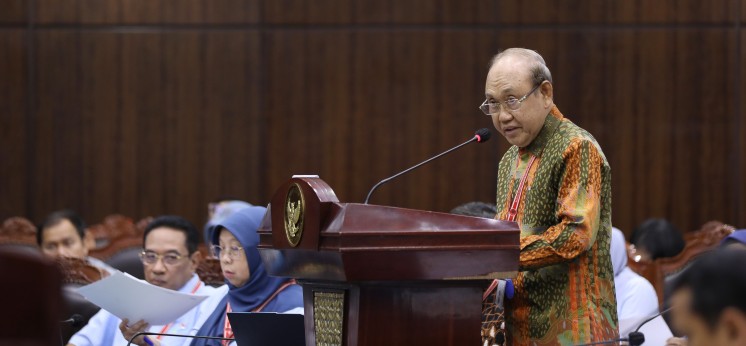
Wahiduddin Adams testifying as an expert for the Government at a judicial review hearing of the Health Law for case No. 143/PUU-XXIII/2025, Monday (12/8/2025). Photo by MKRI/Ifa.
JAKARTA (MKRI) — The term “primary organizer” in Article 187 paragraph (4) of the Health Law must be understood not as a form of institutional exclusivity that positions teaching hospitals as dominant actors. Rather, it should be seen as an effort to realize the functional capacity of teaching hospitals in managing clinical services and professional training, while maintaining academic authority under the responsibility of universities after undergoing assessment, accreditation, and formal cooperation with universities and the Collegium.
The statement was made by former constitutional justice Wahiduddin Adams in his testimony as an expert for the Government at the eighth hearing for the material judicial review of Article 187 paragraph (4) and Article 209 paragraph (2) of Law No. 17 of 2023 on Health on Monday, December 8, 2025. The hearing for case No. 143/PUU-XXIII/2025, chaired by Chief Justice Suhartoyo, was to present the testimonies of experts and witnesses for the Government.
More specifically, Wahiduddin stated that in Article 187 paragraph (4) of the Health Law, the phrase “primary organizer of education,” which is subsequently supplemented by the phrase “while continuing to cooperate with universities,” is not contradictory to the word “may,” which in this context has a specific meaning of “having the right to” or even “being authorized to.”
“That the phrase ‘primary organizer’ in this context is not intended to replace or take over the role of universities as the primary organizers of education, but rather to expand the capacity of the national education system in order to accelerate the fulfillment of the need for specialist/subspecialist doctors throughout Indonesia,” emphasized Wahiduddin.
A Dynamic Balance Pattern
Next, Wahiduddin explained that Article 209 paragraph (2) of the Health Law begins with the phrase “apart from being organized by universities.” This phrase, which is the implementation of the university-based concept, he continued, is not meant merely to reflect a spirit of complementarity, but also to affirm a form of commensalism or a dynamic balance pattern between the university-based concept and the hospital-based concept to ensure the acceleration of the number and distribution of specialist doctors in Indonesia. This form of commensalism can be further strengthened by limitations or collaborative spirit among relevant and competent parties, namely universities, the ministry responsible for education, the ministry responsible for health, and the collegium.
“The hospital-based concept applied under the Health Law does not negate the principle of striving for and organizing a national education system that enhances faith and piety as well as noble character in order to educate the life of the nation, as regulated by laws, but instead elaborates and even strengthens it,” explained Wahiduddin.
Trilogy of Global Standards
The next expert for the Government, Titi Savitri Prihatiningsih, explained that the World Federation of Medical Education (WFME), an international body established by WHO and the World Medical Association (WMA), has issued the Trilogy of Global Standards, one of which is the Global Standards for Postgraduate Medical Education (PGME). These WFME standards were formulated by representatives of regional organizations from five continents, reflecting the situation and conditions across those regions.
“From the outline of the WFME Global Standards, there are aspects acknowledged as global best practices, namely (1) mission and values, (2) curriculum, (3) assessment, (4) postgraduate doctors, (5) teachers and clinical supervisors, (6) education and training resources, (7) quality improvement, and (8) governance and administration,” said Titi.
The term “postgraduate medical education” is understood as all educational programs undertaken after completing undergraduate medical education until a doctor can practice independently as a specialist, including internships and specialist/subspecialist/fellowship training. In several countries, specialist/subspecialist training is conducted as a joint degree program together with a master’s or doctoral program. Examples of best practices in specialist training in developed countries include the United Kingdom, the Netherlands, and the USA.
In Standard 8, Titi continued, the term used for the organizer of postgraduate medical education (including specialist training) is “the responsible body,” defined as institutions whose forms vary across countries. Specialist training may be organized by a single institution or by several institutions in cooperation. These institutions may include healthcare organizations such as hospitals of various types, government bodies, professional organizations, or other institutions.
Whoever serves as the responsible body for postgraduate medical education, including specialist training, must have a governance structure for specialist medical education, including supervision, an appropriate learning environment, resource allocation including transparent budgeting accessible to stakeholders, aligned with the mission and functions of specialist training, and ensuring institutional stability.
In her concluding remarks, Titi stated that in accordance with the WFME Global Standards model, it is possible to have a single standard for specialist medical training organized by various types of institutions, whether universities or hospitals. “LAM-PTkes [or the Indonesian Accreditation Agency for Higher Education in Health], as an independent accreditation body mandated to accredit specialist medical education programs, already has specialist training standards derived from the WFME Global Standards,” explained the professor of medical education and bioethics at Gadjah Mada University (UGM).
Education in Germany
The first witness for the Government, cardiologist Dicky Armein Hanafy, described specialist medical education in Germany, which is conducted in teaching hospitals accredited by the Ärztekammer (General Medical Council). Dicky completed his specialty training at Universitätsklinikum Münster, a teaching hospital of the Westfälische Wilhelms-Universität Münster. Registration is done directly with the teaching hospital, and if accepted, the trainee is employed under a work contract with a fixed salary based on the state’s standard doctor pay scale, with no tuition fees.
During training as a resident (Assistenzarzt), salary increases based on experience and years of work because residents provide medical services to the hospital. Learning is conducted through apprenticeship, discussions with supervisors, daily morning conferences, and weekly interdepartmental or mortality conferences.
Dicky explained that the curriculum in Germany is regulated by the collegium, preventing any double standards in curriculum that could arise from comparing university-based and hospital-based systems in Indonesia from the perspective of an educator and program director.
“Specialist training in Germany is conducted by teaching hospitals accredited by the Ärztekammer (General Medical Council) using a standard curriculum adapted by each teaching hospital. Unlike in Indonesia where specialist training is based on credit units (SKS), in Germany it is based on the number and variety of cases and the competencies that must be achieved,” explained Dicky, who is Director of Human Resources, Education, and Research of Harapan Kita National Cardiovascular Center in Jakarta.
A New Hope for Pursuing Education
The other witness, Triadi Putra Paladan, stated that with the opening of the first PPDS RSPPU (residency training at teaching hospitals) admissions at the end of 2024, a new opportunity emerged for him to pursue specialist medical education, especially for doctors serving in remote areas. In the PPDS RSPPU program in cardiology at the National Cardiovascular Center (RSJPDHK), there is an integrated specialist training system combining university-based and hospital-based models. Triadi explained that he pursued education within the same cohort, without any distinction between the two program types.
“We study in the same classroom, perform the same clinical service functions, and bear the same duties and responsibilities as trainees. We receive the same facilities and opportunities in pursuing education. Legal protection and fulfillment of our rights as trainees are provided equally, both for hospital-based and university-based [residency training],” said Triadi, one of the trainees in the hospital-based specialist medical education program in cardiology at the Harapan Kita National Cardiovascular Center in Jakarta.
Also read:
Dualism of Specialist Education Providers under Health Law Disputed
Petitioners Stress Dualism of Specialist Education Providers under Health Law
House: Transformation in Education Essential for Equitable Distribution of Specialists
Health Minister Talks Need for Innovation in Execution of Specialist Medical Education
Being President's Proxy, Ministry of Higher Education Refuses to Testify on Health Law
Collaboration between Teaching Hospitals and Universities Ensures Academic Quality
Expert: Hospitals as Partners of Universities in Health Education
Doctors and medical students Razak Ramadhan Jati Riyanto, M. Abdul Latif Khamdilah, M. Hidayat Budi Kusumo, and M. Mukhlis Rudi Prihatno are Petitioners I-IV in this case. At the preliminary hearing on Wednesday, August 28, the Petitioners through counsels Dimas Pradana and Arunega Dikta Widyatmaka argued that the provisions a quo contravene Article 28D paragraph (1) and Article 31 paragraph (3) of the 1945 Constitution. They contended that while the law purported to transform the system by providing an alternative pathway for specialist and subspecialist education through universities and teaching hospitals, it failed to harmonize and reconcile the provisions with Law No. 17 of 2023, as well as with the explicit mandates of Law No. 20 of 2003 and Law No. 12 of 2012.
The Petitioners acknowledge the Government’s declared need to accelerate the production of specialist and subspecialist doctors. However, they argued that this policy created contradictions and misconceptions, generating legal uncertainty that was neither fair nor clear when the legislature introduced a new system of primary organizers of specialist/subspecialist education (RSPPU).
In their view, the legislature acted irrationally in establishing the RSPPU by prioritizing the mass production of doctors without first empowering universities that already exist across Indonesia. They further contended that the system has led to conflicts of interest and tension between two different organizing systems: universities, which operate on a university-based system, and RSPPU, which functions on a hospital-based system. This divergence, they argued, resulted in unequal treatment of medical residents during and after their training.
The Petitioners asserted that Article 187 paragraph (4) and Article 209 paragraph (2) of Law No. 17 of 2023 violate Article 31 paragraph (3) of the 1945 Constitution because the Government introduced a dualism of professional education providers for specialist and subspecialist programs without first harmonizing the respective mandates concerning educational authority. They argued that this dualism could foster envy and conflicts of interest among both providers and medical residents.
Explore case No. 143/PUU-XXIII/2025 (in Indonesian).
Author : Sri Pujianti
Editor : N. Rosi
PR : Fauzan Febriyan
Translator : Yuniar Widiastuti (NL)
Disclaimer: The original version of the news is in Indonesian. In case of any differences between the English and the Indonesian versions, the Indonesian version will prevail.
Monday, December 08, 2025 | 16:16 WIB 310