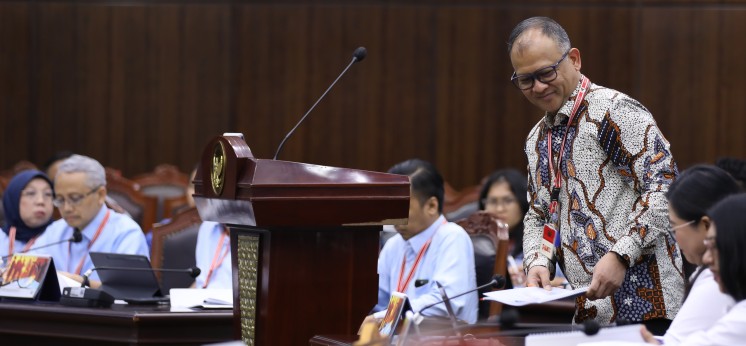
Khairul Munadi testifying on behalf of the Ministry of Higher Education, Science, and Technology as a Relevant Party at a judicial review hearing of the Health Law, Monday (11/10/2025). Photo by MKRI/Ifa.
JAKARTA (MKRI) — The Constitutional Court (MK) held the sixth material judicial review hearing of Article 187 paragraph (4) and Article 209 paragraph (2) of Law No. 17 of 2023 on Health on Monday, November 10, 2025. The petition in case No. 143/PUU-XXIII/2025 was filed by doctors and medical students Razak Ramadhan Jati Riyanto, M. Abdul Latif Khamdilah, M. Hidayat Budi Kusumo, and M. Mukhlis Rudi Prihatno (Petitioners I-IV).
The hearing, chaired by Chief Justice Suhartoyo, was held to hear the statement of the Ministry of Higher Education, Science, and Technology (Kemdiktisaintek) as a Relevant Party and an expert presented by the Petitioners. Director-General of Higher Education Khairul Munadi stated that during the drafting of the Health Bill, the ministry accepted the concept of hospitals serving as the main providers of education through a collaborative-integrative model. This means that teaching hospitals cooperate with universities within a comprehensive and accountable higher education system. This approach aims to ensure that academic quality, clinical professionalism, and the development of medical science are integrated in accordance with the principles of the tridharma (three pillars) of higher education.
To guarantee quality and global relevance, faculties of medicine and medical colleges in Indonesia actively conduct benchmarking and international collaboration with professional medical associations in various countries. The Indonesian Medical Council (KKI) subsequently issued the standards for specialist and subspecialist medical education, which serve as national guidelines for all study programs in terms of graduate competencies, curriculum, and academic management. This demonstrates progress toward a higher education system that is standardized and measurable at both national and international levels.
In relation to this case within the framework of the Health Law, teaching hospitals as primary organizers (RSPPU) must operate under a non-profit principle as mandated by the Higher Education Law and supported by regulations from the Ministry of Health. It is important to note that Article 185 paragraph (3) of the Health Law requires that hospitals established by the public must be legal entities engaged solely in health services. In this context, the RSPPU model must ensure that professional education is conducted on a non-profit basis so as to prevent the commercialization of specialist education, which would contradict the foundational spirit of the national education system.
“And in the long term, to maintain the integrity of the higher education system and protect students, it must be ensured that any non-university entity authorized to provide higher education, including RSPPU, adheres to the fundamental principles of the education system, including the principles of non-profit operation, academic autonomy, internal quality assurance, and social responsibility. Further harmonization between the Health Law and the Higher Education Law is essential to ensure that the reform of professional education does not result in an inconsistent and unaccountable institutional framework,” explained Khairul from the plenary courtroom.
Systemic and Holistic Reform
Khairul further explained that the implementation of medical education should not be limited to achieving clinical competencies but must also focus on shaping professional character that upholds ethics, humanity, and academic integrity. In such a long, intensive, and hierarchical process as medical and specialist training, behavioral deviations such as bullying, verbal and non-verbal violence, discrimination, and harassment can emerge at various levels.
According to Khairul, such phenomena occur not only within faculties of medicine but also in clinical training settings such as teaching hospitals. Therefore, systemic and holistic reform is needed to ensure that the entire educational process takes place in a safe, inclusive, and dignified environment. Ongoing reforms in medical education are being carried out by the Minister of Higher Education, Science, and Technology along with the Ministry of Health within the framework of the academic health system (SKA), particularly in improving access, quality, and relevance of specialist education, including facilitating the accelerated establishment of new specialist programs.
Within this framework, he continued, the Minister of Higher Education, Science, and Technology has issued Ministerial Regulation No. 55 of 2024 on the Prevention and Handling of Violence in Higher Education Institutions. The implementation of this regulation is particularly relevant to medical education, considering the hierarchical nature of the learning process involving lecturers, residents, and health workers in teaching hospitals.
“The reform of medical education must not only be achieved through curriculum improvement and academic quality enhancement, but also through institutional cultural transformation that fosters empathy, mutual respect, and professionalism. Consistent implementation of Regulation No. 55 of 2024 is expected to strengthen the moral responsibility of all stakeholders, both in faculties of medicine and in teaching hospitals, to create a better educational environment,” said Khairul.
State Responsibility
Meanwhile, Slamet P.H., the expert presented by the Petitioners, expressed the view that by granting primary authority to teaching hospitals without reference to Article 31 paragraph (3) of the 1945 Constitution and the Higher Education Law, the Health Law obscures the State’s responsibility for the administration of higher education and risks establishing an education system outside the national education system. Furthermore, supervision conducted by the Ministry of Health rather than by academic authorities could undermine professionalism.
Slamet argued that the scheme of specialist and subspecialist medical education conducted by teaching hospitals diminishes quality assurance, quality control, and performance standards in higher education. As a result, it could widen the gap between research and the real problems faced by graduates of teaching hospitals, which poses potential risks to the public. Moreover, the lag in exposure to the latest research findings could cause graduates to become stagnant in their fields of expertise.
“The administration of specialist and subspecialist medical education by teaching hospitals undermines the academic autonomy of universities, as they lack the capacity to conduct research necessary for developing professional knowledge,” explained Slamet, who presented his statement online.
Also read:
Dualism of Specialist Education Providers under Health Law Disputed
Petitioners Stress Dualism of Specialist Education Providers under Health Law
House: Transformation in Education Essential for Equitable Distribution of Specialists
Health Minister Talks Need for Innovation in Execution of Specialist Medical Education
Being President's Proxy, Ministry of Higher Education Refuses to Testify on Health Law
At the preliminary hearing, the Petitioners argued that these provisions contravene Article 28D paragraph (1) and Article 31 paragraph (3) of the 1945 Constitution. They contended that while the law purported to transform the system by providing an alternative pathway for specialist and subspecialist education through universities and teaching hospitals, it failed to harmonize and reconcile the provisions with Law No. 17 of 2023, as well as with the explicit mandates of Law No. 20 of 2003 and Law No. 12 of 2012.
The Petitioners acknowledged the Government’s declared need to accelerate the production of specialist and subspecialist doctors. However, they argued that this policy created contradictions and misconceptions, generating legal uncertainty that was neither fair nor clear when the legislature introduced a new system of primary organizers of specialist/subspecialist education (RSPPU).
In their view, the legislature acted irrationally in establishing the RSPPU by prioritizing the mass production of doctors without first empowering universities that already exist across Indonesia. They further contended that the system has led to conflicts of interest and tension between two different organizing systems: universities, which operate on a university-based system, and RSPPU, which functions on a hospital-based system. This divergence, they argued, resulted in unequal treatment of medical residents during and after their training.
The Petitioners asserted that Article 187 paragraph (4) and Article 209 paragraph (2) of Law No. 17 of 2023 violate Article 31 paragraph (3) of the 1945 Constitution because the Government introduced a dualism of professional education providers for specialist and subspecialist programs without first harmonizing the respective mandates concerning educational authority. They argued that this dualism could foster envy and conflicts of interest among both providers and medical residents.
Track the case No. 143/PUU-XXIII/2025 here.
Author : Sri Pujianti
Editor : Lulu Anjarsari P.
PR : Fauzan Febriyan
Translator : Yuniar Widiastuti (NL)
Disclaimer: The original version of the news is in Indonesian. In case of any differences between the English and the Indonesian versions, the Indonesian version will prevail.
Monday, November 10, 2025 | 15:08 WIB 1099