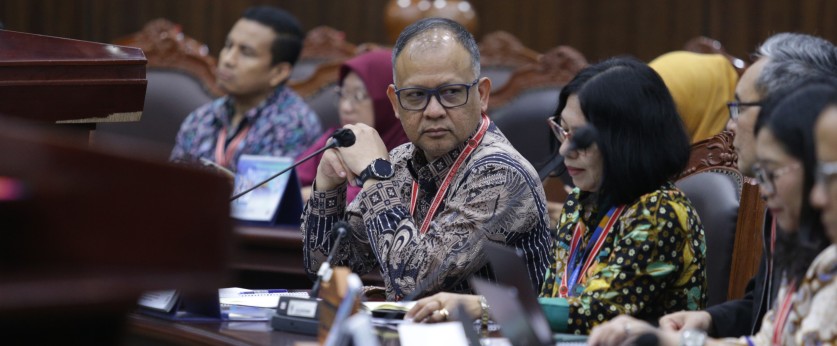
Director-General of Higher Education Khairul Munadi at the material judicial review of the Health Law for case No. 182/PUU-XXII/2024, Tuesday (10/14/2025). Photo by MKRI/Bayu.
JAKARTA (MKRI) — The Constitutional Court (MK) held the eighth hearing for the material judicial review of Law No. 17 of 2023 on Health for cases No. 156/PUU-XXII/2024 and No. 182/PUU-XXII/2024 on Tuesday, October 14, 2025 to hear the Ministry of Higher Education, Science, and Technology; the Association of Indonesian Dental and Oral Hospitals; and the Indonesian Collegium of Obstetrics and Gynecology.
At the said hearing, Director-General of Higher Education at the Ministry, Khairul Munadi, stated that as a scientific body, the collegium serves to formulate competency standards, develop evidence-based curricula, and provide academic recommendations that ensure alignment between learning outcomes and the needs of the professional workforce. Meanwhile, the council is responsible for establishing and supervising professional practice standards, including the registration and certification of health practitioners.
“The relationship between the collegium and the council is complementary, with the collegium ensures academic and scientific quality, while the council guarantees professional competence at the level of practice,” he said in the plenary courtroom.
Khairul explained that the collegium occupies a strategic position as a scientific forum that bridges the academic and professional domains. It ensures that higher education in the health sector remains connected to the dynamics of scientific development and healthcare practices in society.
The collegium serves as an intellectual forum linking academic and scientific education with professional practice based on objective and evidence-based scientific standards. This function is vital in ensuring the compatibility of learning outcomes in higher education with the professions and the continuously evolving professional service standards.
In the implementation of higher education for medical and health professionals, the functions of the collegium encompass several interrelated areas. First, it plays a role in developing national education standards for medical and health professionals as stipulated under Article 280 paragraph (3) of the Health Law. Second, it participates in formulating requirements and standards for teaching hospitals as provided under Article 187 paragraph (6) of the Health Law. Third, it collaborates with universities in administering competency examinations for prospective medical and health professionals as regulated under Article 213 paragraph (3) of the Health Law.
Collaboration between Ministries
Khairul stated that as the institution responsible for higher education and scientific development, the Ministry of Higher Education, Science, and Technology bears the responsibility of ensuring that every academic program and activity in the health field operates in accordance with the principles of quality assurance, academic freedom, and relevance to societal needs. Through the supervision of universities, curriculum improvement, and quality monitoring, it ensures that graduates of medical and health programs possess competencies recognized both academically and professionally.
Meanwhile, the Ministry of Health plays an equally important role as the policymaker in public health services and national health workforce planning. It is responsible for formulating policies that ensure a balance between the number of health graduates and the health service needs of society.
“Collaboration between the Ministry of Higher Education, Science, and Technology and the Ministry of Health is indispensable, as the education of health professionals is not merely an academic matter, but also pertains to the interests of the national health system as a whole,” said Khairul.
In addition to the ministries, professional organizations also occupy an important position in this collaborative ecosystem. Professional organizations serve as guardians of ethics, honor, and professional discipline—key elements of integrity in health services.
Through their involvement in developing ethical and professional practice standards, professional organizations help ensure that graduates of medical and health programs not only master technical skills but also uphold ethical and humanitarian values. These organizations are also involved in the establishment of independent accreditation bodies responsible for accrediting study programs, thereby strengthening external oversight of educational quality for public accountability.
Khairul emphasized that the collegium must stand on equal footing with universities as scientific partners that mutually review and enrich each other in maintaining academic and professional quality. Accordingly, the independence of the collegium is a prerequisite for the sustainability of the higher education system for medical and health professionals.
“Without scientific freedom and academic autonomy, the collegium will lose its capacity to fulfill its role as the guardian of academic quality and guarantor of professional integrity, which constitute the very essence of the higher education mandate,” he said.
He further explained that competency forms the foundation of the collegium’s existence, as all its functions and authorities stem from scientific capability and professional expertise in its field. The collegium is not established as an administrative institution but as a scientific forum that brings together experts and professional educators with deep mastery of specific health disciplines. Therefore, every policy, recommendation, and standard produced by the collegium must be based on valid academic considerations, accountable methodology, and practical experience relevant to healthcare needs.
The Court will commence the ninth hearing on 13:30 WIB on the same day to hear experts it has summoned.
Also read:
IDI Board and 52 Citizens of Various Professional Backgrounds to Test 24 Articles in the Health Law
IDI Board and 52 Citizens Question the Dismissal of Collegium in Health Law
House: Medical Workers Mentoring and Supervision Under Government Authority
Health Minister: Collegium Under Professional Organizations Creates Conflict of Interest
Petitioners’ Expert Talks Conflation of Medical, Health Workers in Health Law
Perdesti Never Officially Recognized Under IDI
AFDOKGI: Current Collegium Vulnerable to Executive Interference
The Petitioners of case No. 182/PUU-XXII/202 comprise of the executive board of the Indonesian Doctors Association (PB IDI) represented by chairman Adib Khumaidi and secretary-general Ulul Albab, along with 52 individuals consisting of doctors, civil servants, lecturers, employees of state-owned enterprises, police officers, military officers, students, retirees, and housewives. They challenge Article 311 paragraph (1), Article 268 paragraph (1), Article 270, Article 272 paragraphs (1), Article 272 paragraph (3), Article 258 paragraph (2), Article 264 paragraphs (1) and (5), Article 291 paragraph (2), Article 421 paragraph (1), Article 442, and Article 454 letter c of the Health Law.
At the preliminary hearing, the Petitioners argued that the Minister of Health had direct intervention and control over the collegium. The minister now has authority to receive a review of the decisions by the professional disciplinary council, to manage the fulfillment of professional credit units (SKP) for medical workers. The minister also has intervention and full control over the implementation of medical education and training.
The Petitioners submitted at least 14 petitums, including a request for the Court to grant the petition in its entirety. They request the Court to make the following interpretations of articles in Law No. 17 of 2023: Article 311 paragraph (1) as “Medical and Health Workers shall form a professional organization for doctors, namely the Indonesian Medical Association, and a professional organization for dentists, namely the Indonesian Dental Association;” Article 268 paragraph (1) as “To improve the quality and technical competence of Medical Workers and Health Workers, and to provide protection and legal certainty for the public, an Indonesian Medical Council shall be established for Medical Workers and for Health Workers an Indonesian Health Council;” Article 270 as “The membership of the Council for Medical Workers shall consist of: a. the Central Government; b. professional organizations of Medical Workers and Health Workers; c. the collegium of professional organizations; and d. the community;” Article 272 paragraph (1) as “To develop disciplines and educational standards for Medical Workers and Health Workers, expert groups from each professional organization in each medical discipline may form a collegium established by the respective professional organizations;” interpret Article 272 paragraph (3) as “The Collegium for Medical Workers shall have the functions of: a. drafting competency standards for Medical Workers; and b. drafting curriculum standards for continuing education for Medical Workers, to be implemented by professional organizations;” and interpret Article 258 paragraph (2) as “Training and/or competency development activities as referred to in paragraph (1) shall be organized by professional organizations and/or training institutions accredited by professional organizations.” They also request the interpretation of Article 264 paragraph (1) letter b, Article 264 paragraph (5), Article 291 paragraph (2), Article 421 paragraph (1), Article 442, and Article 454 letter c of the Health Law.
Also read:
Medical or Health Disciplinary Council’s Recommendation on Criminal or Civil Sanction Questioned
Medical Disciplinary Council’s Recommendation on Sanction Asked to Be Abolished
Govt: Medical Disciplinary Council’s Recommendation Does Not Hinder Law Enforcement
Disciplinary Council Maintains Discipline Among Medical and Health Workers
MDP Member: Investigation Can Commence Without MDP’s Recommendation
Court Will Summon Several Parties to Discuss Collegium in Health Law
Meanwhile, the case No. 156/PUU-XXII/2024 was filed by the Association of Medical and Health Law Consultants (PKHMK) and two advocates. They challenge Article 304 of the Health Law, which concerns provision on disciplinary actions for the profession to support the professionalism of medical and health personnel. The minister formed an assembly that deals with the profession’s discipline. The permanent or ad hoc assembly determines whether a professional disciplinary violation has been committed. The regulation is then delegated to the Government Regulation (PP) No. 28 of 2024 on Health as the implementing provisions, which regulates the establishment, duties, functions, and membership of the Professional Disciplinary Council (MDP).
The Petitioners believe it would be inappropriate for an ethics council to be given authority to recommend and examine any violation of criminal or civil law. In their petitums, they request that the Court declare the phrase “a recommendation from the assembly must first be requested as referred to in Article 304” in Article 308 paragraphs (1), (2), (3), (4), (5), (6), (7), (8), and (9) of the Health Law unconstitutional and not legally binding.
Author : Mimi Kartika
Editor : Lulu Anjarsari P.
PR : Raisa Ayuditha Marsaulina
Translator : Yuniar Widiastuti (NL)
Disclaimer: The original version of the news is in Indonesian. In case of any differences between the English and the Indonesian versions, the Indonesian version will prevail.
Tuesday, October 14, 2025 | 13:26 WIB 285