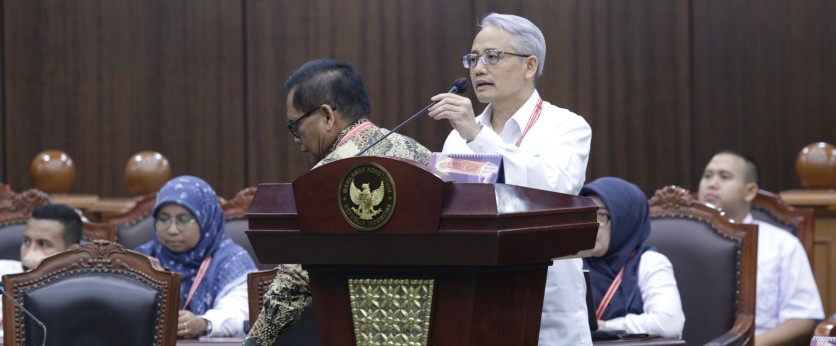
Health Ministry’s secretary-general Kunta Wibawa Dasa Nugraha testified as the president’s proxy at the third judicial review hearing of Law No. 17 of 2023 on Health, Thursday (5/8/2025). Photo by MKRI/Bayu.
JAKARTA (MKRI) — The Constitutional Court (MK) held the third material judicial review hearing of Article 308 paragraphs (1), (2), (3), (4), (5), (6), (7), and (8) of Law No. 17 of 2023 on Health to hear the House of Representatives (DPR) and the president for case No. 156/PUU-XXII/2024. The Health Ministry’s secretary-general Kunta Wibawa Dasa Nugraha testified as the president’s proxy in the plenary courtroom on Thursday, May 8, 2025. He said the Professional Disciplinary Council’s (MDP) recommendation does not hinder law enforcement officials, in this case the police, in assessing the health service process offered by medical or health professionals in criminal and civil cases.
“The MDP’s recommendation does not hinder justice seekers because the recommendation’s deadline is set at no longer than 14 days since the complaint is received,” he said.
He added that Article 308 paragraph (8) of the Health Law stresses that if the Council does not make a recommendation within that deadline, it is regarded to have done so for an investigation into a criminal offense. Requests for recommendations by medical or health professionals or their attorneys in civil cases can be carried out in parallel with the examination in court, so civil procedural law can run in accordance with the provisions or does not stop the legal process.
This shows that the MDP’s recommendation does not keep justice seekers from seeking legal remedies. As stipulated in Article 308 paragraphs (1) and (2), it cannot be interpreted to replace the applicable criminal and civil procedural laws, but rather as technical support in determining aspects of professional disciplinary violations that intersect with legal aspects and as legal considerations by law enforcement officials or judges in carrying out their duties and functions in accordance with the legislation.
Kunta said that the MDP is akin to the Notary Ethics Council (MKN) under Article 66 of Law No. 30 of 2004 on the Notary Public. The MKN’s approval for the judicial process has also been reviewed by the Constitutional Court for allegedly complicating the investigation process or for requiring investigation into notaries.
The Court held that the MKN’s approval does not aim to complicate the investigation process or the need for examination of notaries, moreover the MKN must either accept or reject the request for approval no later than 30 days from the receipt of the letter requesting approval. In the event that the MKN does not provide any response within this period, it is deemed to have accepted the request for approval. The deadline aims to prevent the MKN from hampering the investigation process.
The Petitioners challenge the phrase “a recommendation from the assembly must first be requested as referred to in Article 304” in said norms. Article 308 paragraph (1) of the Health Law reads, “In the event that a Medical Personnel or Health Personnel is suspected of committing any unlawful acts in the implementation of health services that can be subject to criminal sanctions, a recommendation from the assembly must first be requested as referred to in Article 304.” Meanwhile, Article 308 paragraph (2) reads, “For a Medical Personnel and Health Personnel who is held accountable for actions/inactions related to the implementation of Health Services that harm any Patient in a civil manner, a recommendation from the assembly must first be requested as referred to in Article 304.”
Meanwhile, Article 304 concerns provision on disciplinary actions for the profession to support the professionalism of medical and health personnel. The minister formed an assembly that deals with the profession’s discipline. The permanent or ad hoc assembly determines whether a professional disciplinary violation has been committed.
The regulation is then delegated to the Government Regulation (PP) No. 28 of 2024 on Health as the implementing provisions, which regulates the establishment, duties, functions, and membership of the MDP. Kunta revealed that since the appointment of MDP members until April 30, 2025, the Council has received 25 requests for recommendations, including for 22 criminal cases and 3 civil lawsuits, 21 of which have been responded, while four are being examined.
Meanwhile, the House’s Commission III member Rudianto Lallo emphasized that the MDP’s recommendations are only recommendations, while the investigation process is still carried out by law enforcement officials.
“The MDP’s recommendations are only recommendations whether or not an investigation can be carried out because the professional practices carried out by medical or health professionals are in accordance or not in accordance with established professional standards, service standards, and standard operating procedures,” Lallo said.
Also read:
Medical or Health Disciplinary Council’s Recommendation on Criminal or Civil Sanction Questioned
Medical Disciplinary Council’s Recommendation on Sanction Asked to Be Abolished
The Association of Medical and Health Law Consultants (PKHMK) and two advocates ask that the provision on recommendation on criminal/civil sanctions from the Professional Disciplinary Council (MDP) for medical and health personnel be abolished.
The Petitioners believe it would be inappropriate for an ethics council to be given authority to recommend and examine any violation of criminal or civil law. The council cannot be equated with any law enforcement body in the formal sense, which has pro justitia authority, so it must apply due process of the law as well as the presumption of innocence, as it is a disciplinary institution in medicine and health that has the authority to determine whether a medical or health personnel has committed any misconduct or violation in the implementation of their profession. Therefore, rather than due process of law, the council focuses more on due process of ethics and due process of discipline.
The Petitioners argued that any unequal treatment against medical and health personnel in law enforcement cannot be justified and is unconstitutional, as stipulated in Article 27 paragraph (2) of the 1945 Constitution. They must be treated equally before the law in all stages. The requirement for the council’s approval is contrary to the principle of independence in the judicial process. Criminal and civil proceedings are required before obtaining the council’s recommendation, which can result in a protracted judicial process, which may lead to a denial of justice.
In their petitum, the Petitioners request that the Court declare the phrase “a recommendation from the assembly must first be requested as referred to in Article 304” in Article 308 paragraph (1) of the Health Law unconstitutional and not legally binding.
Author : Mimi Kartika
Editor : Lulu Anjarsari P.
PR : Fauzan Febriyan
Translator : Yuniar Widiastuti (NL)
Disclaimer: The original version of the news is in Indonesian. In case of any differences between the English and the Indonesian versions, the Indonesian version will prevail.
Thursday, May 08, 2025 | 16:46 WIB 275