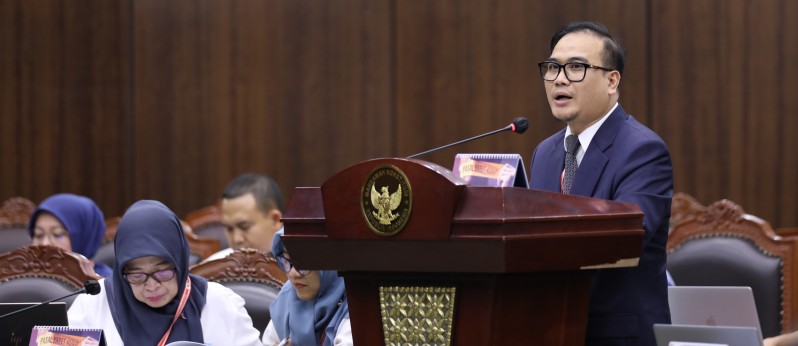
Professional Disciplinary Council’s vice chairman Ahmad Redi testifying as a Relevant Party at the fourth judicial review hearing of Law No. 17 of 2023 on Health, Thursday (5/22/2025). Photo by MKRI/Ifa.
JAKARTA (MKRI) — The Constitutional Court (MK) held the fourth material judicial review hearing of Article 308 paragraphs (1), (2), (3), (4), (5), (6), (7), and (8) of Law No. 17 of 2023 on Health for case No. 156/PUU-XXII/2024 on Thursday, May 22, 2025 in the plenary courtroom to hear the Relevant Party and the witness for Petitioner IV.
The Professional Disciplinary Council’s (MDP) as the Relevant Party, represented by vice chairman Ahmad Redi, said that as an institution enforcing processional discipline, it has an original intent to ensure that medical and health workers carry out all their legal obligations under Article 274 of the Health Law. Thus, he said, the MDP’s recommendations are not meant to assess whether or not there is a violation of the law committed by the individual.
“The MDP feels it is important and Article 308, in our opinion, is in accordance with the constitutional will of the articles of the Constitution in the context of this institution, is very helpful in protecting the public interest as well as protecting health workers and medical personnel who have practiced according to standards,” he said before the constitutional justices.
Article 308 paragraph (1) of the Health Law reads, “In the event that a Medical Personnel or Health Personnel is suspected of committing any unlawful acts in the implementation of health services that can be subject to criminal sanctions, a recommendation from the assembly must first be requested as referred to in Article 304.” Meanwhile, Article 308 paragraph (2) reads, “For a Medical Personnel and Health Personnel who is held accountable for actions/inactions related to the implementation of Health Services that harm any Patient in a civil manner, a recommendation from the assembly must first be requested as referred to in Article 304.”
Ahmad Redi said, since its establishment until May 21, 2025, the MDP had received requests for recommendations from various agencies in all regions. It had recommended that 27 medical and health workers could be investigated, 11 medical and health workers could not be investigated, while three requests were being reviewed. It had also issued recommendations for 5 medical and health workers in civil cases.
To date, the MDP is still fulfilling its duties to examine and respond to all requests for recommendations. Its limited structure, with only nine members at the central level, does not hinder the quality and quantity of its performance nor does it cause the council to neglect requests.
Protection for Medical and Health Workers
The Petitioners presented drg. Vera Dumonda Silitonga—an expert on management, human resources, civil law on health, and hospital administration management—as an expert. She emphasized that medical and health workers have the right to be protected from unfounded criminalization. However, this protection must be provided through an objective and transparent legal process, not through a closed and administrative mechanism.
“Article 308 actually imposes the responsibility of this protection on a single administrative channel that is less accountable and does not have a checks and balances the way the judiciary does,” she said.
Silitonga revealed that, compared to the UK, Germany, Japan, and the United States, criminal and civil sanctions against medical and health workers in Indonesia requires a recommendation from the Disciplinary Council. The role of ethics bodies in those countries is only consultative, technical opinions are included, and many cases are resolved in the civil realm. Only in Indonesia does the ethics body have the formal authority to determine whether criminal process can proceed.
Thus, she said, Article 308 of the Health Law places the MDP, which is not a judicial institution, in a position to intervene in the law enforcement. This certainly interferes with the independence of law enforcement officials, creates overlap and uncertainty in the legal system, and could potentially create unaccountable power.
Victim Testimonies
The Petitioners also presented Venny Romatua Damanik and Dedy Rinaldy Siregar as witnesses. Damanik, an advocate, has a client named Rintho Franki Lumbangaol, whose wife Vanny Fransisca was allegedly the victim of malpractice by an obstetrician and an anesthesiologist at the Ibu dan Anak Hospital (RSIA) Nuraida in Bogor.
Her client has reported the two doctors to the Indonesian Medical Disciplinary Board (MKDKI). The MKDKI revoked dr. Lukman’s registration certificate (STR) for three months and gave dr. Yudhanarko a written warning.
The client has also made a report on the malpractice at the Bogor City Police and in the process of examining the report, the Bogor City Police was restricted due to Article 308 paragraphs (1), (2), and (5) of the Health Law. They stated that there must be a recommendation from the MDP to determine whether or not the report could be investigated.
“Initially, the Bogor City Police investigator was also very reluctant to continue this case to the investigation stage because of [the need for] the MDP’s recommendation. But we asked them to raise this case to investigation stage without the recommendation, which the investigator refused. Due to the prolonged issue of the MDP’s recommendation, [my] client lost patience and sent letters requesting legal protection and justice to the House of Representatives (DPR), Komnas HAM (National Commission on Human Rights), Ombudsman, and KPAI (Indonesian Child Protection Commission). Finally, the Bogor City Police investigator was forced to yield and send a letter requesting a recommendation to the MDP,” Damanik said.
She added that her client had been harmed by the enforcement of Article 308 of the Health Law. She believes no medical or health workers would want to ask for the MDP for recommendations when they are sued in court.
“We also received information that many lawsuits in court have been [declared inadmissible] because they are premature, because there was no recommendation from the MDP requested by the medical workers being sued,” Damanik revealed.
Also read:
Medical or Health Disciplinary Council’s Recommendation on Criminal or Civil Sanction Questioned
Medical Disciplinary Council’s Recommendation on Sanction Asked to Be Abolished
Govt: Medical Disciplinary Council’s Recommendation Does Not Hinder Law Enforcement
The Association of Medical and Health Law Consultants (PKHMK) and two advocates ask that the provision on recommendation on criminal/civil sanctions from the Professional Disciplinary Council (MDP) for medical and health personnel be abolished.
The Petitioners believe it would be inappropriate for an ethics council to be given authority to recommend and examine any violation of criminal or civil law. The council cannot be equated with any law enforcement body in the formal sense, which has pro justitia authority, so it must apply due process of the law as well as the presumption of innocence, as it is a disciplinary institution in medicine and health that has the authority to determine whether a medical or health personnel has committed any misconduct or violation in the implementation of their profession. Therefore, rather than due process of law, the council focuses more on due process of ethics and due process of discipline.
The Petitioners argued that any unequal treatment against medical and health personnel in law enforcement cannot be justified and is unconstitutional, as stipulated in Article 27 paragraph (2) of the 1945 Constitution. They must be treated equally before the law in all stages. The requirement for the council’s approval is contrary to the principle of independence in the judicial process. Criminal and civil proceedings are required before obtaining the council’s recommendation, which can result in a protracted judicial process, which may lead to a denial of justice.
In their petitum, the Petitioners request that the Court declare the phrase “a recommendation from the assembly must first be requested as referred to in Article 304” in Article 308 paragraph (1) of the Health Law unconstitutional and not legally binding.
Author : Mimi Kartika
Editor : Lulu Anjarsari P.
PR : Fauzan Febriyan
Translator : Yuniar Widiastuti (NL)
Disclaimer: The original version of the news is in Indonesian. In case of any differences between the English and the Indonesian versions, the Indonesian version will prevail.
Thursday, May 22, 2025 | 15:58 WIB 258