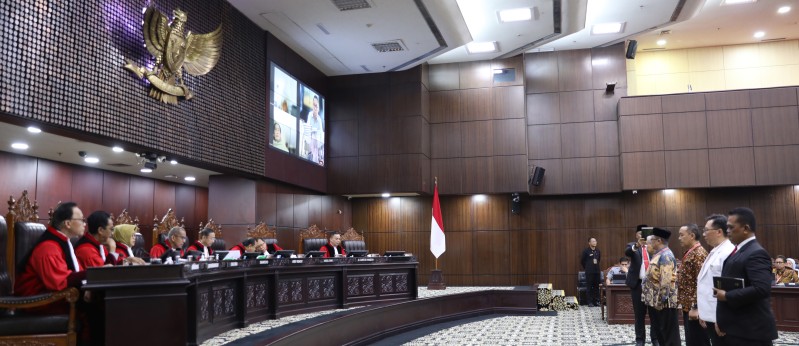
Government experts and witnesses taking oath before the constitutional justices at the sixth hearing for the material judicial review of the Health Law for case No. 182/PUU-XXII/2024, Monday (7/7/2025). Photo by MKRI/Ifa.
JAKARTA (MKRI) — The Indonesian Society for Aesthetic Medicine (Perdesti) stated that it has never been formally rejected by the Congress of the Indonesian Medical Association (IDI), yet it has also never been officially recognized as a special-interest society under IDI. According to dr. Hendry Hartono, Perdesti’s chairperson and founder, all requirements—including documentation and organizational oversight guidance—had been fully complied with IDI’s directives.
“[Perdesti] has never been formally rejected by the IDI Congress, yet it has never been formally recognized as a special-interest society under IDI, even though all requirements, both documentation and organizational oversight, were fully met as instructed by IDI,” said Hartono, who appeared as a witness presented by the President sixth material judicial review hearing of Law No. 17 of 2023 on Health for case No. 182/PUU-XXII/2024 on Monday, July 7, 2025 in the Constitutional Court’s (MK) plenary courtroom.
He explained that IDI, through its Professional Services Development Council (MPPK), reviewed three independent special-interest organizations—Perdesti (established in 2006), the Indonesian Society of Healthy-Aging Medicine (Perpasti, 2008), and Indonesian Society of Anti-Aging Medicine (Perkapi, 2008). The Council then recommended their consolidation into a single umbrella body of doctors specializing in anti-aging and aesthetics recognized by IDI. In 2013, IDI formally instructed these organizations, through an official decree (SK), to merge into the Indonesian Society of Anti-Aging, Wellness, Aesthetic, and Regenerative Medicine (Perdaweri), citing the need to simplify oversight and facilitate formal recognition.
However, while Perkapi and Perpasti chose to dissolve themselves as organizations, Hartono said, Perdesti did not dissolve and continues to operate as a legally recognized association. In his view, the rapid formation of Perdaweri reflected what he described as a forced takeover orchestrated by IDI as the sole professional organization.
Hartono further argued that the state should allow aesthetic medicine practitioners to choose not to join IDI or its umbrella organization Perdaweri if an alternative professional body such as Perdesti aligns better with their scientific approach and ethical values. According to him, Law No. 17 of 2023 on Health provides a pathway for Perdesti and the aesthetic doctors it represents to obtain practice legitimacy without relying on a professional organization that may not always act impartially.
The Health Law mandates the unification of the medical council functions into a single entity directly accountable to the President and coordinated by the Minister of Health, instead of being placed under the authority of a professional organization as previously practiced. This unification is seen as a way to prevent monopoly over competency and ethical assessments by a single group and to pave the way for the recognition of new professional organizations such as Perdesti in a more inclusive and equitable manner.
Meanwhile, Professor Aidul Fitriciada Azhari, a constitutional law scholar at Muhammadiyah University of Surakarta, who appeared as an expert presented by the President, stated that the phrase “Medical and Health Workers may form a professional organization” in Article 311 paragraph (1) of Law No. 17 of 2023 is, in fact, an expression of respect for freedom of association as guaranteed by the 1945 Constitution. According to him, the state neither monopolizes nor unilaterally determines which professional organizations should exist, and the presence of multiple professional organizations in society is a social reality that must be recognized in law.
“This article does not serve as a means of dissolving or forcibly merging professional organizations; rather, it affirms the constitutional right of every medical and health worker to establish or join an organization voluntarily,” he explained.
Responding to concerns that the absence of strict limitations in the phrase “may form” could lead to legal disorder, he clarified that both grammatically and systematically, the provision refers specifically to professionals with legally recognized qualifications. Therefore, he argued, the law does not open the door for just anyone to establish an organization in the name of medical professionals.
Before adjourning the session, Chief Justice Suhartoyo announced that today’s hearing was the last evidentiary hearing. The litigants may submit a written concluding statement by Tuesday, July 15, 2025. Meanwhile, the Court would deliberate at a meeting to decide the ruling for the petition.
Also read:
IDI Board and 52 Citizens of Various Professional Backgrounds to Test 24 Articles in the Health Law
IDI Board and 52 Citizens Question the Dismissal of Collegium in Health Law
House: Medical Workers Mentoring and Supervision Under Government Authority
Health Minister: Collegium Under Professional Organizations Creates Conflict of Interest
Petitioners’ Expert Talks Conflation of Medical, Health Workers in Health Law
The Petitioners of the case comprise of the executive board of the Indonesian Doctors Association (PB IDI) represented by chairman Adib Khumaidi and secretary-general Ulul Albab, along with 52 individuals consisting of doctors, civil servants, lecturers, employees of state-owned enterprises, police officers, military officers, students, retirees, and housewives. They challenge Article 311 paragraph (1), Article 268 paragraph (1), Article 270, Article 272 paragraphs (1), Article 272 paragraph (3), Article 258 paragraph (2), Article 264 paragraphs (1) and (5), Article 291 paragraph (2), Article 421 paragraph (1), Article 442, and Article 454 letter c of the Health Law.
At the preliminary hearing, the Petitioners argued that the Minister of Health had direct intervention and control over the collegium. The minister now has authority to receive a review of the decisions by the professional disciplinary council, to manage the fulfillment of professional credit units (SKP) for medical workers. The minister also has intervention and full control over the implementation of medical education and training.
The Petitioners submitted at least 14 petitums, including a request for the Court to grant the petition in its entirety. The request the Court to make the following interpretations of articles in Law No. 17 of 2023: Article 311 paragraph (1) as “Medical and Health Workers shall form a professional organization for doctors, namely the Indonesian Medical Association, and a professional organization for dentists, namely the Indonesian Dental Association;” Article 268 paragraph (1) as “To improve the quality and technical competence of Medical Workers and Health Workers, and to provide protection and legal certainty for the public, an Indonesian Medical Council shall be established for Medical Workers and for Health Workers an Indonesian Health Council;” Article 270 as “The membership of the Council for Medical Workers shall consist of: a. the Central Government; b. professional organizations of Medical Workers and Health Workers; c. the collegium of professional organizations; and d. the community;” Article 272 paragraph (1) as “To develop disciplines and educational standards for Medical Workers and Health Workers, expert groups from each professional organization in each medical discipline may form a collegium established by the respective professional organizations;” interpret Article 272 paragraph (3) as “The Collegium for Medical Workers shall have the functions of: a. drafting competency standards for Medical Workers; and b. drafting curriculum standards for continuing education for Medical Workers, to be implemented by professional organizations;” and interpret Article 258 paragraph (2) as “Training and/or competency development activities as referred to in paragraph (1) shall be organized by professional organizations and/or training institutions accredited by professional organizations.” They also request the interpretation of Article 264 paragraph (1) letter b, Article 264 paragraph (5), Article 291 paragraph (2), Article 421 paragraph (1), Article 442, and Article 454 letter c of the Health Law.
Author : Mimi Kartika
Editor : Lulu Anjarsari P.
PR : Fauzan Febriyan
Translator : Yuniar Widiastuti (NL)
Disclaimer: The original version of the news is in Indonesian. In case of any differences between the English and the Indonesian versions, the Indonesian version will prevail.
Monday, July 07, 2025 | 16:38 WIB 558