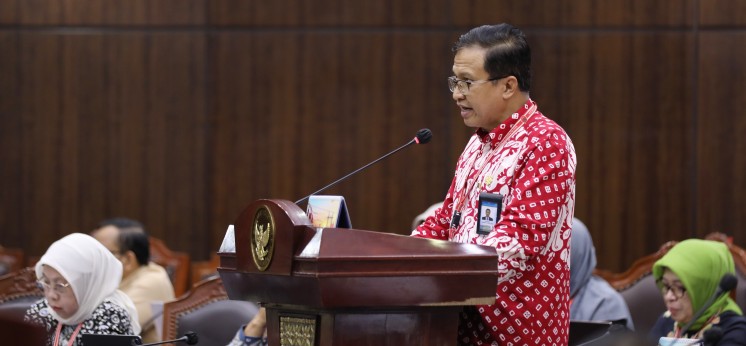
AFDOKGI Chair, Suryono, delivering his statement during the resumed hearings of the judicial review of Law No. 17 of 2023 on Health, Tuesday (30/09). Photo by MKRI/Ifa.
Jakarta (MKRI) – The Constitutional Court (MK) resumed hearings on the judicial review of Law No. 17 of 2023 on Health (the Health Law) in Cases No. 156/PUU-XXII/2024 and 182/PUU-XXII/2024 on Tuesday, September 30, 2025. The Court invited the Indonesian Association of Medical Education Institutions (Asosiasi Institusi Pendidikan Kedokteran Indonesia, AIPKI), the Association of Indonesian Teaching Hospitals (Asosiasi Rumah Sakit Pendidikan Indonesia, ARSPI), and the Association of Indonesian Dental Faculties (Asosiasi Fakultas Kedokteran Gigi Indonesia, AFDOKGI) to present their statements regarding the petition.
AFDOKGI Chair Suryono stated that ideally, the collegium should be an independent institution, free from interference by those in power, so that academic freedom in scientific development is unhindered by intimidation, political pressure, or the objectives of the authorities.
“AFDOKGI fully agrees with the petitioners’ statements on the current non-independence of the collegium, which therefore is vulnerable to executive interests,” Suryono stated.
Suryono noted that AFDOKGI, which encompasses 45 dental schools nationwide, has maintained a harmonious relationship with the Indonesian Dental Collegium (KDGI) in administering competency exams for dental students (UKMP2DG) and issuing certificates for those who pass, both before and after the Health Law’s enactment. However, with the law’s passage, the status of the KDGI shifted from being under the Indonesian Dental Association (PDGI) to being part of the Indonesian Health Council (Konsil Kesehatan Indonesia), which is overseen by the Ministry of Health, along with ten other dental specialty collegia.
Citing Article 272 paragraph (2) of the Health Law, Suryono pointed out that while the collegium is described as an “independent organ” of the health council, in practice, since the council is now under ministerial authority, it no longer operates as an independent entity insulated from the executive branch. Previously, the Indonesian Medical Council answered directly to the President.
AFDOKGI also concurred with the petitioners that Article 451 of Law 17 of 2023, which states, “When this Law enters into force, collegia formed by any professional organization shall remain recognized until collegia under Article 272 created by this Law are established,” constitutes a repressive and authoritarian provision. Suryono argued that there is no fundamental rationale to delegitimize existing collegia formed by professional bodies.
Meanwhile, ARSPI Chair Andi Wahyuningsih Attas affirmed the association’s role in upholding clinical education standards in teaching hospitals, formulating, and recommending policy proposals. She added that teaching hospitals can only be designated as such by the health minister once all the necessary legal requirements have been met.
Under the Health Law, requirements, standards, and accreditation for teaching hospital designation are jointly drafted by the Ministry of Health and the Ministry of Higher Education, Science, and Technology, with collegium involvement. At least nine requirements must be met, including healthcare service delivery and a sufficient range and volume of cases for educational needs. In addition, teaching hospitals must meet management, human resources, educational facilities, and clinical program standards.
“And the process for designating a teaching hospital involves a team from the ministries—specifically, the Ministry of Health, the higher education ministry via the AIPKI, and ARSPI,” Andi explained.
Also read:
IDI Board and 52 Citizens of Various Professional Backgrounds to Test 24 Articles in the Health Law
IDI Board and 52 Citizens Question the Dismissal of Collegium in Health Law
House: Medical Workers Mentoring and Supervision Under Government Authority
Health Minister: Collegium Under Professional Organizations Creates Conflict of Interest
Petitioners’ Expert Talks Conflation of Medical, Health Workers in Health Law
Perdesti Never Officially Recognized Under IDI
The Petitioners of the case comprise of the executive board of the Indonesian Doctors Association (PB IDI) represented by chairman Adib Khumaidi and secretary-general Ulul Albab, along with 52 individuals consisting of doctors, civil servants, lecturers, employees of state-owned enterprises, police officers, military officers, students, retirees, and housewives. They challenge Article 311 paragraph (1), Article 268 paragraph (1), Article 270, Article 272 paragraphs (1), Article 272 paragraph (3), Article 258 paragraph (2), Article 264 paragraphs (1) and (5), Article 291 paragraph (2), Article 421 paragraph (1), Article 442, and Article 454 letter c of the Health Law.
At the preliminary hearing, the Petitioners argued that the Minister of Health had direct intervention and control over the collegium. The minister now has authority to receive a review of the decisions by the professional disciplinary council, to manage the fulfillment of professional credit units (SKP) for medical workers. The minister also has intervention and full control over the implementation of medical education and training.
The Petitioners submitted at least 14 petitums, including a request for the Court to grant the petition in its entirety. The request the Court to make the following interpretations of articles in Law No. 17 of 2023: Article 311 paragraph (1) as “Medical and Health Workers shall form a professional organization for doctors, namely the Indonesian Medical Association, and a professional organization for dentists, namely the Indonesian Dental Association;” Article 268 paragraph (1) as “To improve the quality and technical competence of Medical Workers and Health Workers, and to provide protection and legal certainty for the public, an Indonesian Medical Council shall be established for Medical Workers and for Health Workers an Indonesian Health Council;” Article 270 as “The membership of the Council for Medical Workers shall consist of: a. the Central Government; b. professional organizations of Medical Workers and Health Workers; c. the collegium of professional organizations; and d. the community;” Article 272 paragraph (1) as “To develop disciplines and educational standards for Medical Workers and Health Workers, expert groups from each professional organization in each medical discipline may form a collegium established by the respective professional organizations;” interpret Article 272 paragraph (3) as “The Collegium for Medical Workers shall have the functions of: a. drafting competency standards for Medical Workers; and b. drafting curriculum standards for continuing education for Medical Workers, to be implemented by professional organizations;” and interpret Article 258 paragraph (2) as “Training and/or competency development activities as referred to in paragraph (1) shall be organized by professional organizations and/or training institutions accredited by professional organizations.” They also request the interpretation of Article 264 paragraph (1) letter b, Article 264 paragraph (5), Article 291 paragraph (2), Article 421 paragraph (1), Article 442, and Article 454 letter c of the Health Law.
Author : Mimi Kartika
Editor : Lulu Anjarsari P.
PR : Fauzan Febriyan
Translator : Rizky Kurnia Chaesario/Yuniar Widiastuti (NL)
Disclaimer: The original version of the news is in Indonesian. In case of any differences between the English and the Indonesian versions, the Indonesian version will prevail.
Tuesday, September 30, 2025 | 13:54 WIB 190