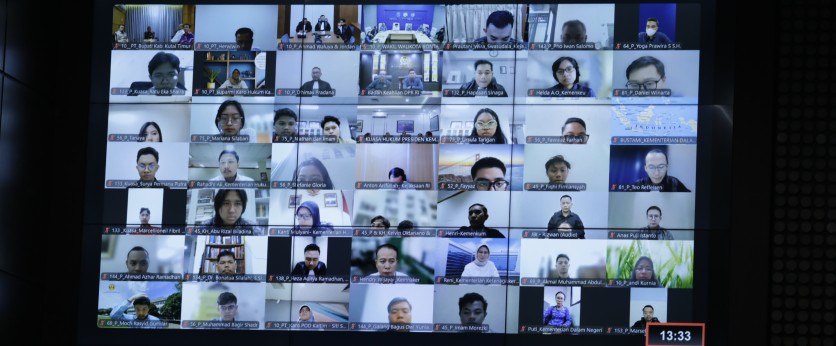
Decision/Decree Pronouncement of Case No. 45/PUU-XXIII/2025 on the formal judicial review of Law No. 3 of 2025 on the Amendment to Law No. 34 of 2004 on the Indonesian National Armed Forces, Wednesday (17/9). Photo by MKRI/Bay.
Jakarta (MKRI) – The Constitutional Court (MK) issued Decision No. 45/PUU-XXIII/2025 on the formal judicial review of Law No. 3 of 2025 on the Amendment to Law No. 34 of 2004 on the Indonesian National Armed Forces. In the verdict, the Court declares the Petitioners’ petition unacceptable.
The Court holds that the Petitioners, comprising seven students: Muhammad Alif Ramadhan, Kelvin Oktariano, Mohammad Syaddad Sumartadinata, Fiqhi Firmansyah, and Imama Morezki Batanta Manihuruk, do not have legal standing.
Justice Enny stated that after being studied and examined during the hearing sessions, no evidence or facts exhibit the Petitioners’ active involvement in the legislation process of Law No. 3 of 2025 since the beginning. At the end, the Court held that the petitioners have no legal standing.
However, Chief Justice Suhartoyo and Deputy Chief Justice Saldi Isra have a dissenting opinion. They opined that the Court should declare that the Petitioners have legal standing, and the Court may consider the main points of their petition further.
Also read:
Petition on Army Law Highlights Armed Forces Assignment to Ministries
Reviewing Indonesian National Army Law Legislation Process
DPR: Continued Discussion on the Army Law Bill Depends on Political Agreement
Expert: Army Law Legislation Process Unconstitutional
Development of Meaningful Participation Test in the Making of Army Law
DPR Expert: Public Participation Issues Become the Gateway for Judicial Review
Prof. Aswata: Lawmaking Law Cannot Be Used As Basis to Formally Review Army Law
The Petitioners essentially questioned violations of several principles in the formation of laws and regulations as stipulated in Article 5 of the Lawmaking Law. These principles include the principle of clarity of purpose, the principle of appropriate institutional or official authority, the principle of conformity between the type, hierarchy, and content, the principle of implementability, the principle of utility and effectiveness, the principle of clarity in formulation, and the principle of openness. The formulation of these principles in Article 5 of the lawmaking law is cumulative; hence, all principles must be met.
The absence of the principles of clarity of purpose, utility, effectiveness, and openness in the legislation process of the TNI Law results in a formal flaw. Therefore, in their petitum, the Petitioners asked the Court to declare that the making of Law No. 3 of 2025 on the TNI does not fulfill the lawmaking requirements and is not legally binding.
Author: Mimi Kartika.
Editor: N. Rosi
Humas: Andhini Sayu Fauzia.
Translator: Rizky Kurnia Chaesario
Disclaimer: The original version of the news is in Indonesian. In case of any differences between the English and the Indonesian versions, the Indonesian version will prevail.
Wednesday, September 17, 2025 | 15:46 WIB 151