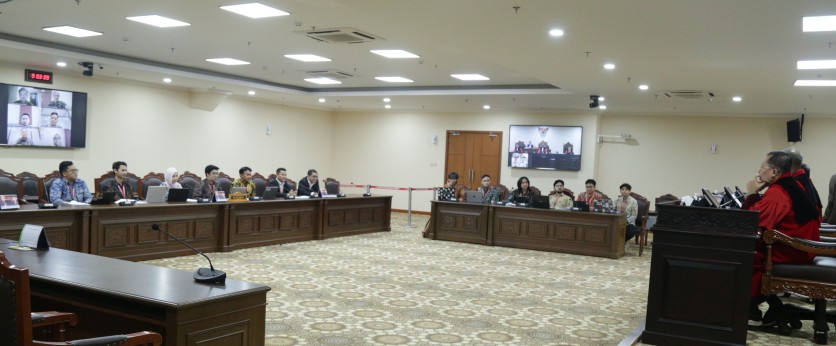
Formal and material judicial review hearing of Law No. 3 of 2025 on the Amendment to Law No. 34 of 2004 on the Indonesian National Armed Forces (Army Law) for Case No. 45/PUU-XXIII/2025, 55/PUU-XXIII/2025, 69/PUU-XXIII/2025, and 79/PUU-XXIII/2025, Friday (9/5/2025). Photo by MKRI/Bay.
Jakarta (MKRI)—The Constitutional Court held a hearing on eleven cases of formal and material judicial review of Law No. 3 of 2025 on the Amendment to Law No. 34 of 2004 on the Indonesian National Armed Forces (Army Law). The hearing was divided into three panels of justices. Deputy Chief Justice Saldi Isra presided over one panel, accompanied by Justice Ridwan Mansyur and Justice Arsul Sani, to hear Case No. 45/PUU-XXIII/2025, 55/PUU-XXIII/2025, 69/PUU-XXIII/2025, and 79/PUU-XXIII/2025.
“This is the first time in the history of the Constitutional Court that one issue is heard simultaneously in three different panels. This is the first time in the history of the Court because there are so many petitions. So, indeed, the enthusiasm to submit the petition is high,” Deputy Chief Justice Saldi Isra stated during the preliminary hearing on Friday, May 9, 2025, at the Courtroom.
Case No. 45/PUU-XXIII/2025 was filed by seven students: Muhammad Alif Ramadhan, Namoradiarta Siahaan, Kelvin Oktarino, M. Nurroby Fatih, Nicholas Indra Cyrill Kataren, Mohammad Syaddad Sumartadinata, and R. Yuniar A. Alpandi. Case No. 55/PUU-XXIII/2025 was submitted by private employees: Christian Adrianus Sihite and Noverianus Samosir. Case No. 69/PUU-XXIII/2025 was filed by students, among others, Moch Rasyid Gumilar, Kartika Eka Pertiwi, Akmal Muhammad Abdullah, Fadhil Wirdiyan Ihsan, and Riyan Fernando. Case No. 79/PUU-XXIII/2025 was submitted by students Endrianto Bayu Setiawan, Raditya Nur Sya’bani, Felix Rafiansyah Affandi, Dinda Rahmalia, Muhamad Teguh Pebrian, and Andrean Agus Budiyanto.
Behind Closed-Door Meeting
The Petitioners, essentially, questioned the lawmaking principles' violation as stipulated in Article 5 of the Lawmaking Law (P3 Law). The principles are, among other things, clear purposes; institutional principles, or appropriate formulating officials; the principle of compatibility between type, hierarchy, and content material; the principle of implementability; the principle of usability and usefulness; the principle of clarity of formulation; and the principle of openness.
The Petitioners of Case No. 69/PUU-XXIII/2025 explained that the openness principle based on the elucidation of Article 5 letter g of the Lawmaking Law emphasizes that lawmaking starts from transparent and open planning, formulation, discussion, endorsement, or stipulation, and promulgation.
“The violation of openness is apparent in the crucial discussion on the TNI Law revision bill, the meeting of the working group that was held behind closed doors in the Fairmont Hotel on March 14-15, 2025. This action effectively prevented the people’s participation in giving input in the critical stage,” Akmal Muhammad Abdullah stated.
Lawmaking principles stipulated in Article 5 of the Lawmaking Law were cumulatively formulated, meaning that all principles must be fulfilled and cannot be ignored. By not fulfilling the clear purposes principle, the utilization and usefulness principles, and the openness principle in the formulation process of the Army Law, it caused a formal flaw.
Hence, in the petitum, the Petitioners requested the Court to declare the formulation of Law No. 3 of 2023 on the Indonesian National Armed Forces does not fulfill the provisions of the lawmaking procedure based on the 1945 Constitution of the Republic of Indonesia and does not have legally binding force.
Armed Forces Occupy Government Positions
Meanwhile, referring to the academic paper of the Army Law Revision Bill, there is a role expansion of active armed forces in government ministries/agencies. It is said to resolve limited human resources issues. However, according to the Petitioners, there were contradictions because the assignment of active armed forces in ministries/agencies potentially prohibited a meritocracy system within the government.
Military-trained armed forces were believed to carry the culture of one command, which may erode democracy. Meanwhile, military tradition with a command system may clash with the democratic governance system.
Hence, in addition to a formal petition, Case No. 79/PUU-XXIII/2025, also requested for material review of Article 7 paragraph (2) letter b point 9 and point 15 that reads, “Main duties as referred to in paragraph (1) are carried out by b. military operations other than war, namely to: 9. Assist government duties in region; 15. Assist in the effort to overcome cyber defense threats;” and Article 7 paragraph (4), which reads: “The implementation of military operations other than war as referred to in paragraph (2) letter b is further regulated by Government Regulation or Presidential Regulation, except for paragraph (2) letter b number 10.”
Then, the Petitioners also petitioned for material judicial review of Article 47 paragraph (1), that reads, “Armed forces may occupy positions in ministries/agencies in charge of coordinating the fields of state politics and security, state defense including the national defense council, the state secretariat handling the affairs of the presidential secretariat and the presidential military secretariat, state intelligence, cyber and/or state ciphers, national security institutions, search and rescue, national narcotics, border management, disaster management, counter-terrorism, maritime security, the Attorney General's Office of the Republic of Indonesia, and the Supreme Court. Article 47 paragraph (3) reads, “Armed forces who occupy certain positions as referred to in paragraph (1) are based on the request of the head of the ministry/agency and are subject to the applicable administrative provisions within the ministry and agency."
“The Petitioners opined that various civil positions stipulated in Article 47 paragraph (1) of Law No. 3 of 2025 are, basically, more appropriate to be occupied by civic elements, or at least by armed forces who have officially resigned from their military status. It is based on the military professionalism and civil supremacy principles within the framework of the constitutional democratic system.” Petitioner of Case No. 79/PUU-XXIII/2025, Andrean Agus Budianto, stated.
However, the Petitioners partially accepted if some positions in the presidential military secretariat, the Supreme Court, and the Attorney General’s Office were filled by active armed forces, considering its technical and operational relevance with the defense field or function. However, regarding other positions as stipulated in Article 47 paragraph (1), the involvement of active armed forces risks an overlap between civil and military functions, blurs neutrality and military professionalism principles, and contradicts the civic position characteristics, which should be free of military command structure.
In the petitums, the Petitioners requested the Court to declare Article 7 paragraph (2) letter b point 9 of the Army Law constitutional as long as it is interpreted as “assisting the duties of regional governments based on laws and regulations;” Article 7 paragraph (2) letter b point 15 of the Army Law constitutional as long as it is interpreted as “assisting in the effort to overcome cyber attacks which threaten the national defense system;” Article 7 paragraph (4) of the Army Law constitutional as long as it is interpreted as “Military operations other than war as referred to in paragraph (2) letter b is further regulated in laws;” Article 47 paragraph (1) of the Army Law constitutional as long as it is interpreted as “Armed forces may occupy positions in ministries/agencies in the field of presidential military secretariat, the Attorney General’s Office of the Republic of Indonesia, and the Supreme Court.” In addition, Article 47 paragraph (3) of the Army Law is constitutional as long as it is interpreted as “Armed forces who occupy certain positions as referred to in paragraph (1) are based on laws and regulations and are subject to the applicable administrative provisions within the ministry and agency.”
Justices’ Advice
Justice Ridwan Mansyur advised the Petitioners of each case to observe the Constitutional Court Regulation No. 2 of 2021 on the Procedure of Judicial Review to formulate the petition systematically. The Petitioners may explain clearly and carefully their legal standings and the constitutional harms they suffered due to the enactment of the tested law, which is against the 1945 Constitution of the Republic of Indonesia.
“The explanation will later convince the Court that the Petitioners are legitimate or not only the Petitioners, because if [the petition] is successful, it is not only for the interest of the Petitioners but also all of the Indonesian citizens,” Justice Ridwan stated.
Meanwhile, Deputy Chief Justice Saldi Isra added that the Petitioners, who were mostly university students, may join the other students in different cases to strengthen the arguments in this petition. According to the Deputy Chief Justice, despite different university backgrounds, by joining, the Petitioners may strengthen their arguments, petitions, and supporting evidence for the same goal.
“It is better for the university students to join in one petition, think about it. So that all university students in Indonesia appear to be united in one petition. I suspect that in other panels there are also university students, so that you can complete each other's arguments, propositions, and other things. Because it is not about representing the universities that is important, but the substance that you fight for,” Deputy Chief Justice Saldi Isra stated.
Before adjourning the hearing, Deputy Chief Justice Saldi Isra said that the Petitioners may revise their petitions within 14 days. The document must be submitted on Thursday, May 22, 2025, at the latest.
Also read:
Petition No. 45/PUU-XXIII/2025
Petition No. 55/PUU-XXIII/2025
Petition No. 69/PUU-XXIII/2025
Petition No. 79/PUU-XXIII/2025
Author: Mimi Kartika.
Editor: N. Rosi
PR: Andhini Sayu Fauzia.
Translator: Rizky Kurnia Chaesario
Disclaimer: The original version of the news is in Indonesian. In case of any differences between the English and the Indonesian versions, the Indonesian version will prevail.
Friday, May 09, 2025 | 14:28 WIB 288