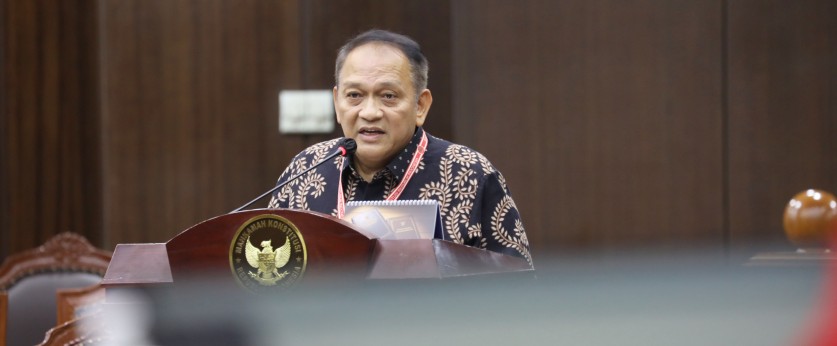
Constitutional Law Lecturer from Universitas Indonesia, Mohammad Novrizal, attending the hearing to testify on the judicial review of Army Law as an expert, Tuesday (1/7). Photo by MKRI/Panji.
Jakarta (MKRI) – A Constitutional Law Lecturer from Universitas Indonesia, Mohammad Novrizal, asserted that the legislative process of Law No. 3 of 2025 on the Amendment to Law No. 34 of 2004 on the Indonesian National Armed Forces (Army Law) is unconstitutional. He contends that the process violated statutory regulations governing law-making procedures, which are an implementation of the constitutional norm stipulated in Article 22A of the 1945 Constitution of the Republic of Indonesia (UUD NRI).
Novrizal, serving as an expert witness for the petitioners in Case Number 45/PUU-XXIII/2025 during the Constitutional Court hearing on July 1, 2025, explained that the planning and preparatory stages of the Army Law amendment were unconstitutional. He emphasized that the drafting of bills must be based on the Annual Priority National Legislation Program (Prolegnas Prioritas Tahunan). However, the Army Law amendment was only listed in the Medium-Term National Legislation Program (Prolegnas Jangka Menengah), not in the Annual Priority Program nor in the Open Cumulative List of either program. According to Article 23 paragraph (1) of the Law on the Formation of Legislation (UU P3), the Prolegnas must include an open cumulative list that encompasses amendments resulting from Constitutional Court decisions.
Novrizal further noted that the decision to discuss the Army Law amendment bill only emerged during the 13th Plenary Session of the House of Representatives (DPR) in the second session period of 2025 on February 18, 2025. During this session, the DPR agreed to amend the 2025 Annual Priority Prolegnas, which had been previously established by DPR Decree Number 64/DPRRI/I/2024-2025. However, the official agenda of that plenary session did not include any item regarding the amendment of the Prolegnas to incorporate the Army Law amendment into the priority bills. The official minutes recorded only two agenda items: the second-level discussion and decision on the bill amending Law Number 4 of 2009 on Mineral and Coal Mining, and the Commission I report on the acceptance of defense and security equipment grants from abroad, followed by a decision. No mention was made of any Prolegnas amendment discussion.
Although the minutes on page 36 noted that the DPR had discussed transferring the Army Law amendment bill from the Medium-Term Prolegnas to the Annual Priority List, this was based solely on the receipt of Presidential Letter Number R-12/Pres/02/2025 dated February 13, 2025, appointing government representatives to discuss the bill. Novrizal argued that such a transfer effected solely by a presidential letter is invalid as it contravenes the procedural rules. Changes to the meeting agenda must comply with the mechanism stipulated in Article 290 of the DPR Regulation No. 1 of 2020 on the Rules of Procedure, which requires formal processes within the Deliberation Body (Badan Musyawarah) and explicit reflection in the official meeting agenda. The absence of any formal proposal or approval by the Deliberation Body renders the Prolegnas amendment during the 13th Plenary Session unlawful under the DPR Rules of Procedure.
Novrizal also addressed the possibility of agenda changes during the meeting under "force majeure" conditions as per Article 291 paragraph (1) of the DPR Rules of Procedure. However, he highlighted the lack of a clear legal definition of "force majeure" in this context, invoking the legal maxim Ubi ius incertum, ibi ius nullum ("Where the law is uncertain, there is no law"). He suggested referring to the Constitutional Court’s interpretation of "urgency" in Presidential Regulation in Lieu of Law (Perpu) cases, specifically the Court’s ruling in Case Number 138/PUU-VII/2009, which sets three criteria for urgency: an urgent need to resolve a legal issue swiftly; absence or inadequacy of existing laws; and the impracticality of following regular legislative procedures due to time constraints. The circumstances at the time of designating the TNI Law amendment as a priority bill did not meet these criteria.
Moreover, Novrizal stated that had the DPR considered there to be a "force majeure" justifying the inclusion of the TNI Law amendment in the 2025 Annual Priority Prolegnas, this should have been explicitly disclosed during the plenary session. The official minutes, however, contain no such disclosure. Consequently, the discussion of Prolegnas amendments outside the predetermined agenda is invalid, and no "force majeure" condition is reflected in the preamble ("Menimbang") or general explanation sections of the enacted TNI Law amendment.
As a procedural consequence, Novrizal emphasized that any changes to the Annual Priority Prolegnas must be accompanied by amendments to the prior DPR decision establishing the relevant Prolegnas period, particularly the annex listing bills to be discussed, in accordance with Article 37 paragraph (6) of the DPR Regulation on Law Formation. He concluded that discussions in the plenary session must not exceed the pre-established agenda, including any modifications or additions. The plenary agenda is not flexible but must be strictly regulated and adhered to by the chair and participants, ensuring procedural compliance and legal certainty.
Also read:
Petition on Army Law Highlights Armed Forces Assignment to Ministries
Reviewing Indonesian National Army Law Legislation Process
DPR: Continued Discussion on the Army Law Bill Depends on Political Agreement
Previously, on Monday (June 23, 2025), the Chair of the First Commission of the Indonesian House of Representatives (DPR RI), Utut Adianto, stated that the continuation of the deliberation on the Army Law Bill largely depends on the political agreement between the President and the new DPR period. The further process of deliberating the amendment to the Army Law Bill is said to have originated from a presidential letter.
“In the event that the newly inaugurated President decides to continue the legislative process of the Bill and issues Presidential Letter Number R-12/Pres/02/2025 dated February 13, 2025, to proceed with the deliberation of the previously discussed Bill, and the DPR RI agrees to conduct the deliberation, this can be interpreted as a political consensus to continue the legislative process of the said Bill, rendering the lawmaking process constitutional,” Utut explained.
Based on Utut’s statement at that time, the presidential letter, signed by Prabowo Subianto and addressed to the Speaker of the DPR RI, concerns the appointment of government representatives to discuss the Bill amending Law Number 34 of 2024 regarding the TNI. The letter primarily addresses institutional restructuring and changes in the nomenclature of ministries and ministers assigned to these tasks, specifically the Minister of Law, Minister of Finance, Minister of Defense, and Minister of State Secretariat.
Subsequently, the President, represented by the Minister of Law, Supratman Andi Agtas Supratman, refuted the petitioners’ argument that the formation of the amended Army Law failed to meet the principle of transparency as mandated by the Lawmaking Law (UU P3). The incorporation of public aspirations into the substance of the amended Army Law Bill, which began as early as 2023, demonstrates that the legislative process was neither rushed nor opaque but complied with the principles of transparency and meaningful public participation.
The hearing was convened concurrently for Cases Number 45, 56, 69, 75, and 81/PUU-XXIII/2025 in the Plenary Courtroom. Seven students filed Case Number 45/PUU-XXIII/2025: Muhammad Alif Ramadhan, Namoradiarta Siaahan, Kelvin Oktariano, M. Nurrobby Fatih, Nicholas Indra Cyrill Kataren, Mohammad Syaddad Sumartadinata, and R. Yuniar A. Alpandi. Students, including Moch Rasyid Gumilar, Kartika Eka Pertiwi, Akmal Muhammad Abdullah, Fadhil Wirdiyan Ihsan, and Riyan Fernando, filed Case Number 69/PUU-XXIII/2025. Case Number 81/PUU-XXIII/2025 was filed by the Indonesian Legal Aid Foundation (YLBHI), the Participatory Society Initiative for Just Transition (Imparsial), the Commission for the Disappeared and Victims of Violence (Kontras), along with individuals Inayah WD Rahman, Eva Nurcahyani, and Fatiah Maulidiyanty.
The Petitioners essentially questioned violations of several principles in the formation of laws and regulations as stipulated in Article 5 of the Lawmaking Law. These principles include the principle of clarity of purpose, the principle of appropriate institutional or official authority, the principle of conformity between the type, hierarchy, and content, the principle of implementability, the principle of utility and effectiveness, the principle of clarity in formulation, and the principle of openness.
In their petitum, the Petitioners requested the Court to declare that the formation of Law No. 3 of 2025 on the Amendment to Law No. 34 of 2004 on the Indonesian National Armed Force does not meet the requirements of law formation under the 1945 Constitution, to declare Law No. 3 of 2025 does not have legally binding force, and to reinstate Law No. 34 of 2004 on the Indonesian National Armed Forces.
Also read:
Petitioners Argue Army Law Illegal
DPR: Continued Discussion on the Army Law Bill Depends on Political Agreement
Author: Mimi Kartika.
Editor: N. Rosi
PR: Andhini Sayu Fauzia.
Translator: Rizky Kurnia Chaesario
Disclaimer: The original version of the news is in Indonesian. In case of any differences between the English and the Indonesian versions, the Indonesian version will prevail.
Tuesday, July 01, 2025 | 15:06 WIB 399